
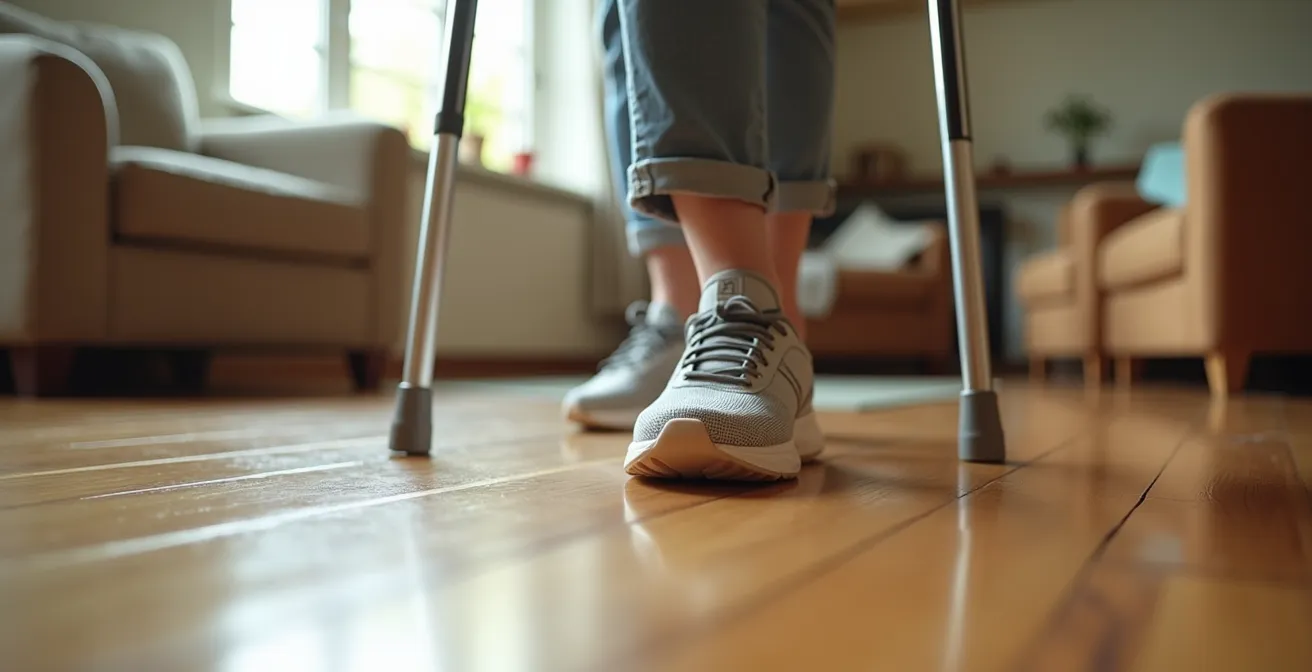
Contrary to popular belief, preventing falls at home isn’t just about buying “non-slip” slippers or avoiding socks. The key is understanding the biomechanics of your gait and the physics of friction at the surface interface between your foot and the floor. This guide provides a clinical framework for selecting footwear and modifying your environment based on principles of stability, ensuring your feet receive the proprioceptive feedback necessary to prevent slips on hardwood and trips on carpet.
The quiet shuffle of socks on a polished hardwood floor is a familiar sound in many homes. For many seniors, however, this seemingly harmless habit represents a significant and underestimated fall risk. The conventional advice is often simplistic: wear slippers with grip. But this guidance fails to address the complex interplay between footwear, floor surfaces, and the subtle changes in gait that occur with age. A shoe that grips tile aggressively might become a dangerous trip hazard on the edge of a carpet.
As a podiatrist specializing in fall prevention, I see the consequences of poor indoor footwear choices daily. The problem is rarely a single factor but a cascade of small risks: the worn-out sole, the sock material with a low coefficient of friction, the almost imperceptible shuffling gait that fails to clear a quarter-inch threshold. We often focus on obvious hazards while ignoring the primary interface between our body and the ground: our feet and what we put on them.
This article will move beyond generic recommendations. We will dissect the biomechanics of stability, analyzing *why* certain materials and sole designs succeed or fail on different surfaces. We will explore the critical difference between slip hazards and trip hazards, and why a solution for one can create a problem for the other. By understanding these underlying principles, you can develop a clinical framework for choosing footwear that truly enhances your stability and confidence at home.
To navigate this critical topic, we will systematically address the most common questions and environmental factors, from the dangers lurking in your sock drawer to the proper way to secure an area rug. This structured approach will empower you to make informed decisions for a safer home environment.
Summary: A Clinical Approach to Indoor Footwear and Fall Prevention
- Why Wool Socks Are a Death Trap on Tile Floors?
- How to Identify Non-Slip Soles That Won’t Trip You on Carpet?
- Hospital Grip Socks or Hard-Soled Shoes: Which Is Safer for Home?
- The “Shuffling Walk” Habit That Increases Slip Risk
- How to Walk Safely on Wet Surfaces When You Can’t Avoid Them?
- Why a 1/4 Inch Threshold Is a Major Fall Hazard for Shuffling Gaits?
- Carpet Tape or Rubber Underlays: Which Protects Floors and People?
- How to Secure Area Rugs to Hardwood Floors to Prevent Tripping?
Why Wool Socks Are a Death Trap on Tile Floors?
The perception of socks as a comfortable, harmless indoor option is one of the most dangerous misconceptions in home safety. From a biomechanical standpoint, most common socks—especially those made of wool or smooth synthetic blends—create a low-friction barrier between your foot and the floor. This drastically reduces the coefficient of friction (COF), the very force that prevents a slip. The issue is particularly acute on hard, smooth surfaces like tile, laminate, or polished hardwood, where there is no texture for the sock fibers to grip. This is not a minor issue; statistics are stark, showing that 36 million adults 65+ fall each year, with a significant portion of these incidents occurring indoors.
The material and structure of the sock are critical variables. Scientific research into sock-skin interface dynamics reveals that the knit structure has the largest influence on frictional force. A study in the Journal of Foot and Ankle Research demonstrated how different materials create vastly different slip risks. The findings highlighted that terry knit structures consistently produced a higher frictional force than single jersey knit structures found in typical dress or casual socks. This means a fluffy athletic sock may offer marginally more resistance than a thin wool sock, but both remain fundamentally unsafe compared to appropriate footwear.
Furthermore, socks offer zero structural support and muffle proprioceptive feedback—the crucial communication from the nerves in your feet to your brain about your body’s position in space. Without this clear feedback, your brain cannot make the micro-adjustments in muscle control needed to maintain balance, turning a small slide into an uncontrolled fall.
Before walking across an entire floor, you should assess the risk your current socks present. Here are a few clinical checks:
- Test on a small area first: Stand on the slickest surface in your home (e.g., tile), and gently shift your weight side-to-side and forward-and-back. If you feel any gliding, the socks are unsafe.
- Check for wear patterns: Extreme wear on the balls of the feet and the edges of the heels are sure signs of damage that compromises any minimal grip the fabric might have. If a sock is worn thin, its risk profile increases dramatically.
- Consider room transitions: Pay special attention when moving from a high-friction surface like carpet to a low-friction one like hardwood. This transition is a common point of failure.
- Keep socks clean: Any dust or debris collected on the bottom of socks acts like tiny ball bearings, further reducing the coefficient of friction.
How to Identify Non-Slip Soles That Won’t Trip You on Carpet?
The term “non-slip” is a marketing label, not a clinical standard. A sole that provides excellent grip on one surface can be a significant hazard on another. The primary challenge is finding footwear that prevents slips on hard floors without creating a trip hazard on carpeted surfaces. An overly aggressive, “grippy” sole can catch on carpet fibers, causing the foot to stop abruptly while the body’s momentum continues forward—a classic recipe for a fall. The key is to analyze the sole’s design features, not just its material.
The ideal indoor sole balances grip and glide. This is achieved through specific design considerations: the tread pattern, the depth of the lugs (the “teeth” of the tread), and the shape of the sole’s edges. A sole with deep, aggressive lugs designed for outdoor hiking provides a very high coefficient of friction but will snag dangerously on rugs and carpets. Conversely, a completely smooth leather sole will glide easily over carpet but offers almost no slip resistance on tile.
The goal is a multi-directional tread pattern that is relatively shallow. This design provides enough channels to disperse water on wet surfaces and create friction on smooth floors, but isn’t deep enough to “bite” into carpet fibers. Another crucial feature is a beveled or rounded heel and toe edge. This rounded profile allows the shoe to slide up and over obstacles like the edge of a rug, rather than catching on it. This small detail dramatically reduces the risk of tripping during room-to-room transitions.
The following table, based on principles of industrial footwear safety, breaks down how different sole features perform on the two most common indoor surfaces. As a reference, an analysis of footwear choices for preventing falls provides a deeper look into these characteristics.
| Sole Feature | Performance on Hard Floors | Performance on Carpet | Trip Risk |
|---|---|---|---|
| Deep aggressive lugs | Excellent grip | High friction/catching | High on carpet |
| Shallow multi-directional tread | Good grip | Smooth transition | Low |
| Beveled/rounded edges | Moderate grip | Excellent glide | Very low |
| Smooth sole | Poor grip | Good glide | Low (but slip risk high) |
Hospital Grip Socks or Hard-Soled Shoes: Which Is Safer for Home?
The choice between soft-form grip socks and structured, hard-soled indoor shoes is a common clinical question. While hospital-issued grip socks have become popular for home use, they represent a compromise, not an ideal solution. Their primary advantage is convenience and some friction from silicone dots. However, they lack the two most critical components for senior foot stability: structural support and proprioceptive clarity. As a research team noted in the Journal of Rehabilitation Medicine, there is clear evidence for this risk:
Walking indoors barefoot or in socks and walking indoors or outdoors in high-heel shoes have been shown to increase the risk of falls in older people.
– Research team, Journal of Rehabilitation Medicine
A structured shoe with a firm, supportive heel counter and a hard sole provides a stable base. This stability is essential for controlling ankle rotation and providing the brain with clear, unambiguous feedback about the foot’s contact with the ground. Grip socks, being soft and malleable, allow the foot to twist and roll within them, and the soft cushioning can dampen the sensory signals needed for balance. The image below visualizes this fundamental difference in support.
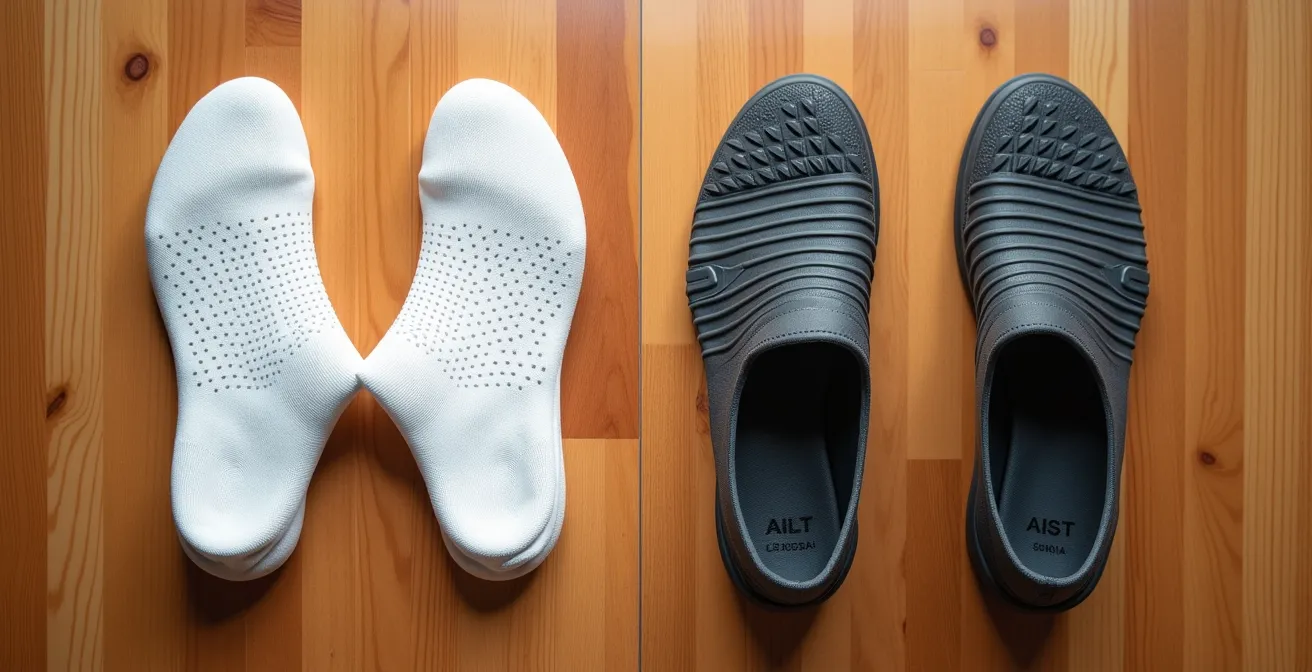
As you can see, the shoe offers a solid, predictable platform, while the sock conforms to the foot, offering no protection against torsional instability. However, the choice is not always absolute and depends on the specific use case. Grip socks can be a reasonable option for short, direct trips, such as getting out of bed to use the bathroom at night, where the risk of bending over to put on shoes might be greater. But for all-day wear and general mobility, a supportive shoe is clinically superior.
- For short nighttime trips to the bathroom: Grip socks offer quick on/off functionality and adequate traction for a short distance.
- For all-day wear or if you have neuropathy: A hard-soled, supportive shoe is essential. Conditions like diabetic neuropathy reduce sensation, making the structural support and clear feedback from a shoe even more critical.
- For those with known balance issues: Hard-soled shoes are non-negotiable. They provide the necessary ankle stability and proprioceptive feedback to help the body’s balance system function optimally.
- For limited mobility or back pain: Easy slip-on grip socks can reduce the risk associated with bending to put on shoes, but this convenience must be weighed against the reduced stability during walking.
The “Shuffling Walk” Habit That Increases Slip Risk
Footwear is only one part of the equation; how you walk is equally, if not more, important. A “shuffling gait,” characterized by short steps and insufficient foot clearance from the floor, is a major contributor to trips and slips in older adults. This gait pattern is not just a “bad habit”; it’s often a subconscious adaptation to a fear of falling or a symptom of underlying muscular weakness, joint stiffness, or neurological conditions. When you shuffle, you dramatically increase the likelihood of your foot catching on any uneven surface, from a rug edge to a floor threshold. It also means the foot lands flat or on the forefoot, rather than with a proper heel-strike, reducing stability and control.
The type of footwear worn can either exacerbate or mitigate a shuffling gait. Heavy, clunky, or poorly fitting shoes require more effort to lift, encouraging the wearer to drag their feet. This creates a dangerous feedback loop: the fear of falling leads to shuffling, and the heavy shoes required for a sense of “security” make the shuffling worse. From a clinical perspective, the solution is not heavier shoes but lighter, more responsive ones.
Improving this gait pattern often involves a combination of physical therapy to strengthen leg muscles and a conscious switch to appropriate footwear that encourages a more natural walking motion.
Case Study: The Impact of Shoe Weight on Gait Patterns
Physical therapists have long observed that heavy shoes can directly contribute to a shuffling gait. In clinical settings, switching an older adult from heavy, rigid footwear to lightweight options with specific features like a thinner sole and a “forefoot rocker” design has a measurable effect. The rocker sole, which is slightly curved up at the toe, helps the foot roll through the step, significantly improving foot clearance (the height the foot lifts off the ground) and reducing the effort required to walk. This change not only reduces shuffling but also improves posture and balance by promoting a more efficient gait.
The first step to correcting this habit is awareness. Pay attention to the sound your feet make as you walk. Do you hear a smooth roll or a constant scuffing? A conscious effort to “walk tall,” lift your feet, and land on your heel can begin to retrain your body’s muscle memory. This, combined with lightweight, well-fitting shoes, forms a powerful strategy for fall prevention.
How to Walk Safely on Wet Surfaces When You Can’t Avoid Them?
Even with the best footwear, encountering an unexpectedly wet surface—a spill in the kitchen, a wet floor after a shower—presents an acute slip hazard. In these moments, your walking technique must adapt to maximize stability. The normal heel-to-toe gait pattern becomes dangerous on a low-friction surface. When your heel strikes first, the contact area is small, and the force is concentrated, making it easy for the foot to slide out from under you. The key is to change your gait biomechanics to maximize the contact area between your sole and the floor.
This involves adopting a “penguin walk,” similar to how one navigates ice. By taking shorter steps and keeping your feet more directly under your body’s center of gravity, you maintain better control. Most importantly, you should attempt to place your foot down flat, rather than landing on the heel. This instantly increases the surface area of the sole in contact with the floor, distributing your weight and increasing frictional resistance. It may feel unnatural, but it is a clinically proven technique to prevent slips in low-traction environments.
It’s also important to understand that not all “waterproof” soles are created equal. Many durable and lightweight materials used in modern shoes, such as PVC and polyurethane compounds, are excellent at keeping water out but can have a very low coefficient of friction when wet. Natural rubber or specialized synthetic rubber compounds with a high-traction rating generally perform much better. Your technique, however, remains your best defense.
Follow these steps when you must cross a wet surface:
- Take shorter steps and keep your center of gravity directly over your feet. Widen your stance slightly for a more stable base.
- Walk flat-footed rather than with a normal heel-to-toe motion to maximize the sole’s surface contact with the floor.
- Keep one hand free and near a wall or countertop. Having a hand available to grab a support surface can be the difference between a stumble and a serious fall.
- Test the surface with small, tentative foot movements before committing your full body weight to a step.
Why a 1/4 Inch Threshold Is a Major Fall Hazard for Shuffling Gaits?
In the context of a shuffling gait, even the smallest vertical obstacle becomes a significant trip hazard. A standard room threshold, often just a quarter-inch high, is a perfect example of an environmental risk that is invisible to most but a major danger for those with low foot clearance. When a person shuffles, their toes may only clear the ground by a fraction of an inch. A threshold presents a solid, unmoving barrier that can catch the front of the shoe, leading to an immediate forward pitch and fall.
The danger is magnified by its ubiquity. Thresholds are found between rooms with different flooring types, at exterior doors, and at the entrance to some bathrooms. For someone with a healthy gait, they are unnoticeable. For a senior with a shuffling walk, they are a minefield. The close-up view below illustrates just how little margin for error exists between a shuffling foot and a standard threshold, creating a high-risk surface interface.
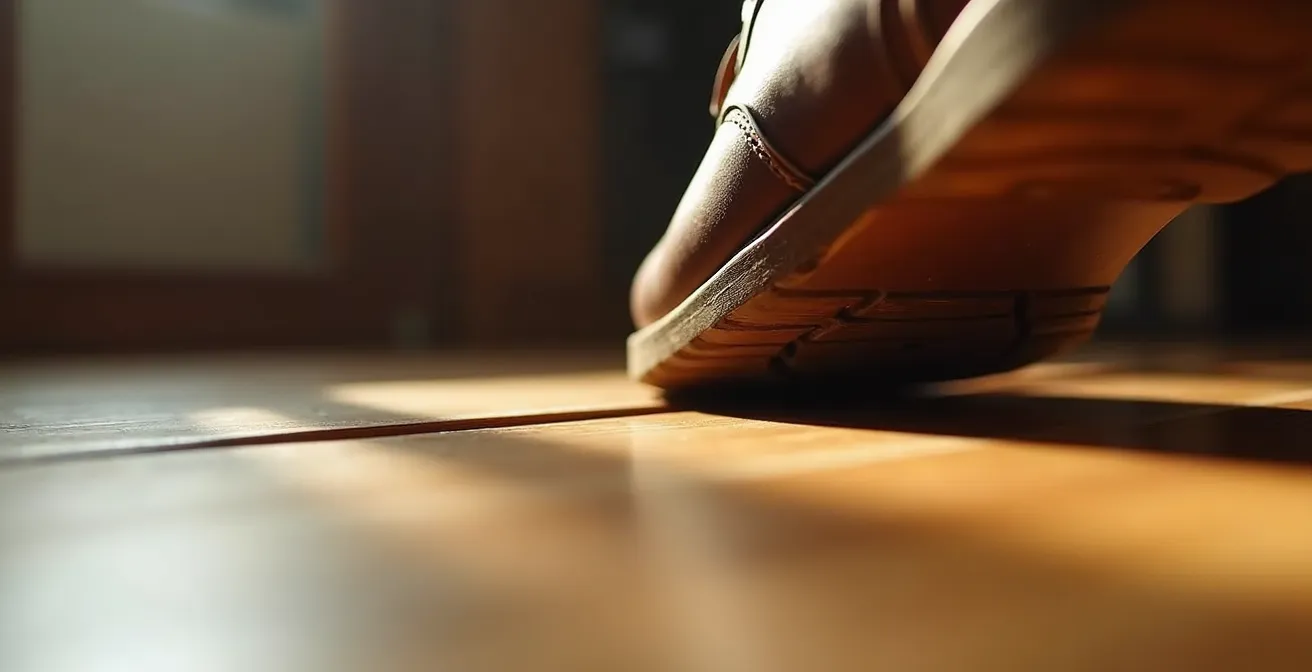
As this image shows, the minimal gap is where the danger lies. Addressing this specific hazard is a crucial part of creating a fall-proof home. The ideal solution is to remove the threshold entirely to create a seamless, level floor surface. However, this can be costly and is not always practical. Fortunately, there are several effective modification strategies that can dramatically reduce the risk, ranging from simple visual cues to physical ramps.
The table below ranks the most common threshold modification options by their effectiveness in mitigating this specific trip hazard. While complete removal is the clinical gold standard, other options provide a significant safety improvement at a lower cost and with less difficulty.
| Solution Type | Cost | Installation Difficulty | Effectiveness |
|---|---|---|---|
| Complete threshold removal | High | Professional needed | Excellent – eliminates hazard |
| Beveled ramp threshold | Medium | Moderate DIY | Very good – smooth transition |
| High-contrast tape on edge | Low | Easy DIY | Good – improves visibility |
| Rubber threshold cover | Low-Medium | Easy DIY | Good – reduces height differential |
Carpet Tape or Rubber Underlays: Which Protects Floors and People?
Securing an area rug is not just about preventing the rug itself from slipping; it’s about choosing a method that protects both the floor finish and, most importantly, the person walking on it. The two most common solutions, double-sided carpet tape and rubber underlays, have vastly different performance profiles and associated risks. Carpet tape often seems like a quick and cheap fix, but from a clinical safety perspective, it is a poor choice. It can fail unpredictably, lose adhesion over time, and often leaves a sticky, damaging residue on hardwood floors that can be difficult to remove and can even become a slip hazard itself.
A high-quality rubber or felt-rubber hybrid underlay is the superior option. Unlike tape, which only secures the perimeter, an underlay provides a consistent, high-friction surface across the entire area of the rug. This prevents not only sliding but also “bunching” or “wrinkling” in the middle of the rug, another common trip hazard. The cushioning effect of an underlay can also reduce foot fatigue, but its primary function is to increase the coefficient of friction between the rug and the floor.
Case Study: Flooring Friction in Hospital Safety Programs
The importance of high-friction flooring is well-documented in institutional settings. A study published in the Archives of Physical Medicine and Rehabilitation detailed a slip mitigation program in a hospital. This comprehensive effort included replacing smooth flooring with surfaces that had a rougher texture and a higher coefficient of friction (COF). The results were clear: the intervention was demonstrated to significantly reduce slip events. This principle applies directly to the home environment; a rubber underlay effectively increases the COF of the rug-floor interface, mimicking the success of these large-scale safety programs.
When selecting an underlay, it’s critical to choose one that is certified as “finish-safe” for your specific flooring type, especially for polyurethane-finished hardwood or vinyl plank. Some cheaper rubber pads can react with floor finishes over time. A good underlay is an investment in safety that far outweighs the short-term convenience of tape.
Action Plan: Auditing Your Rugs and Floors for Safety
- Identify all unsecured rugs: Go room by room and list every area rug, bath mat, or runner that is not secured with a high-quality underlay.
- Check for edge curling and bunching: For rugs that are “secured,” check all corners and edges. If they lift or curl easily, they are a major trip hazard and the securing method is failing.
- Test tape adhesion (if used): If tape is currently in use, test a small, hidden area to see if it has damaged the floor finish or left a sticky residue. Plan for removal and replacement with an underlay.
- Select the right underlay: Choose a felt-rubber hybrid for high-traffic areas to provide both grip and cushioning. Ensure the pad is the correct size, extending almost to the rug’s edge.
- Implement and inspect: Install the new underlays and add corner grippers if edge curling is a persistent issue. Schedule a follow-up check in one month to ensure nothing has shifted.
Key Takeaways
- True fall prevention goes beyond “non-slip” labels; it requires understanding the biomechanics of gait and the physics of friction.
- The ideal indoor sole balances grip for hard floors with a smooth glide for carpets, often featuring a shallow, multi-directional tread and beveled edges.
- Environmental hazards like quarter-inch thresholds and unsecured area rugs pose a disproportionate risk to those with a shuffling gait and must be actively mitigated.
How to Secure Area Rugs to Hardwood Floors to Prevent Tripping?
Having established that a rubber underlay is superior to tape, the final step is to implement the best practice for securing your area rugs to eliminate them as a fall risk. An unsecured rug on a hardwood floor is one of the most common and preventable causes of falls in the home. The goal is to create a single, stable unit where the rug and floor move as one, with no slipping, bunching, or curling edges. The effectiveness of different securing methods varies dramatically, and choosing the right one depends on balancing grip strength, floor safety, and ease of use.
The gold standard is a full-size, high-quality rubber or felt-rubber pad cut just slightly smaller than the rug itself. This provides maximum surface area contact and the highest possible coefficient of friction. While perimeter-only solutions like tape or corner grippers can help, they leave the center of the rug unsecured and prone to wrinkling, which can be just as dangerous as a sliding rug. Double-sided tape, while offering good initial grip, is a poor long-term solution as it is difficult to remove and poses a high risk of permanently damaging the floor finish.
The combination of a full pad with additional corner grippers offers the most robust and complete solution. The pad prevents sliding, while the corner grippers specifically address the common problem of edge curling, which is a primary trip hazard. This two-part system ensures the rug lays perfectly flat and stays in place, even in high-traffic areas.
This table compares the most common methods, highlighting why a full pad is the clinically recommended choice for maximizing safety.
| Method | Grip Strength | Floor Safety | Ease of Removal | Cost |
|---|---|---|---|---|
| Full rubber pad | Excellent | Good with quality pad | Easy | Medium-High |
| Perimeter tape only | Fair | Risk of residue | Difficult | Low |
| Corner grippers + pad | Excellent | Very good | Easy | Medium |
| Double-sided tape | Good initially | Can damage finish | Very difficult | Low |
Taking these steps to choose the right footwear and meticulously secure your home environment is not about limiting your life; it is about enabling it. By systematically removing these risks, you create a space where you can move with confidence and independence. Assess your footwear and your floors today to ensure your home is a true sanctuary of safety and stability.