
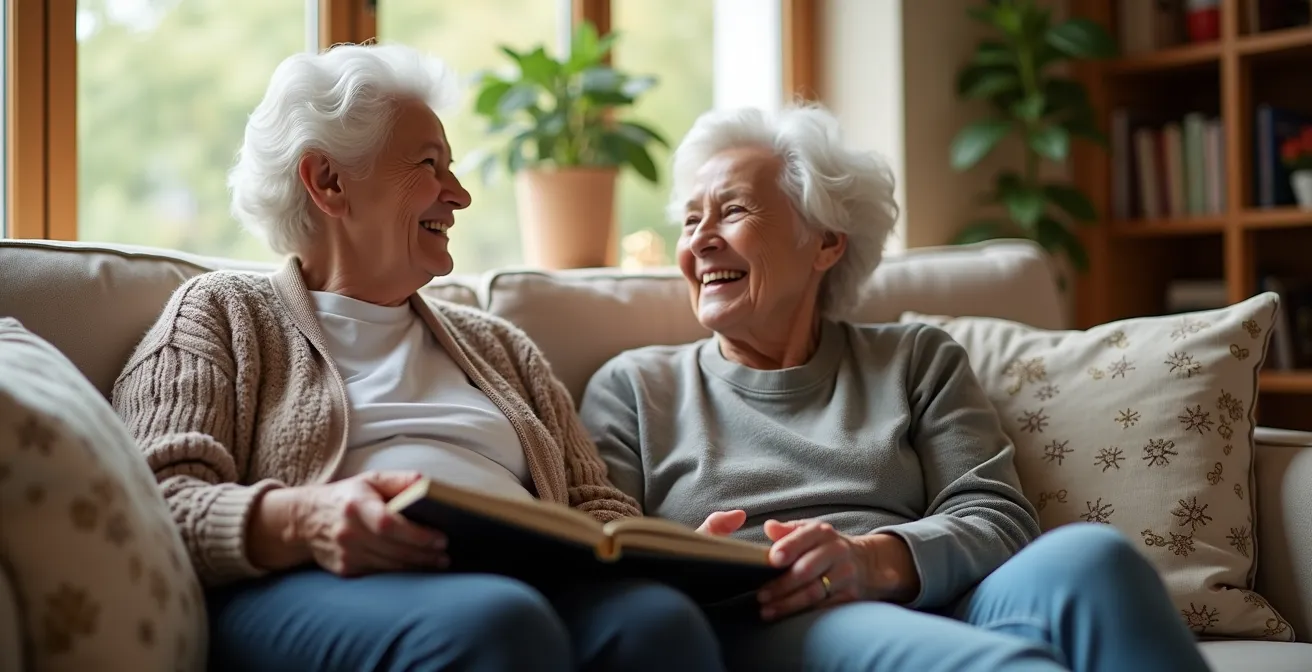
Many families notice their aging parents are lonely, even with practical help at home. The solution isn’t more task-based support, but a shift towards relational care. This guide reframes the caregiver’s role from a simple helper to a ‘social scaffold’—a partner who actively uses conversation and connection as therapeutic tools. You will learn how to find someone who can not only assist with daily needs but also rebuild the vital emotional and neural pathways that loneliness erodes, transforming daily interactions into powerful medicine for the mind and heart.
You’ve arranged for help. The groceries are bought, the house is tidy, and medications are managed. Yet, when you call your parent, you hear a familiar quietness in their voice. It’s the sound of loneliness, a profound isolation that practical support alone cannot touch. You see them becoming more withdrawn, less engaged, and you worry that despite your best efforts, they are fading. This is a common and heartbreaking challenge for families who see that physical needs being met is only half the battle.
The standard approach is to focus on a caregiver’s efficiency and qualifications for physical tasks. We check their ability to lift, cook, and clean. But what if the most critical qualification is one we rarely screen for? What if the key to reviving your parent’s spirit and health lies not in the tasks they perform, but in the quality of the conversations they share? The true antidote to this deep-seated loneliness isn’t just presence; it’s genuine connection.
This guide moves beyond the checklist of practical duties to explore a more profound approach: choosing a caregiver who can be a true conversation partner. We will treat companionship not as a pleasant bonus, but as a primary, therapeutic duty. We will explore how to architect a relationship that provides “social scaffolding,” helping your parent rebuild their sense of self and their connection to the world. It’s time to find a caregiver whose most valuable skill is their ability to listen, to share, and to reignite the spark of engagement, proving that a meaningful conversation can be as vital as any medication.
This article will guide you through the science behind why conversation is so crucial for senior health and provide concrete strategies for finding and nurturing this kind of relationship. From using memory-triggering tools to setting healthy boundaries, you’ll gain a complete framework for making your next caregiving choice one that truly nourishes the soul.
Summary: Beyond Assistance: How to Find a Caregiver Who Is a True Companion
- Why Daily Conversation Lowers the Risk of Depression in Seniors?
- How to Use Photo Albums to Spark Meaningful Conversations?
- Professional Companion or Volunteer Visitor: Which Is More Reliable?
- The Boundary Trap: When Attachment to a Caregiver Becomes Unhealthy
- When to Plan Short Outings to Break the Monotony of Home?
- Why Isolation Accelerates Memory Loss More Than Genetics?
- How to Use Aromatherapy to Trigger Positive Autobiographical Memories?
- Why Social Connection Is as Vital as Medication for Heart Health?
Why Daily Conversation Lowers the Risk of Depression in Seniors?
The silence in a senior’s home is often more than just a lack of noise; it’s a breeding ground for depression. While many factors contribute to mental health in later life, the absence of regular, meaningful conversation is a significant and often underestimated risk. For the more than 2 million Americans aged 65 and older who suffer from some form of depression, social interaction is not a luxury—it’s a clinical necessity. Daily conversation acts as a powerful antidepressant by providing validation, stimulation, and a sense of belonging.
At its core, conversation is a form of emotional co-regulation. When a senior shares a story, a worry, or a simple observation, and a caregiver listens with empathy, it helps to regulate the nervous system. This reciprocal exchange confirms that their thoughts and feelings matter, countering the narrative of irrelevance that can fuel depressive states. Research consistently shows a direct link between the quality of social networks and mental well-being. Studies have found that a smaller social network and infrequent interactions are associated with perceived isolation, which in turn is a strong predictor of both depression and anxiety.
Furthermore, longitudinal data confirms that loneliness is not a fleeting feeling but a condition that actively predicts depressive symptoms years down the line. A caregiver who is a skilled conversation partner provides more than just company; they are a frontline defense against this decline. By engaging in daily chats, they are actively strengthening the senior’s social scaffolding, reinforcing their identity and connection to the world. This simple act of talking and listening becomes a daily therapeutic intervention, proving far more effective than passive companionship.
How to Use Photo Albums to Spark Meaningful Conversations?
One of the most powerful tools in a companion caregiver’s toolkit is the humble photo album. Far more than a collection of old pictures, it’s a gateway to the past and a potent catalyst for “memory activation.” For a senior who may struggle with short-term recall or feel disconnected from their own life story, revisiting photographs can unlock a wealth of narrative, identity, and emotion. The goal is not just to look at pictures, but to use them as a springboard for conversational therapy, helping the senior reconnect with who they are.
The process of sharing memories through photos is a cornerstone of reminiscence therapy. It allows the senior to take the lead, positioning them as the expert of their own life. A skilled companion acts as a “story-catcher,” listening with curiosity and prompting with gentle, open-ended questions like, “Tell me about this day,” or “What was she like?” This approach validates their life experiences and reinforces their sense of self-worth, which can be eroded by age and isolation.
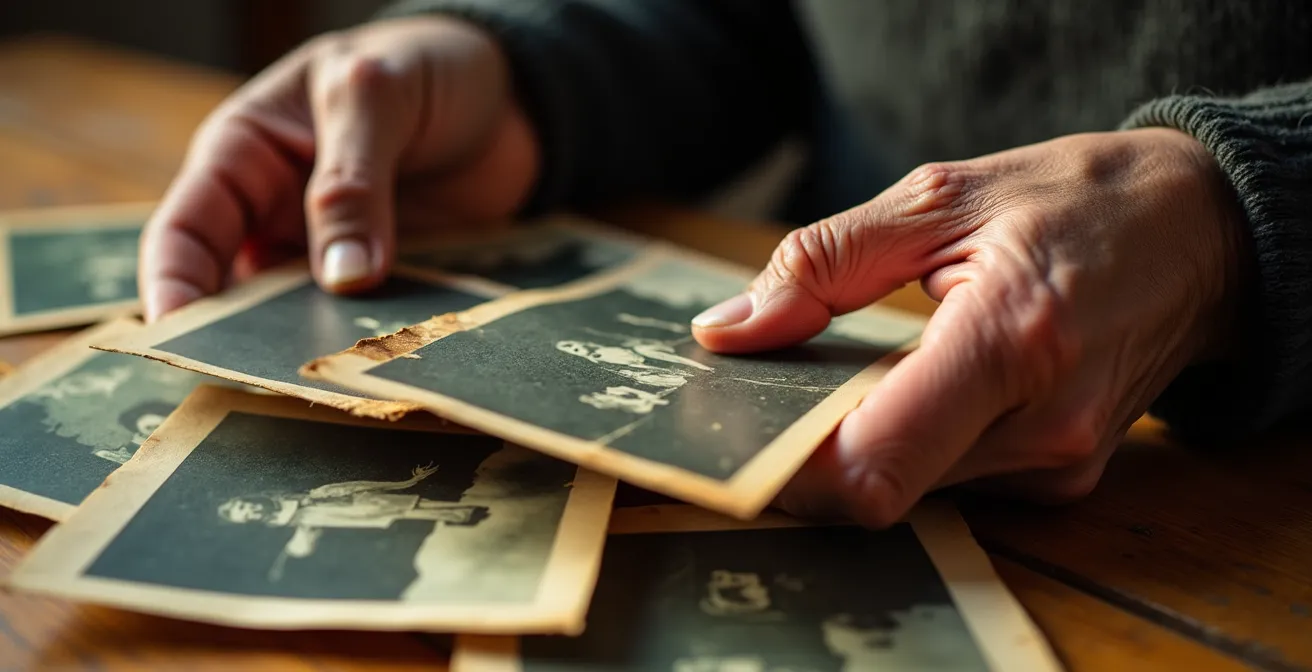
As you can see in the image, the tactile experience of holding a photograph can be profoundly grounding. To enhance this, a caregiver can create a multi-sensory experience by pairing the photos with period-appropriate music or even familiar scents, further anchoring the memories. This isn’t just a pleasant afternoon activity; it’s a structured technique to stimulate cognitive pathways and foster a deep, meaningful bond between the senior and their caregiver. It transforms a simple visit into a shared journey through a life well-lived.
Your Action Plan: Turning Photo Albums into Conversation Gold
- Photo Selection: Gather photos that span various life stages, focusing on significant events, beloved people, and happy moments.
- Become a Story-Catcher: Keep a dedicated notebook to jot down names, dates, and anecdotes shared, creating a precious record for the family.
- Engage Multiple Senses: Pair the photo viewing with period-appropriate music or familiar scents (like a favorite perfume or the smell of baking bread) to deepen the experience.
- Go Digital: Use tools like Google Photos to scan old images and add voice recordings of your parent telling the story behind the picture, creating a lasting digital legacy.
- Let Them Lead: Use open-ended questions and allow the senior to guide the conversation, avoiding simple yes/no questions to encourage richer storytelling.
Professional Companion or Volunteer Visitor: Which Is More Reliable?
When seeking companionship for a loved one, families often face a choice between a paid professional caregiver and a well-meaning volunteer. As gerontologist Sherri Snelling notes, many seniors are “sitting alone and not having conversations and not really staying as much engaged in life or feeling as relevant.” Both professionals and volunteers can help fill this void, but their reliability, training, and accountability differ significantly. Understanding these differences is crucial for architecting a stable and effective “social scaffold” for your parent.
We’ve got loved ones who are sitting alone and not having conversations and not really staying as much engaged in life or feeling as relevant.
– Sherri Snelling, gerontologist and spokesperson for Comfort Keepers
A professional companion, typically hired through an agency, brings a level of consistency and accountability that is hard to match. They are contractually obligated to show up for scheduled visits, and if they are sick, the agency is responsible for finding a replacement. Furthermore, professionals often receive formal training in communication techniques, dementia care, and maintaining professional boundaries. This training is invaluable, as it equips them to handle challenging situations and ensures the relationship remains supportive without becoming co-dependent. They are screened, insured, and answerable to a governing body, providing a layer of security for the family.
A volunteer visitor, often from a community or religious organization, offers companionship from a place of altruism, which can foster a warm, genuine friendship. This service is typically free, which is a major advantage for many families. However, reliability can be a concern. Volunteers have their own lives and commitments, and visits may become irregular with no guaranteed backup. Their training is often minimal, and they are accountable primarily to their own conscience. While a beautiful bond can form, the lack of a formal structure can make it a less dependable long-term solution for consistent social engagement.
The following table, inspired by insights on companion care, breaks down the key differences to help you make an informed decision based on your family’s specific needs for reliability and skilled interaction.
| Aspect | Professional Companion | Volunteer Visitor |
|---|---|---|
| Training | Formal training in communication techniques, dementia care | May have basic orientation, varies widely |
| Accountability | Accountable to agency and contract | Accountable to personal conscience |
| Consistency | Scheduled visits, replacement available if needed | May be irregular, no guaranteed replacement |
| Cost | Paid service, may be covered by insurance | Free service |
| Background Checks | Required by agencies | Depends on organization |
| Emotional Boundaries | Professional boundaries maintained | May develop more personal attachment |
The Boundary Trap: When Attachment to a Caregiver Becomes Unhealthy
While the goal is to foster a warm and supportive bond, there is a fine line between a healthy connection and an unhealthy attachment. The “boundary trap” occurs when the professional relationship blurs, leading to emotional dependency, guilt, and burnout for both the senior and the caregiver. Recognizing the warning signs is essential for maintaining a sustainable and truly therapeutic dynamic. A healthy relationship empowers the senior; an unhealthy one can inadvertently deepen their sense of helplessness.
For the senior, unhealthy attachment might manifest as extreme jealousy when the caregiver interacts with others, a refusal to accept help from anyone else, or distress when the caregiver takes scheduled time off. For the caregiver, red flags include feeling overwhelming guilt about taking breaks, oversharing personal problems, or feeling completely emotionally drained after every visit. These are signs that the relationship is no longer a professional service but has become an entangled, co-dependent dynamic. Research highlights that the quality of relationships is paramount; in fact, individuals with negative or fraught relationships are at least twice as likely to experience depression.
The key to avoiding this trap is establishing clear expectations from the very beginning. This isn’t about being cold or distant; it’s about creating a safe, respectful, and professional framework for care. Proactive communication is the best prevention. Here are some key red flags and preventative measures to watch for:
- For Seniors: Becoming possessive, showing jealousy, or refusing care from a substitute caregiver are signs of over-dependence.
- For Caregivers: Feeling guilty about personal time, sharing intimate personal details, or feeling emotionally exhausted indicates blurred boundaries.
- Warning Signs: Inappropriate gift-giving (on either side) or expectations of availability outside of scheduled hours signal a shift from professional to personal.
- Prevention: Create a “Communication & Boundary Charter” at the start of the engagement. This document should clearly outline roles, contact expectations, and professional limits.
- Solution: When feasible, especially in an agency setting, regular rotation of caregivers can prevent over-dependence on a single individual and expose the senior to different personalities.
When to Plan Short Outings to Break the Monotony of Home?
For a senior who spends most of their time indoors, the four walls of their home can begin to feel like a prison, shrinking their world and stifling their spirit. Breaking the monotony with short, regular outings is a cornerstone of effective companion care. These excursions are not just about a change of scenery; they are strategic interventions that provide sensory stimulation, social opportunities, and a renewed sense of connection to the community. The key is to start small and build confidence gradually, a process we can call “outing scaffolding.”
The transformation can be remarkable. Consider the story of Rob, a senior who had become increasingly isolated after losing his ability to drive. His companion caregiver didn’t just provide in-home help; she became his bridge back to the world. By helping him with his hygiene and taking him to dine at his favorite restaurant, she didn’t just provide a meal—she restored a piece of his identity and brought joy back into his routine. This case study perfectly illustrates how a simple outing, planned with care, can reignite motivation and combat the effects of isolation.
The “Outing Scaffolding Technique” is a gentle, progressive approach to reintroducing a senior to the outside world. It acknowledges that a full-day trip can be overwhelming and instead builds up tolerance and enthusiasm through manageable steps.
- Phase 1 – Micro-outings: Begin with something as simple as sitting on the porch or a balcony for 10-15 minutes each day.
- Phase 2 – Mini-outings: Progress to short drives around the neighborhood, enjoying the view without the pressure of getting out of the car.
- Phase 3 – Short destinations: Plan a brief visit to a low-stress nearby location, like a quiet park or a garden center, for about 30 minutes.
- Phase 4 – Social outings: Graduate to more interactive activities, such as a visit to a café for a cup of tea or participating in an event at a local senior center for an hour or two.
A pre-outing checklist including medications, water, and a familiar comfort object like a small photo album can help manage any anxiety.
Why Isolation Accelerates Memory Loss More Than Genetics?
While genetics certainly play a role in cognitive health, a growing body of evidence suggests that social isolation may be an even more powerful accelerator of memory loss. The human brain is a social organ; it thrives on interaction, communication, and new stimuli. When deprived of this, its functions begin to decline. The World Health Organization reports that about a quarter of older people are affected by social isolation, making it a widespread public health crisis with profound neurological consequences.
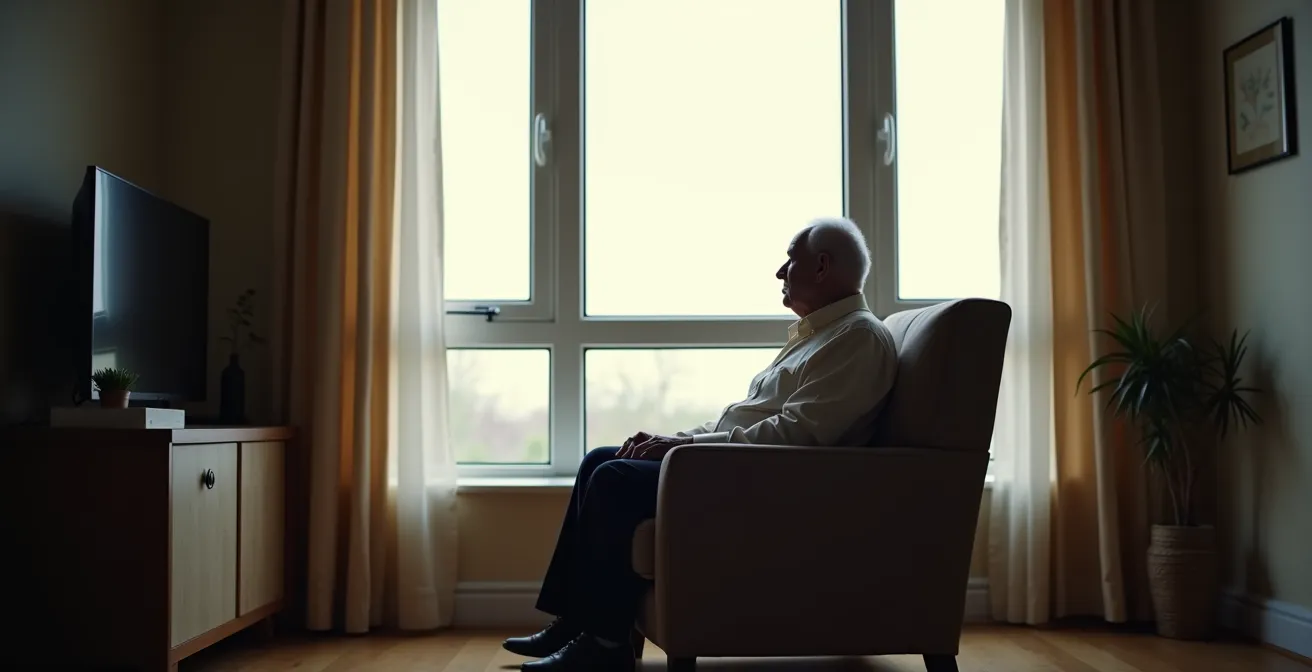
Think of the brain as a muscle. A conversation requires it to perform a complex workout: listening, processing information, accessing vocabulary, forming a response, and reading social cues. This “cognitive calisthenics” keeps neural pathways active and strong. When a person is isolated, this muscle gets very little exercise. The lack of stimulation leads to a reduction in cognitive reserve—the brain’s ability to withstand age-related damage. This is why a person living in isolation may experience a faster cognitive decline than someone with a genetic predisposition who remains socially active.
Research, including extensive meta-analyses, provides strong statistical evidence for this connection. Studies highlight that the very structure of a senior’s social network—its size, diversity, and the frequency of interactions—is strongly associated with a reduction in depressive symptoms, which are themselves a major risk factor for dementia. A caregiver who acts as a conversation partner is therefore not just providing emotional comfort; they are delivering a daily dose of brain training. They are actively helping the senior maintain their cognitive reserve, making social connection a powerful, non-pharmacological tool in the fight against memory loss.
How to Use Aromatherapy to Trigger Positive Autobiographical Memories?
Beyond visual cues like photo albums, our sense of smell offers one of the most direct and powerful pathways to memory. The olfactory bulb is intricately linked to the amygdala and hippocampus, the brain’s centers for emotion and memory. This is why a simple scent—like baking bread, freshly cut grass, or a specific perfume—can instantly transport us back decades. For seniors, especially those with cognitive decline, aromatherapy can be a profound tool for “memory activation,” triggering positive autobiographical memories that may otherwise be inaccessible.
The science supporting this is astonishingly strong. A recent study demonstrated how nightly exposure to fragrances can dramatically enhance memory in older adults. Over six months, participants were exposed to different essential oil fragrances while they slept. The results were remarkable: these individuals showed a 226% increase in cognitive performance compared to a control group, as measured by a standard memory test. This suggests that passively enriching the olfactory environment can have a massive, restorative effect on the brain.
A companion caregiver can harness this power by creating a “Personalized Scent Biography” for their client. This involves more than just diffusing random pleasant smells; it’s a thoughtful process of identifying and reintroducing scents that hold personal significance. This relational approach turns aromatherapy from a passive therapy into an active, engaging experience that sparks conversation and joy.
- Interview Family: Ask family members about significant scents from the senior’s life—the smell of their father’s pipe tobacco, the flowers from their wedding, or a favorite holiday dish.
- Source High-Quality Oils: Use pure, high-quality essential oils that match the identified scents. Avoid synthetic fragrances, which can be overwhelming and lack the same neurological impact.
- Start Low and Slow: Begin with a very low concentration in a diffuser, never applying oils directly to the skin without proper dilution and guidance.
- Time the Scents: Use stimulating scents like rosemary and lemon in the morning to promote alertness, and calming scents like lavender and orange in the evening to aid relaxation.
- Observe and Document: Keep a journal of which scents evoke positive responses or spark specific memories, and stop immediately if a scent triggers any negative feelings.
Key Takeaways
- Relational care is a therapeutic intervention, not just a service. The quality of the caregiver-senior relationship directly impacts health.
- Conversation acts as “cognitive calisthenics,” actively fighting depression and slowing memory loss by keeping neural pathways engaged.
- Practical tools like photo albums (reminiscence) and aromatherapy (scent biography) are effective methods for sparking meaningful interaction and memory activation.
Why Social Connection Is as Vital as Medication for Heart Health?
The conversation about senior health often separates the mind and the body. We treat depression with one set of tools and heart disease with another. However, this is a false dichotomy. The emotional well-being fostered by strong social connections is not just good for the soul; it is a critical factor in cardiovascular health. For an aging heart, a daily dose of meaningful conversation can be as protective as a daily dose of medication.
The mechanism is rooted in the body’s stress response. Chronic loneliness and isolation lead to elevated levels of cortisol, the primary stress hormone. Sustained high cortisol levels contribute to increased blood pressure, inflammation, and higher cholesterol—all major risk factors for heart disease and stroke. Positive social interaction acts as a natural antidote. A warm, empathetic conversation can lower stress, reduce cortisol, and trigger the release of oxytocin, a hormone that promotes feelings of trust and bonding and has a calming effect on the cardiovascular system.
Therefore, a caregiver who provides genuine companionship is actively participating in preventative heart care. They are helping to manage their client’s physiological stress response in a way no pill can. When we reframe companionship as a core component of a holistic health plan, the caregiver’s role is elevated from a simple aide to a key member of the healthcare team. Their work in building a supportive, low-stress environment directly contributes to a healthier heart, lower blood pressure, and a stronger, more resilient body. This underscores the fundamental truth: we are social creatures, and our bodies are hardwired to thrive on connection and wither in its absence.
The evidence is clear: choosing a caregiver is about much more than finding help with daily tasks. It’s about finding a partner who can provide the emotional and social stimulation that is vital for a senior’s overall health. Begin your search for a caregiver who understands that their most important role isn’t just to assist, but to connect. Evaluate candidates based on their ability to provide this vital social and emotional support, and you will be investing in your loved one’s health and happiness in the most profound way possible.