

In summary:
- To effectively fight cognitive decline, you must move beyond passive puzzles and embrace complex, novel activities.
- Skills like learning a musical instrument or dual-tasking create “cognitive friction” that builds new neural pathways.
- Social engagement and strategic learning are more powerful for brain health than repetitive, solitary apps.
- Varying your mental challenges is critical to avoid the “plateau of comfort” where brain benefits cease.
- You can train your brain strategically by identifying your peak cognitive hours and using powerful mnemonic techniques.
As we age, the fear of losing our mental sharpness is a common and valid concern. You’ve likely heard the standard advice: “keep your brain active,” which for many translates to a daily crossword or Sudoku puzzle. We’re told to use “brain training” apps that promise to turn back the clock. While these activities aren’t harmful, they are often a form of passive entertainment, like a leisurely stroll for your mind when it’s capable of so much more.
These repetitive tasks often cause our brains to run on autopilot. They strengthen existing neural pathways but do little to forge new ones. This is the crucial distinction most advice misses. But what if the real key to a resilient mind isn’t just about staying busy, but about embracing a specific kind of challenge? What if the goal isn’t just to exercise the brain you have, but to actively build a better, more connected one?
The strategy is called Active Neuro-Engagement. It’s a shift from mindlessly filling in blanks to intentionally seeking out complex, multi-faceted activities that create a healthy “cognitive friction.” This friction forces your brain to build new connections, create neural scaffolding, and increase its cognitive reserve. It’s about choosing the challenging path because that is where the growth happens.
This guide will serve as your coaching manual. We will dismantle the myth of passive brain training and equip you with powerful, evidence-based strategies. We’ll explore why picking up a guitar is a better workout than any app, how to turn a walk in the park into a cognitive power session, and how to build a “Memory Palace” for your daily needs. It’s time to stop just exercising your brain and start truly transforming it.
This article provides a complete roadmap to understanding and implementing these powerful cognitive strategies. Explore the sections below to build your personal brain training program.
Summary: Beyond Brain Games: A Coach’s Guide to Actively Delaying Cognitive Decline
- Why Learning a New Instrument Is Better Than Sudoku for Your Brain?
- How to Practice “Dual-Tasking” While Walking in the Park?
- Brain Training Apps or Bridge Club: Which Offers Better Social Cognition?
- The Routine Trap: Why Doing the Same Puzzle Daily Stops Working
- When to Schedule Complex Tasks to match Your Peak Cognitive Hours?
- Why Isolation Accelerates Memory Loss More Than Genetics?
- How to Stay Tech-Relevant to Connect With Your Grandchildren?
- How to Build a “Memory Palace” for Your Daily Medication List?
Why Learning a New Instrument Is Better Than Sudoku for Your Brain?
Let’s challenge the most common piece of brain-health advice. While a daily number puzzle provides a comfortable sense of accomplishment, it’s a single-domain activity. It engages a narrow part of your brain that quickly becomes efficient, leading to diminishing returns. Learning a musical instrument, however, is the ultimate in multi-domain stimulation. It’s a full-brain workout that requires a symphony of cognitive functions to work in harmony: fine motor skills, auditory processing, memory recall, and emotional expression.
This isn’t just theory; it’s backed by compelling evidence. Research from the University of Exeter’s PROTECT study has shown that this type of complex engagement pays dividends. A study of over a thousand adults confirmed that playing a musical instrument is linked to improved memory and executive function. The cognitive benefits are not just a brief spark; continuing to play into later life provides an even greater protective effect, harnessing the brain’s precious cognitive reserve.

Look at the image above. It’s not just about hitting the right notes. It’s about the coordination between hands, eyes, and ears. It’s about translating abstract symbols (notes) into physical action and emotional sound. This process of integration and translation is what creates the “cognitive friction” necessary for building new neural pathways. Sudoku is about finding a pre-existing solution within a closed system; music is about creating something new and expressive. One is a maintenance task; the other is a construction project for your brain.
How to Practice “Dual-Tasking” While Walking in the Park?
Your daily walk is fantastic for your physical health, but are you leaving cognitive benefits on the table? Most of us walk on autopilot, our minds wandering or disengaged. This is a missed opportunity for Active Neuro-Engagement. The concept of “dual-tasking” involves performing a cognitive task while engaged in a physical one, forcing your brain to manage attention, balance, and processing simultaneously. This isn’t about dangerous distraction; it’s about intentional, layered challenges.
Instead of just walking, you can introduce a simple secondary task. For example, try one of these challenges during your next walk:
- The Alphabet Game: Look for objects that start with each letter of the alphabet, in order from A to Z.
- Serial Sevens: Count backward from 100 by sevens (100, 93, 86…). This engages working memory and concentration.
- Listen and Summarize: Listen to a short segment of a podcast or audiobook, then pause it and verbally summarize the key points.
Why does this work? It prevents your brain from slipping into its default mode. You are actively managing resource allocation, which strengthens your executive functions—the brain’s air traffic control system responsible for planning, focusing, and juggling multiple tasks. Large-scale research like the POINTER study has shown that people in structured lifestyle programs, which often include such combined physical and mental exercises, can delay normal cognitive aging by one to two years. It’s a powerful demonstration that how you engage your brain matters as much as the activity itself.
Brain Training Apps or Bridge Club: Which Offers Better Social Cognition?
The market is flooded with apps promising to make your brain younger with a few taps a day. While many can improve performance on the specific tasks they train, they often miss a critical component of human cognition: social interaction. A game of bridge, a book club discussion, or even a lively debate with friends is a far more complex and beneficial workout for the brain’s social cognition networks.
These real-world interactions demand that you interpret non-verbal cues, anticipate others’ strategies, regulate your emotional responses, and adapt your thinking on the fly. This is a dynamic, unpredictable environment that no app can fully replicate. As the National Institute on Aging highlights, social engagement is a cornerstone of cognitive health. In their review of current research, they state:
The I-CONECT trial showed regular internet calls could help lower cognitive decline risk, and the Health and Retirement Study found high social engagement was associated with better cognitive health in later life.
– National Institute on Aging, NIA Cognitive Health Research
This doesn’t mean apps are useless. They can be excellent for targeted training of specific functions like processing speed. The optimal approach is a hybrid one, as an analysis in the scientific journal Nature suggests. The following table, based on their findings, compares the two approaches.
The data, summarized in a comparative analysis of cognitive training methods, suggests a clear path forward: use apps as a targeted tool, like a dumbbell for a specific muscle, but rely on social activities for a full-body, functional workout that prepares your brain for the complexities of real life.
| Aspect | Brain Training Apps | Bridge Club/Social Activities |
|---|---|---|
| Cognitive Domains Improved | Processing speed, working memory, executive function | Theory of Mind, emotional regulation, adaptive strategy |
| Social Benefits | Limited (unless online multiplayer) | High social interaction, reduces isolation |
| Flexibility | Can practice anytime, adaptive difficulty | Fixed schedule, dependent on others |
| Scientific Evidence | Study showed improvements regardless of age (60-80 years) | Strong evidence for social engagement preventing cognitive decline |
| Recommended Approach | Hybrid model: Use apps for targeted training, social activities for application | |
The Routine Trap: Why Doing the Same Puzzle Daily Stops Working
Have you ever mastered a puzzle or game to the point where it feels effortless? That feeling of ease is your brain on autopilot, and it’s a sign that the cognitive benefits have flatlined. This is the “Routine Trap”—the point where a once-challenging activity becomes so familiar that it no longer stimulates neuroplasticity. Your brain, an incredibly efficient organ, has optimized its pathways for that specific task and is no longer being forced to build new ones.
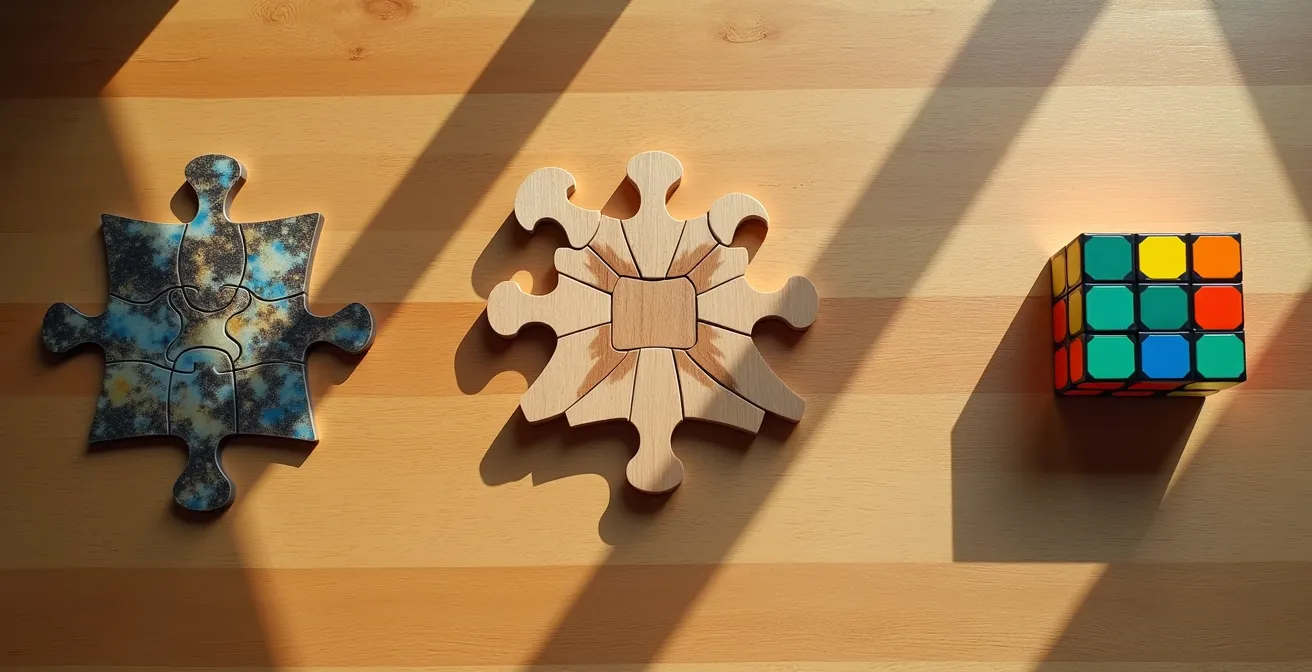
To keep your brain growing, you must embrace the principle of variety and novelty. Instead of doing the same crossword every day, try a week of alternating activities: a logic puzzle on Monday, learning a new card game on Tuesday, a jigsaw puzzle on Wednesday. This “cognitive interleaving” forces your brain to switch gears, retrieve different rule sets, and apply different problem-solving strategies. Frequent engagement is good, but varied engagement is what leads to true growth.
The most effective digital tools have this principle built in. They escape the Routine Trap by constantly adapting the challenge to your performance level.
Case Study: Adaptive Training with BrainHQ
Groundbreaking research from McGill University explored the effects of the BrainHQ training program, which features a series of speed-based cognitive games that become more demanding as users improve. The study found that this adaptive training restored the health of certain neural systems to levels typically seen in someone 10 years younger. This was the first time any non-pharmaceutical intervention had demonstrated such a restorative effect in humans, highlighting the power of continuously escalating challenges.
This is the essence of Active Neuro-Engagement: staying just outside your comfort zone. The moment a task becomes easy, it’s a signal from your brain that it’s time to increase the difficulty or, better yet, move on to a completely new challenge.
When to Schedule Complex Tasks to match Your Peak Cognitive Hours?
Not all hours of the day are created equal for your brain. We all have a natural “chronotype,” or a biological rhythm that dictates when our cognitive functions are at their peak. For some, this is early in the morning (the “larks”), while for others, it’s later in the evening (the “owls”). Working with your brain’s natural energy cycle, rather than against it, can dramatically improve your ability to learn and solve complex problems.
Ignoring your peak cognitive hours is like trying to swim against a strong current. You’ll expend far more energy for less progress. The key is to schedule your most demanding mental activities—like learning that new instrument or tackling a difficult financial plan—during these prime-time windows. Lighter tasks, like routine chores or light reading, can be reserved for the troughs when your focus naturally wanes.
But how do you find your personal peak time? It requires a bit of self-auditing. You can’t just guess; you need to collect data on your own performance. This simple protocol will help you map your unique cognitive landscape and create a schedule that maximizes your mental horsepower. Don’t think of it as a rigid set of rules, but as a flexible blueprint for working smarter, not harder.
Your Action Plan: Find Your Cognitive Prime Time
- Keep a one-week log: Every two hours, rate your focus, energy, and creativity on a simple 1-10 scale.
- Identify patterns: Look for consistent times of day when your scores for analytical tasks (focus) vs. creative tasks (creativity) are highest.
- Schedule strategically: Block out 90-minute “deep work” sessions for your most complex tasks during these identified peak hours.
- Plan for ‘brain breaks’: After each 90-minute block, take a 15-20 minute break. This is non-negotiable. Walk, stretch, or listen to music to let your brain recharge.
- Match tasks to your chronotype: Use your peak hours for high-focus, analytical work. Surprisingly, research suggests creative insights often come during your non-optimal hours when your mind is less filtered.
Why Isolation Accelerates Memory Loss More Than Genetics?
While we often point to genetics as the primary driver of cognitive decline, a far more powerful and controllable factor is social isolation. A lonely brain is a vulnerable brain. Chronic loneliness acts as a powerful stressor, increasing inflammation and disrupting the very brain chemistry that supports learning and memory. It deprives us of the rich, unpredictable, and stimulating environment that social interaction provides.
Think about what a simple conversation requires: you must listen, process information, access your own memories, formulate a response, and read social cues, all in real-time. This is a complex, continuous cognitive workout. When you are isolated, this vital source of mental stimulation vanishes. The brain, lacking this input, can begin to atrophy, much like a muscle that is never used. The link is so strong that high social engagement is associated with better cognitive health, independent of other risk factors.
This is where building and maintaining a strong “cognitive reserve” becomes critical. Cognitive reserve is the mind’s resilience to neuropathological damage. It’s built through a lifetime of education and stimulating activities. A powerful way to build this reserve is through bilingualism, an activity that requires constant mental juggling.
Case Study: The Bilingual Brain’s Defense System
Research from Concordia University provides a stunning look at this effect. Scientists found that the hippocampus, a brain region crucial for memory, was noticeably larger in bilinguals with Alzheimer’s disease compared to their monolingual counterparts, even when matched for the same level of cognitive impairment. This suggests that bilingualism helps the brain maintain its physical structure, a phenomenon known as “brain maintenance.” This mental stimulation, along with a healthy lifestyle, acts as a protective buffer, delaying the onset of dementia symptoms by an average of 4-5 years.
Isolation is the antithesis of this process. It robs the brain of the very challenges needed to build and maintain this crucial defense system, making it far more susceptible to the effects of aging and disease.
How to Stay Tech-Relevant to Connect With Your Grandchildren?
The “digital divide” between generations can feel like a chasm, contributing to feelings of isolation and irrelevance. Many seniors view technology as a frustrating chore to be mastered. As your coach, I challenge you to reframe this completely. Don’t think of it as “learning technology”; think of it as “learning your grandchild’s world.” The goal isn’t to become a tech expert, but to use technology as a bridge to a deeper, more meaningful connection.
This shift in perspective changes everything. It transforms a frustrating task into an act of love and curiosity. Instead of trying to master an entire app, focus on a single, shared activity. The technology is merely the venue; the connection is the main event. This approach not only strengthens your intergenerational bonds but also provides a powerful, motivating context for learning a new skill—a core tenet of Active Neuro-Engagement.

Here are some concrete ways to build these tech-savvy connections:
- Embrace Reverse Mentorship: Ask your grandchild to teach you one specific thing, like how to use a filter on a video call or find a song on Spotify. This empowers them and creates a fun learning experience for you.
- Co-Consume Media: Pick a streaming series to watch “together” from your respective homes. You can text or call after each episode to discuss it. The show becomes a shared cultural touchpoint.
- Collaborate on a Project: Create a shared digital photo album or a collaborative music playlist. The joint creation process is a powerful bonding activity.
- Focus on Shared Experiences: Use video calls not just to talk, but to *do* things together. Play a simple online game, read a story, or even cook the same recipe in your own kitchens.
The key is to let go of the pressure to be perfect. Your grandchildren don’t expect you to be a tech wizard. They will cherish your willingness to step into their world and share an experience with them.
Key Takeaways
- Passive activities like the same daily puzzle lead to a “routine trap” with diminishing cognitive benefits.
- Active Neuro-Engagement, through complex and novel skills like learning music, provides a superior full-brain workout.
- Social activities and dual-tasking are powerful, real-world methods to strengthen executive functions and social cognition.
How to Build a “Memory Palace” for Your Daily Medication List?
One of the most practical and powerful tools for enhancing memory is a technique used by memory champions for centuries: the Method of Loci, or “Memory Palace.” This isn’t a physical place, but a vivid, detailed location in your mind—like your own home—that you can populate with images representing the things you need to remember. It works by linking abstract information (like a medication name) to concrete, sensory-rich images in a familiar spatial context.
For a daily medication list, this technique can be transformative. Instead of relying on a simple list, which engages only a small part of your memory, you create a rich, multi-sensory story. This process engages your visual cortex, spatial awareness, and creative thinking, encoding the information much more robustly. For example, medical students use this exact technique to memorize complex drug interactions by imagining bizarre scenes within a familiar university building.
Here’s how you can build a simple memory palace for a morning medication routine using your own home as the blueprint:
- Choose Your Palace and Path: Decide on a familiar location, like your house. Map a specific, unchangeable route, for example, from your bed to the bathroom and then to the kitchen.
- Create Exaggerated Images: For each medication, create a bizarre, unforgettable image. If you take a heart pill, don’t just picture a pill. Picture a giant, cartoonishly beating heart bouncing on your bathroom sink. For a blood pressure pill, imagine a fire-hose (pressure) spraying water all over the hallway.
- Place the Images on Your Path: Mentally “place” each image at a specific spot along your route. The giant heart is on the sink. The fire-hose is blocking the hall. A bone-strengthening pill might be a huge dinosaur bone propping open the kitchen door. The more absurd, the better.
- Walk Through Your Palace: To recall your list, you simply take a mental walk along your pre-defined path. As you “see” each bizarre image, you will instantly recall the medication associated with it. Practice this mental navigation regularly to solidify the connections.
This technique transforms a mundane memory task into an act of creative storytelling. It’s a prime example of Active Neuro-Engagement, proving that you have the power to fundamentally change how your memory works.
Your brain is not a static organ destined to decline; it is a dynamic and adaptable engine waiting for the right challenge. The first step away from passive puzzles and toward Active Neuro-Engagement is a choice you can make today. Choose one new, complex, and joyful activity from this guide and commit to it. Your future self will thank you. The power to build a more resilient brain is in your hands.