

The secret to joint-safe cardio isn’t just choosing ‘low-impact’ exercises; it’s mastering the hidden mechanics of movement that actively protect you.
- The type of resistance you use (like bands vs. weights) has a dramatic impact on joint pressure and bone health.
- How you breathe during a movement can either safeguard your body or dangerously spike your blood pressure.
- The timing of your workout directly influences your daily energy levels and can prevent afternoon slumps.
Recommendation: Focus on mastering one technique from this guide—like proper breathing or using resistance bands—before simply adding more minutes to your workout. Quality of movement is your best long-term protection.
The desire to stay active, strong, and independent is a powerful motivator. Yet for many seniors, this desire is met with a very real fear: the fear of injury. The thought of a fall, a painful joint flare-up, or an injury that could compromise your mobility is terrifying. It can feel like you’re trapped between the risks of inactivity and the risks of activity itself. You want the energy and health benefits of cardio, but the potential cost to your knees and hips seems too high.
Common advice often feels overly simplistic. You’re told to “just swim” or “try a stationary bike.” While these are good starting points, they miss the most crucial element. They tell you *what* to do, but not *how* to do it in a way that truly fortifies your body against injury. True safety and longevity in fitness don’t come from just picking a low-impact machine; they come from understanding the mechanics of your own body during movement.
But what if the key to protecting your joints wasn’t avoiding all strain, but learning to apply the *right kind* of stress? What if you could build a routine that not only gets your heart rate up but also actively lubricates your joints, strengthens your bones, and even teaches your body to move more efficiently? This isn’t about exercising less; it’s about exercising smarter. It’s about mastering the hidden details that make all the difference.
This guide, written from the perspective of a certified senior fitness instructor, will walk you through these essential mechanics. We will explore everything from the safest tools for building strength and the right way to breathe during exertion to the optimal time of day to exercise for all-day energy. Prepare to move with confidence again.
This article provides a comprehensive roadmap to building a cardio routine that works with your body, not against it. Below is a summary of the key areas we will cover to help you regain control over your fitness and protect your most important assets: your joints and your independence.
Summary: A Practical Guide to Building a Joint-Protecting Cardio Regimen
- Why Resistance Bands Are Safer Than Dumbbells for Osteoporosis Patients?
- How to Perform Water Aerobics Movements Without Instructor Supervision?
- Stationary Bike or Walking: Which Is Better for Arthritic Knees?
- The Breathing Error That Spikes Blood Pressure During Exercise
- When Is the Best Time to Exercise to Avoid Afternoon Fatigue?
- Why Low-Impact Cardio Increases Daily Energy Levels More Than Napping?
- How to Start Your Day With 5 Gentle Stretches Before Getting Out of Bed?
- How to Build Muscle Strength After 65 Without Straining Joints?
Why Resistance Bands Are Safer Than Dumbbells for Osteoporosis Patients?
When we think of strength training, dumbbells often come to mind first. However, for individuals managing osteoporosis, the physics of how resistance is applied is critical. Dumbbells offer a fixed, constant resistance dictated by gravity. This means the pressure on your joints and bones is highest at the weakest point of an exercise. Resistance bands, on the other hand, provide something called accommodating resistance. The tension increases as you stretch the band, meaning the resistance is lowest at the start of the movement and greatest at the peak, where your muscles are strongest and most capable of handling the load.
This accommodating nature makes bands inherently safer for fragile joints and bones. Instead of fighting gravity, you are working with controlled tension that you can adjust instantly. A compelling 2024 meta-analysis revealed that elastic band training can lead to a nearly 98% improvement in bone mineral density in older women after just 12 weeks. This happens because the gentle, progressive pulling on the bone stimulates osteoblasts—the cells responsible for building new bone tissue—without the jarring impact of heavy weights.
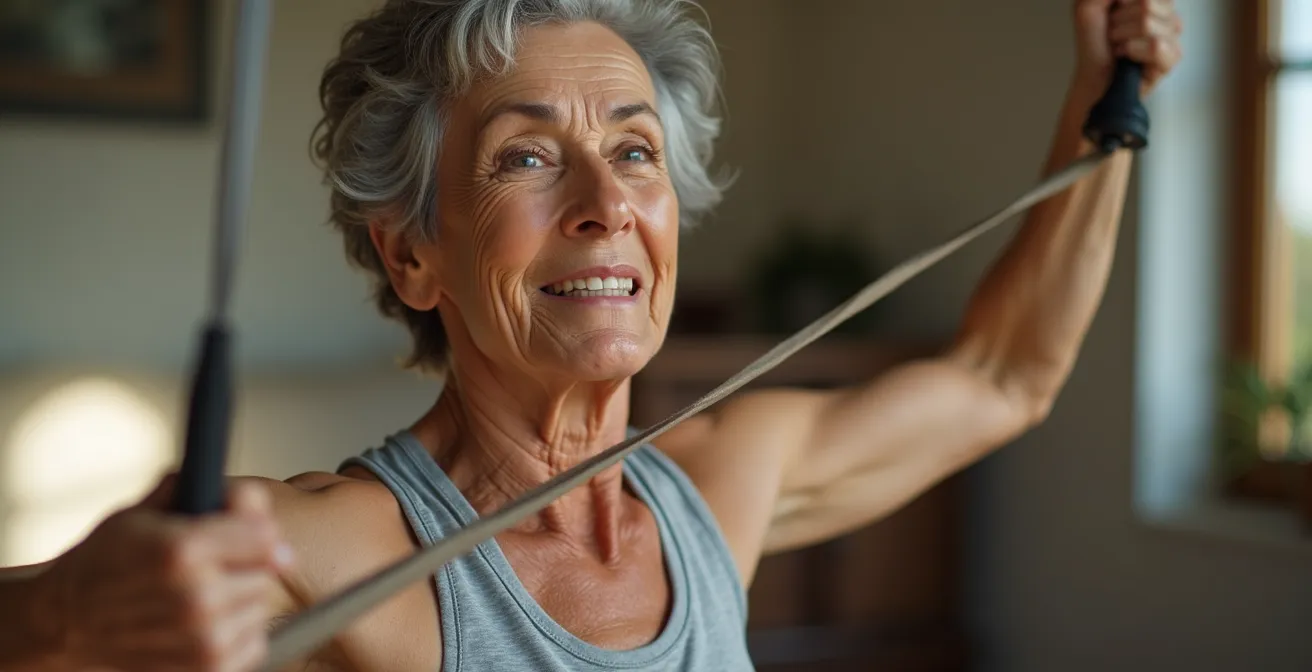
In practice, this means you can effectively challenge your muscles to get stronger while minimizing the risk of fracture or joint strain. A program involving 63 elderly women with osteosarcopenic obesity found that training with elastic bands three times a week led to significant improvements in not only bone density but also muscle strength and fracture risk scores. The key is progressive overload: starting with a lighter band and moving to a heavier one as you get stronger, ensuring continuous adaptation without undue stress.
How to Perform Water Aerobics Movements Without Instructor Supervision?
Water aerobics is a fantastic form of cardio because the water’s buoyancy supports your body weight, virtually eliminating impact on your knees and hips. This support allows you to move with a freedom you might not have on land. But without an instructor, how do you control the intensity to ensure you’re getting a good workout? The secret lies in understanding and manipulating the water’s natural resistance. You don’t need fancy equipment; your own body is the tool.
The key principle is surface area. The larger the surface area you push against the water, the more resistance you create, and the harder your muscles have to work. A closed fist cuts through the water easily (low intensity), while an open, cupped hand acts like a paddle, creating much more drag (high intensity). The same logic applies to your entire body. By simply changing the shape of your hands, the position of your arms, or the speed of your movements, you can tailor the workout’s intensity second by second.
The following table breaks down how you can act as your own instructor, adjusting the difficulty of common water exercises like water walking, leg lifts, or arm presses. Mastering these subtle changes gives you complete control over your workout.
| Body Part | Low Intensity | Medium Intensity | High Intensity |
|---|---|---|---|
| Hands | Closed fist | Open palm | Cupped hand |
| Arms | Arms at sides | Arms extended halfway | Full arm extension |
| Legs | Bent knee movements | Slightly bent legs | Straight leg movements |
| Speed | Slow, controlled | Moderate pace | Quick movements (maintain control) |
Start with low-intensity variations to warm up, then progress to medium or high intensity for the core of your workout. Always focus on maintaining control; the goal is smooth, deliberate movement, not frantic splashing. By paying attention to your body’s interaction with the water, you can create a safe, effective, and perfectly customized cardio session every time.
Stationary Bike or Walking: Which Is Better for Arthritic Knees?
This is a common dilemma for the many people managing knee pain. Both walking and stationary cycling are excellent low-impact options, but they affect the knee joint in fundamentally different ways. The best choice for you often depends on the specific nature of your arthritis and your body’s mechanics. Walking is a weight-bearing exercise, which is fantastic for maintaining bone density. However, each step sends a moderate amount of force through the knee joint. For some, this can aggravate existing inflammation.
The stationary bike, in contrast, is non-weight bearing. Your body is supported by the seat, removing the stress of your body weight from the knee. The continuous, circular motion is particularly beneficial for producing synovial fluid, the natural lubricant in your joints. Think of it like oiling a hinge; the smooth, repetitive movement helps keep the joint moving freely and can actually reduce stiffness. This makes it especially suitable for individuals with patellofemoral pain (pain at the front of the knee/kneecap).
To make an informed decision, it’s helpful to compare them side-by-side, as detailed in this analysis from the Cleveland Clinic. The right setup is crucial for both activities.
| Factor | Stationary Bike | Walking |
|---|---|---|
| Joint Impact | Non-weight bearing, minimal stress | Weight-bearing, moderate stress |
| Synovial Fluid Production | Excellent – continuous motion | Good – intermittent loading |
| Bone Density Benefits | Limited | Superior – weight-bearing stimulus |
| Pain Location Suitability | Best for patellofemoral pain | Better for mild medial/lateral arthritis |
| Setup Requirements | Seat height: 25-35° knee bend at bottom | Rocker-soled shoes or orthotics essential |
Ultimately, there isn’t one “best” answer for everyone. A stationary bike offers superior joint protection from impact, while walking provides essential bone-strengthening benefits. Many people find that alternating between the two gives them the best of both worlds: the joint lubrication of cycling on some days and the bone-building stimulus of walking on others.
The Breathing Error That Spikes Blood Pressure During Exercise
When you lift something heavy or push through a difficult repetition, what’s your first instinct? For most people, it’s to hold their breath. This instinctual action, known as the Valsalva maneuver, is the body’s way of creating internal pressure to stabilize the torso. While it might make you feel stronger for a moment, it is one of the most dangerous and common errors made during exercise, especially for seniors.
Holding your breath under strain dramatically increases pressure inside your chest. This squeezes the major blood vessels, causing a rapid and significant spike in blood pressure. When you finally exhale, your blood pressure can plummet just as quickly. This rollercoaster effect is stressful for the cardiovascular system and can be particularly risky for anyone with hypertension or heart conditions. As certified athletic trainer Dr. Katie Lawton, MEd, explains, this maneuver is a double-edged sword:
The Valsalva maneuver is an instinct to stabilize the core that dangerously spikes both blood pressure and intra-articular pressure in the hips and knees.
– Dr. Katie Lawton, MEd, Cleveland Clinic – Low-Impact Cardio Exercises
The solution is simple in principle but requires conscious practice: exhale on exertion. This means you should breathe out during the hardest part of any movement. For example, when doing a squat, you inhale as you lower your body and exhale as you push back up to standing. When using a resistance band, you exhale as you stretch the band and inhale as you return to the start. This simple rule ensures that pressure doesn’t build up, keeping your blood pressure stable and protecting both your heart and your joints from unnecessary strain.
When Is the Best Time to Exercise to Avoid Afternoon Fatigue?
Have you ever felt energized right after a workout, only to hit a wall of exhaustion a few hours later? This common “afternoon slump” can often be traced back to *when* you exercise, not just *how*. While any movement is better than none, strategic timing can make a world of difference in your all-day energy levels. For many seniors, the sweet spot is the mid-morning, typically around 10 AM.
There are a few physiological reasons for this. First, your body’s natural cortisol levels (the “alertness” hormone) are typically peaking in the morning, giving you a natural boost. Second, any stiffness you may feel upon waking has had a chance to subside, allowing for better mobility and a more comfortable workout. Fitness programs in senior living communities have observed this firsthand, noting that 10 AM classes have higher participation and completion rates. Participants consistently report feeling more energized throughout the afternoon compared to when they exercise very early in the morning or later in the day.
However, what you do *after* your workout is just as important for locking in that energy. A proper cooldown and refueling strategy prevents your blood sugar from crashing and helps your nervous system transition smoothly from an active state to a resting one. It’s a crucial step that turns a good workout into a great day.
Your Post-Workout Energy Lock-In Plan
- 5-minute cooldown: Gradually reduce your exercise pace, allowing your heart rate to return slowly to its baseline. Never stop abruptly.
- Deep breathing: After your cooldown, perform 10 deep, slow diaphragmatic (belly) breaths to calm your nervous system.
- Smart rehydration: Drink 16-20 ounces of water over the next 10-15 minutes. Sipping is better than chugging to allow for proper absorption.
- Strategic snack timing: Wait 15-20 minutes after finishing your exercise, then consume a snack that combines protein and carbohydrates.
- Ideal snack examples: A small container of Greek yogurt with berries, a slice of whole-grain toast with almond butter, or a handful of nuts with apple slices.
By pairing a mid-morning workout with this deliberate post-exercise protocol, you give your body the best possible chance to sustain its energy, turning your fitness efforts into a source of all-day vitality instead of a trigger for afternoon fatigue.
Why Low-Impact Cardio Increases Daily Energy Levels More Than Napping?
When you feel tired, the most logical solution seems to be rest. While a short nap can offer a temporary boost, consistent low-impact cardio creates a much more profound and lasting form of energy. It might seem counterintuitive—spending energy to gain energy—but the magic happens at a cellular level. The old saying, “you have to spend money to make money,” applies perfectly here.
Regular exercise, even at a gentle pace, acts as a signal to your body to become more efficient at producing energy. It stimulates the growth of new mitochondria, which are the tiny “power plants” inside your cells. More mitochondria mean a greater capacity to convert fuel (like glucose and fat) into usable energy (ATP). A nap is like dimming the lights to save power; exercise is like upgrading the entire electrical grid. Research on seniors in 12-week low-impact programs confirms this, showing increased mitochondrial density and efficiency. Participants reported sustained energy improvements, especially in the afternoon, that persisted even on their rest days.
The key is consistency. You don’t need to run a marathon. In fact, the United States Department of Health and Family Services recommends that elderly adults aim for about 2.5 hours of moderate-intensity exercise per week. This could be 30 minutes, five days a week, of brisk walking, water aerobics, or cycling. This regular stimulus is what tells your body to build a more robust energy system. Napping, by contrast, keeps your energy production capacity the same; it just pauses the demand for a short while. So, while it may feel good in the moment, it doesn’t build your long-term energy resilience.
How to Start Your Day With 5 Gentle Stretches Before Getting Out of Bed?
The transition from sleeping to standing can be a vulnerable moment for stiff joints. Instead of shocking your system by immediately standing up, take a few minutes to gently awaken your body while you are still lying comfortably in bed. This simple routine can lubricate your joints, activate your muscles, and set a positive tone for your day’s movements. These stretches should be slow, deliberate, and never pushed to the point of pain.
Here are five gentle stretches you can perform before your feet even touch the floor:
- Ankle Pumps: While lying on your back, gently point your toes away from you, then flex them back toward your shins. This simple movement activates the calf muscles, which act as a “second heart” to help pump blood back up your legs, reducing morning stiffness and swelling. Repeat 15-20 times.
- Knee-to-Chest Hug: Gently pull one knee toward your chest, holding it for 20-30 seconds. You should feel a light stretch in your lower back and glute. Release slowly and repeat on the other side. This helps to decompress the lumbar spine.
- Glute Squeezes: Lie on your back with your knees bent and feet flat on the bed. Gently squeeze your gluteal muscles, hold for 5 seconds, and then relax. This “wakes up” the powerful hip muscles that are essential for stable walking. Repeat 10 times.
- Gentle Trunk Twist: With knees bent and together, slowly lower them to one side, keeping your shoulders flat on the bed. Hold for 20 seconds to feel a gentle stretch through your torso and lower back. Return to the center and repeat on the other side.
- Full Body Stretch (Good Morning Stretch): Reach your arms overhead and extend your legs long, gently stretching your entire body from fingertips to toes, as if you’re yawning. Hold for 10 seconds.
The ankle pump is one of the most effective yet gentle ways to begin this sequence, encouraging circulation throughout the lower body.
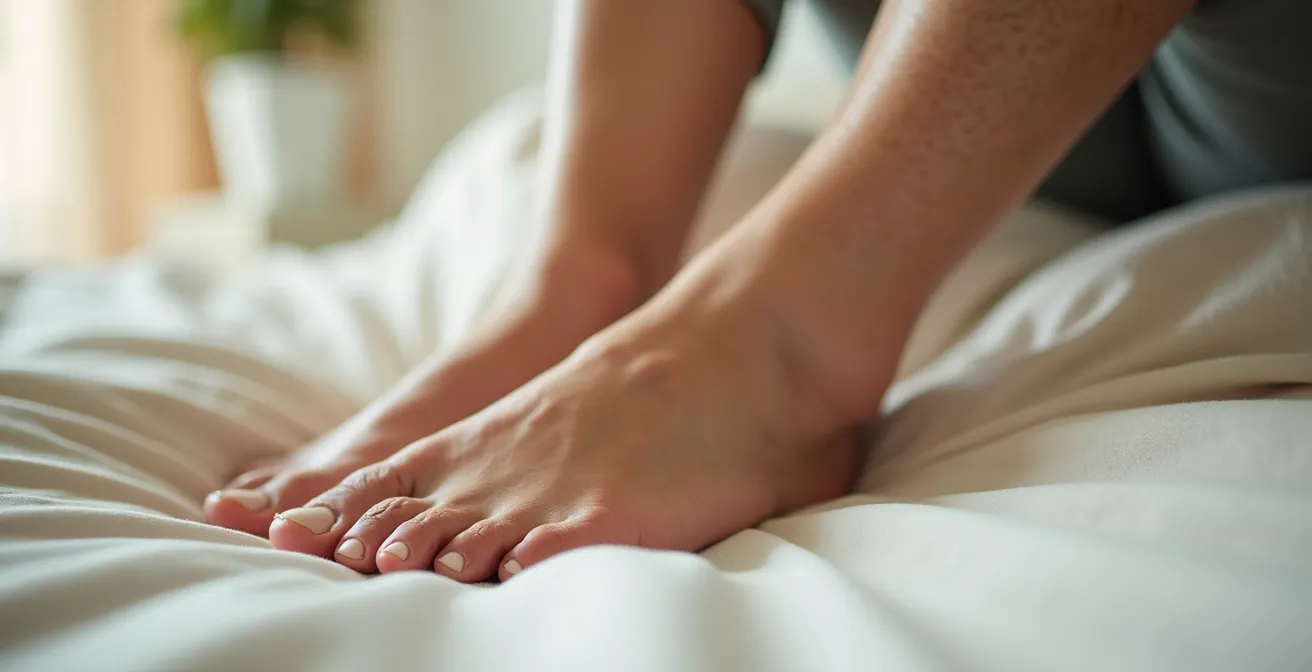
Performing these movements consistently can significantly reduce the aches and pains associated with getting out of bed. It’s a small investment of time that pays large dividends in comfort and mobility throughout your day.
Key Takeaways
- The *type* of resistance (accommodating vs. fixed) is more important for joint safety than the amount of weight.
- Proper breathing technique—exhaling on exertion—is a non-negotiable tool for protecting your heart and joints.
- Mastering the *details* of your movement is the true key to building a sustainable, injury-proof fitness routine for life.
How to Build Muscle Strength After 65 Without Straining Joints?
The loss of muscle mass (sarcopenia) is a natural part of aging, but it is not an irreversible fate. Building and maintaining muscle is crucial for metabolism, balance, and overall functional independence. The challenge, of course, is doing so without overloading joints that may already be sensitive. The solution isn’t to lift heavy weights; it’s to make lighter weights *feel* heavier to your muscles through a technique called Time Under Tension (TUT).
Time Under Tension focuses on the speed of the repetition rather than the amount of weight lifted. Instead of quickly performing a movement, you slow it down dramatically. A 6-week resistance training study published in PubMed highlighted a particularly effective protocol: a 3-1-3 tempo. This means you take 3 seconds for the lifting (concentric) phase, hold for 1 second at the peak, and take 3 seconds for the lowering (eccentric) phase. By extending the time the muscle is working, you create significant metabolic stress that stimulates muscle growth, even with very light weights or resistance bands.
This slow, controlled method maximizes muscle engagement while minimizing the momentum and force that can strain joints. A study focusing on this exact principle found that participants using this method three times weekly with light weights effectively preserved bone density and built muscle with minimal joint stress. This confirms that slow, controlled movements are a highly effective strategy for older adults. You force the muscle to do all the work, not gravity or momentum.
The journey to a stronger, more energetic, and more confident you begins not with a leap, but with a single, smart step. The next logical move is to choose one technique from this guide—whether it’s the 3-1-3 tempo or the mid-morning workout time—and commit to practicing it for just one week. Progress is built on small, consistent, and intelligent actions.