
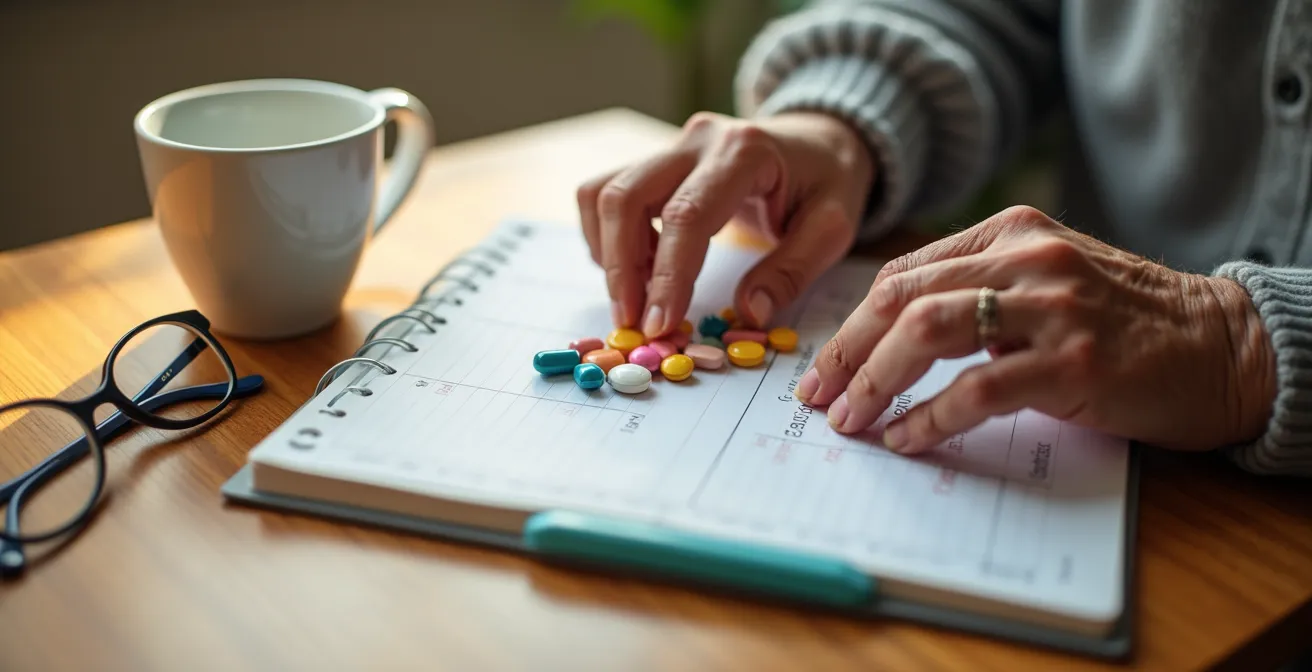
In summary:
- Your mind, not just a pillbox, is your most powerful tool for medication adherence.
- Defeating memory blockers like stress and distraction is the first step to perfect recall.
- Techniques like “Pill Personas” and the “Memory Palace” transform your regimen from a chore into a memorable story.
- Mindful monotasking for just 60 seconds during medication time dramatically reduces errors.
That fleeting moment of panic—”Did I take my morning pills?”—is a frustratingly common experience. We’re often told the solution is external: a better pill organizer, more phone alarms, or a flurry of sticky notes. These tools are helpful, but they are crutches. They address the symptom, not the cause, and can fail, get lost, or be ignored. This constant reliance on outside aids can make us feel like our own memory is failing us, leading to anxiety around those “senior moments” like misplacing keys or forgetting a new acquaintance’s name.
But what if the most reliable medication management system isn’t a plastic box or a digital alert, but the incredible, trainable machine inside your own head? What if, instead of just managing pills, you could actively train your brain to defeat the very things that cause forgetfulness? This guide moves beyond the standard advice. We will explore the real cognitive saboteurs—stress hormones and the myth of multitasking—that directly impact your ability to remember.
We’ll shift the focus from passive reminders to active cognitive encoding. You will learn how to apply the powerful techniques used by memory champions to your daily life. This isn’t about rote memorization; it’s about building a robust, internal framework—a “Memory Palace”—for your health. This article will show you how to turn each pill into a memorable character and each dose into a step in a story you can’t forget, empowering you to take control of your regimen with confidence and mental clarity.
This article provides a structured path to mastering your memory for medication management. Below is a summary of the key techniques and concepts we will explore to build your mental toolkit.
Summary: How to Build a ‘Memory Palace’ for Your Daily Medication List?
- Why Stress Hormones Block Your Ability to Recall Names Instantly?
- How to Create a “Landing Strip” for Essentials to Never Lose Keys Again?
- Smart Speakers or Sticky Notes: Which Is More Reliable for Reminders?
- The Multitasking Habit That Destroys Short-Term Memory Encoding
- How to Use the “Face-Name” Association Method at Social Events?
- How to Create a “In Case of Emergency” Medical Card for Your Wallet?
- Why “Double Dosing” Happens and How to Stop It?
- How to Organize a 5-Drug Regimen Without Mixing Up Dosages?
Why stress hormones block your ability to recall names instantly?
Have you ever been in a conversation, desperately trying to recall a name that’s on the tip of your tongue, only for it to vanish completely? This mental blank is often caused by stress. When we feel pressured, our body releases cortisol, a stress hormone that, in high doses, acts as a memory blocker. It interferes with the brain’s hippocampus, the region responsible for forming and retrieving memories. This isn’t just about social anxiety; the low-grade stress of managing a complex health routine can have the same effect, making you forget if you took a crucial pill only minutes later.
The science is clear: calming the nervous system directly improves memory function. In fact, research from the Journal of Cognitive Neuroscience found that participants showed significantly better memory recall when their cortisol levels were lower. This means that managing your mental state right before you take your medication is as important as having the pills themselves. Creating a moment of calm before the act of taking medicine is a non-negotiable step in building a reliable memory routine.

As you can see, the environment for taking medication should be one of tranquility. Instead of rushing through it, you can implement simple grounding techniques to lower cortisol and sharpen your focus. By taking just 60 seconds to practice mindful breathing, you are actively preparing your brain for successful memory encoding. This small ritual transforms pill time from a stressful chore into a moment of mindful self-care, making the memory of the event stick.
- Set a timer for 60 seconds before your scheduled medication time.
- Practice “box breathing”: inhale for 4 seconds, hold for 4, exhale for 4, and hold for 4.
- While breathing, consciously name 5 things you can see in your medication area.
- Physically touch your pill organizer, feeling its texture, while continuing to breathe deeply.
- State out loud which specific medications you are about to take.
How to create a “landing strip” for essentials to never lose keys again?
The frustration of losing keys, glasses, or a wallet comes from the same root cause as forgetting a dose of medication: a lack of a dedicated, non-negotiable home for the item. Memory champions don’t have perfect brains; they have perfect systems. The “Landing Strip” is one such system—a designated spot in your home where essential items *always* land the moment you walk in the door. By creating this habit, you offload the mental work of remembering where you put something. The action becomes automatic.
This same principle is the foundation for a reliable medication routine. Your “Medication Station” is the landing strip for your health. It should be a dedicated, uncluttered space in your direct daily path—for example, right next to the coffee maker for morning pills or on your bedside table for evening ones. This physical consistency creates a powerful mental cue. When you see the station, your brain is primed to think about your medication, reinforcing the habit loop. It’s about making the right choice the easiest choice.
To make your medication station even more effective, you should incorporate a unique sensory anchor. This could be a distinctively textured mat, a small block of cedar wood with a specific scent, or even a small chime you ring. By engaging more than just your sight, you create a richer, multi-sensory memory of the action, making it far more difficult to forget. Here is how to set up your ultimate medication station:
- Choose a location in your unavoidable daily path (e.g., next to the coffee maker).
- Install adequate lighting, considering a motion-activated LED strip for visibility.
- Place a distinctive textured mat or a special tray to define the space.
- Position your pill organizer, a glass of water, and any checklists together.
- Add a unique sensory anchor like a cedar block or a small, pleasant-sounding chime.
- Keep this area completely uncluttered—it is reserved for medication essentials only.
Smart speakers or sticky notes: which is more reliable for reminders?
In the quest for the perfect reminder system, the debate often boils down to high-tech versus low-tech. Sticky notes are simple and visual, but they can become “invisible” over time as you get used to seeing them. They also offer no feedback; you can’t be sure the task was completed. Smart speakers and phone alarms are proactive, but they can be easily dismissed with a swipe or a verbal command, especially if you’re distracted. So which is better?
The answer is neither—or rather, both, when used together. The most reliable system is not a single tool but a layered strategy that combines an active alert with a required physical action. A simple alarm doesn’t confirm the pill was taken, it only confirms the alarm went off. True reliability comes from creating a “closed-loop” system where the reminder triggers an action, and the action is then confirmed.
A case study from AlfredCamera highlighted this principle effectively. It showed that users who combined a smart speaker reminder with a visual confirmation method had the highest medication adherence. The key was the specificity of the command. Instead of a generic “take your pills” alarm, users set commands like, “Alexa, remind me at 8 AM to take my morning pills and check them off my list.” This command links the alert (the speaker) to a physical action (checking the list), creating a more robust routine. For an even higher level of assurance, caregivers could use two-way audio features to personally check in if an automated reminder was dismissed, closing the loop completely. The best system uses technology not just as an alarm, but as a trigger for a verifiable action.
The multitasking habit that destroys short-term memory encoding
Many of us wear multitasking as a badge of honor, believing we’re being more efficient by juggling several things at once. The truth is, the human brain cannot truly multitask. Instead, it rapidly switches its attention between tasks, a process called “task-switching.” This constant switching comes at a huge cognitive cost. It prevents deep focus and, most critically for medication safety, it severely impairs short-term memory encoding. When you swallow your pills while watching the news and thinking about your grocery list, your brain doesn’t properly tag the event, making it almost impossible to recall later.
This isn’t a minor issue; it has serious consequences. A study on medication administration in older adults is sobering: a study published in PLOS One found that 69.2% of older adults reported making medication errors in the last six months, with distraction being a primary cause. The moment you take your medication requires your full, undivided attention. It’s not a task to be checked off a list while doing something else; it’s a critical moment of self-care that demands respect.

The antidote to the dangers of multitasking is the practice of mindful monotasking. This means dedicating a brief, sacred window of time—even just 60 seconds—to the single task of taking your medication. By turning off the TV, putting down your phone, and sitting at your designated medication station, you send a clear signal to your brain: “This is important. Remember this.” This singular focus ensures the memory is encoded strongly and can be easily retrieved when you ask yourself that question later in the day.
- Turn off all distractions: TV, radio, and phone notifications.
- Sit in your designated medication space.
- Look at each pill individually before taking it.
- Say the medication’s name and its purpose out loud.
- Take the medication mindfully, consciously feeling the act of swallowing.
- Immediately mark completion on your checklist or turn your pill bottle upside down.
- Wait for 10 seconds in silence before moving to your next activity.
How to use the “face-name” association method at social events?
Remembering names at a social gathering is a classic memory challenge. The most effective technique memory experts teach is “Face-Name Association.” You don’t just repeat the name; you link it to a distinctive visual feature of the person. If you meet a baker named “George,” you might imagine him with a chef’s hat (a ‘gorge-ous’ hat). This act of creating a vivid, unusual, and personal mental image creates a strong hook for the memory to hang on. It’s an active process of creative association.
This exact principle can be brilliantly repurposed for remembering your medications. Instead of seeing a collection of anonymous pills, you can give each one a distinct personality. This is the “Pill Persona” technique. Your small, round, blue blood pressure pill isn’t just a pill; it’s “Captain Blue,” the sailor who keeps your rivers flowing smoothly. Your long, yellow capsule becomes “General Mellow Yellow,” whose job is to command your stomach to remain calm. By giving your pills names, jobs, and characters, you transform them from abstract objects into a memorable cast of characters.
Case Study: The “Pill Persona” Technique
The medical education platform Osmosis demonstrated this method’s power. They had students assign characters to different medications for pancreatitis. The students who created and interacted with these personas, such as greeting them out loud (“Hello, little blue blood pressure pill”), showed dramatically improved recall. Verbalizing the persona’s name and job during administration strengthened the memory encoding through multi-sensory engagement, making it far more effective than passive memorization.
Creating your own cast of characters is a fun, creative exercise that pays huge dividends in medication adherence. You’re no longer just taking pills; you’re assembling your team for the day. Here’s how you can start creating your own “Pill Personas”:
- Identify the visual characteristics of each pill (color, shape, size, score lines).
- Create a character name that hints at the medication’s purpose or name (e.g., “Sir Chews-a-lot” for a chewable tablet).
- Develop a simple story or “job description” for each character.
- Group your characters by the time of day they are taken (the “Morning Crew,” the “Bedtime Brigade”).
- Practice greeting each pill by its persona name when you take it.
- Review your cast of characters weekly to keep the associations strong.
How to create a “in case of emergency” medical card for your wallet?
While strengthening your internal memory is crucial, having a reliable external backup for emergencies is non-negotiable. An “In Case of Emergency” (ICE) card in your wallet is one of the most vital pieces of information you can carry. In a situation where you are unable to communicate, this card speaks for you, providing first responders with the critical information they need to treat you safely and effectively. This is especially important in the context of polypharmacy—the use of multiple medications.
The need for this is more common than many realize. According to Poison Control data, about 50% of adults over the age of 65 take five or more medications daily. This complexity increases the risk of dangerous drug interactions if a new medication is administered in an emergency. A well-prepared ICE card is not just a list of drugs; it’s a comprehensive snapshot of your medical self, including your normal baseline, which can be invaluable for diagnosis.
A truly effective ICE card goes beyond just listing medications. It should include details about your routine and what’s “normal” for you. For instance, a note like, “I am normally clear-headed and energetic in the mornings,” can give paramedics crucial context if they find you confused at 10 AM. It helps them distinguish between a new, acute event and a known baseline. Auditing your card regularly is key to ensuring its accuracy and usefulness in a critical moment.
Your 5-Point Audit for a Lifesaving Emergency Card
- Contact & Medication Inventory: List all current medications with dosages and timing. Ensure your emergency contact and primary physician’s phone numbers are clearly visible and up to date.
- Baseline & Routine Capture: Document your “normal” state (e.g., ‘Normally clear-headed in mornings’) and your daily pill routine (e.g., ‘Morning: 2 pills, Evening: 3 pills’). This helps first responders understand your baseline.
- Visual & Allergy Check: Create a medication photo album on your phone and note its existence on the card. Most importantly, list any and all drug allergies in a prominent, impossible-to-miss section, perhaps in red ink.
- Condition & Physician Review: Ensure all major health conditions (e.g., diabetes, hypertension, afib) are listed. Double-check that all physician information is current.
- Update & Sync Protocol: Set a recurring monthly reminder on your calendar to review and update the card. Make immediate updates after any change in your medication regimen.
Why “double dosing” happens and how to stop it?
The dangerous cousin of forgetting a pill is taking it twice. “Double dosing” is a common medication error that can have serious health consequences, ranging from unpleasant side effects to a genuine medical crisis. These mistakes don’t happen because of carelessness, but because of the way our brains handle routine tasks. When a task becomes highly automatic, like driving a familiar route or taking a daily pill, our brain shifts into autopilot. We perform the action without conscious thought, which means we don’t form a strong memory of doing it.
This is why, just minutes after taking a pill, you can have absolutely no memory of the event and reach for the bottle again. This is a significant issue, particularly in environments with complex medication schedules. In fact, medication errors are alarmingly frequent; StatPearls 2024 reports that medication errors occur 8-25% of the time in care facilities, and similar risks exist at home. The primary culprits are distraction and automaticity.
The most effective way to stop double dosing is to break the autopilot habit. You must introduce a conscious, physical “check-off” step that happens *immediately* after you swallow the pill. This action serves as an external confirmation that breaks the automatic loop and creates the memory you need. This could be:
- Flipping the pill bottle upside down for the rest of the day.
- Moving the bottle from a “To Be Taken” spot to a “Taken” spot on your medication station.
- Checking off the dose on a paper chart.
- Using a pill organizer where an empty compartment is the undeniable proof.
The key is the immediacy. The moment the pill is taken, the confirmation action must occur before you have a chance to get distracted. This links the mental act of taking the pill to an undeniable physical proof, making double dosing virtually impossible.
Key takeaways
- Your Mind is the System: The most powerful medication management tool is a well-trained memory, supported by external cues, not replaced by them.
- Focus is a Superpower: Eliminating distractions and practicing “mindful monotasking” for just 60 seconds is the single most effective way to prevent errors like missed or double doses.
- Make it Memorable: Transforming abstract pills into vivid characters (“Pill Personas”) and weaving them into a daily story is a proven memory champion technique that makes your regimen unforgettable.
How to organize a 5-drug regimen without mixing up dosages?
When you’re managing a regimen of five or more medications, each with its own timing and instructions, a simple checklist can feel overwhelming. This is where the ultimate memory champion technique comes into play: the Memory Palace. A Memory Palace isn’t a physical place; it’s a vivid, detailed location in your mind—like your own home or a familiar walk—that you use as a filing system for information. By “placing” your medications in specific locations (loci) within your mental palace, you leverage your brain’s powerful spatial memory to organize your regimen.
The process involves a “mental walk-through.” Instead of trying to recall an abstract list, you simply take a stroll through your familiar mental space. Each piece of furniture or distinct location holds one of your “Pill Personas” and the information associated with it. This narrative chaining method turns a complex list of instructions into a simple, memorable story. You’re not memorizing data; you’re reliving a journey.
The Memory Palace transforms your medication regimen from a source of anxiety into a structured mental map. This table illustrates how you could organize a five-drug regimen within a single room of your house. Notice how each location, medication, and visual scene are linked to create an unforgettable story, as shown in analysis from memory experts at Mullen Memory.
| Locus (Furniture) | Medication | Visual Scene | Time of Day |
|---|---|---|---|
| Bedside Lamp | Drug 1 (Blood Pressure) | Red light bulb pulsing like a heart | Morning |
| Kitchen Table | Drug 2 & 3 (With Food) | Two chefs serving pills on plates | Breakfast |
| Living Room Couch | Drug 4 (Afternoon) | A large clock showing 2 PM on an armrest | After Lunch |
| Bathroom Mirror | Drug 5 (Bedtime) | A glowing moon reflected in the mirror | Evening |
Building your own Memory Palace is a one-time creative investment that provides a lifetime of cognitive control. It’s a deeply personal and incredibly robust system that is immune to power outages or lost phones. Here are the steps to build your own:
- Choose a very familiar room or route for your palace (e.g., your living room).
- Identify 5-7 distinct locations or pieces of furniture (loci) in a logical order.
- Assign one of your “Pill Personas” to each locus.
- Create a vivid, exaggerated, and unusual mental scene for each medication’s details (e.g., dose number is written in giant flaming letters).
- Build a story that takes you on a mental walk-through from one locus to the next in the correct order.
- Practice this mental walk-through twice a day until it becomes second nature.
- When a dose changes, simply “repaint” the numbers in the scene. If a drug is discontinued, mentally “remove” the furniture piece.
Begin today by choosing your palace and placing your first “Pill Persona.” You have the power not just to manage your health, but to train your mind and reclaim absolute confidence in your own memory.