
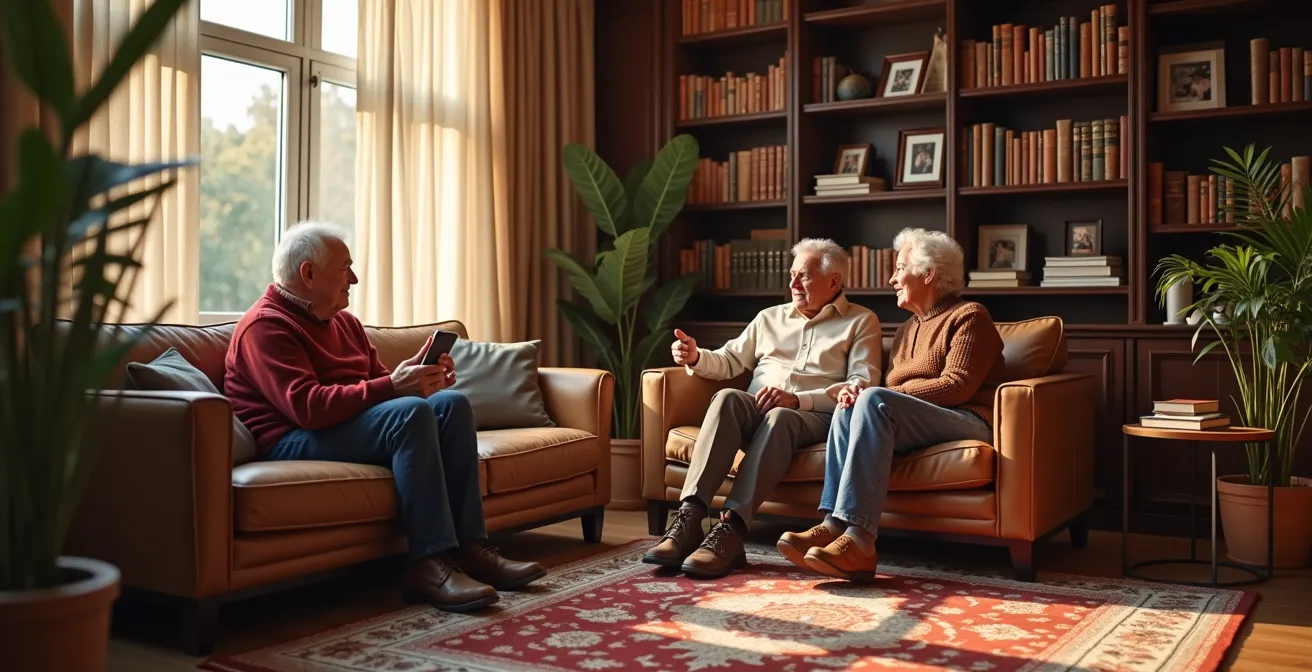
Designing a living room for a senior is not about passive decoration; it’s an active therapeutic process. By treating the space as a form of ‘environmental scaffolding,’ we can go beyond basic safety to create a cognitive support system. This approach uses sensory cues, strategic lighting, and empowering furniture to reduce mental strain, foster autonomy, and stimulate the neural pathways responsible for memory and social connection. The goal is to transform the room from a potential source of confusion into an environment that actively enhances brain health.
When families consider adapting a home for an aging loved one, the focus often falls on the most obvious safety measures: removing trip hazards, improving accessibility, and perhaps adding a few grab bars. These are essential steps, but they only address the physical body. They do little for the mind. The conventional wisdom about “reducing clutter” and “adding familiar photos” barely scratches the surface of what’s possible. These tips treat the environment as a passive backdrop, not the powerful tool it can be.
But what if we re-framed the entire objective? From an environmental psychology perspective, the true key lies in designing not just for safety, but for cognitive support. The living room, the very heart of the home, can be meticulously crafted into a form of environmental scaffolding. This is a space where every element—from the texture of the upholstery to the color temperature of the light—is a deliberate choice designed to reduce cognitive load, trigger positive memories, and empower a sense of agency. This is not about ‘dementia-proofing’; it’s about creating a rich, supportive habitat for the brain.
This guide will walk you through the core principles of creating this cognitive scaffolding. We will deconstruct the living room element by element, exploring how to manage sensory inputs like sound and smell, how to use space to balance safety with stimulation, and how to leverage design to combat feelings of dependency. Finally, we will address the ultimate question of whether to adapt the current home or seek a new one, all through the lens of maximizing long-term brain health.
Summary: Designing a Living Room for Cognitive Well-Being
- Why Untreated Hearing Loss Is a Major Risk Factor for Dementia?
- How to Use Aromatherapy to Trigger Positive Autobiographical Memories?
- New Routes or Familiar Paths: Which Is Better for Spatial Memory?
- The “I Don’t Want to Bother Anyone” Mindset That Shrinks the Brain
- How to Upgrade Home Lighting to Reduce Sundowning Symptoms?
- How to Identify Hidden Fall Hazards in Your Hallways in 10 Minutes?
- Why the Bathroom Is the Most Dangerous Room in Your House?
- Renovate or Relocate: What Is the Best Financial Choice for Aging in Place?
Why Untreated Hearing Loss Is a Major Risk Factor for Dementia?
The link between hearing loss and dementia is one of the most significant, yet often overlooked, aspects of cognitive health. When hearing declines, the brain has to work substantially harder to process auditory information, a phenomenon known as increased cognitive load. This constant strain diverts precious mental resources away from other crucial functions like memory and executive function. Furthermore, difficulty in hearing often leads to social withdrawal. Conversations become taxing, group settings become a blur of noise, and the individual may retreat into isolation, which is itself a major risk factor for cognitive decline.
Creating “acoustic scaffolding” in a living room is therefore not a luxury, but a necessity. It’s about more than just turning down the TV. It involves designing the room to absorb and dampen extraneous noise, making speech clearer and reducing the brain’s workload. Hard surfaces like wood floors and bare walls cause sound to reverberate, creating a chaotic auditory environment. By strategically introducing soft, sound-absorbing materials, you create a calmer, more intelligible space.
Consider these practical acoustic scaffolding solutions:
- Install thick, dense area rugs to absorb sound reflections from hard floors.
- Add heavy curtains or drapes to windows to reduce sound reverberation.
- Position bookcases filled with books along walls to act as natural sound diffusers and absorbers.
- Choose upholstered furniture with textured fabrics like velvet or chenille to minimize echo.
- Place soft furnishings like cushions and throws strategically around the room to further dampen ambient noise.
By treating the room’s acoustics with the same seriousness as its physical layout, you create an environment that supports conversation, reduces mental fatigue, and directly counteracts one of the key drivers of social isolation in seniors.
How to Use Aromatherapy to Trigger Positive Autobiographical Memories?
The olfactory system—our sense of smell—has a uniquely direct pathway to the brain’s limbic system, which governs both emotion and memory. This is why a specific scent can so powerfully transport us back to a distinct moment in time. For individuals with memory impairment, this connection is a profound therapeutic tool. Using aromatherapy is not about making a room smell “nice”; it is about strategically deploying sensory cues to evoke positive autobiographical memories and create a calming atmosphere.
This technique, often part of a multi-sensory approach known as ‘Snoezelen’, focuses on creating a soothing environment that stimulates the senses in a gentle, non-threatening way. The goal is to reduce distress and tap into deep-seated emotional memories that may remain even when short-term memory is compromised. The key is personalization. A generic lavender scent might be relaxing, but the specific aroma of a favorite flower from a childhood garden or a spice used in a beloved family recipe will have a much deeper neurological impact.

As the image above suggests, this can be done beautifully and with dignity. Rather than clinical-looking devices, elegant diffusers can be paired with natural elements that hold personal meaning. A low-tech approach, like a small sachet of dried herbs or a bowl of potpourri with familiar spices, can be just as effective. The practice is about creating small, targeted moments of sensory delight that anchor the individual in a feeling of peace and well-being.
Case Study: Personal Scent Profiles in Memory Care
The Ridge senior living communities implement ‘snoezelen’ sensory experiences that combine soft lighting with personalized aromatherapy. By learning a resident’s history, they can use specific scents, such as that of homemade chocolate chip cookies or a particular type of wood, via low-tech diffusers to create calming environments. This Dutch therapeutic technique has shown marked success in reducing distress and evoking feelings of peace and well-being in residents with dementia, demonstrating the power of highly personalized sensory cues.
New Routes or Familiar Paths: Which Is Better for Spatial Memory?
A common debate in designing for cognitive health is the balance between consistency and stimulation. Should an environment be unchanging to reduce confusion, or should it offer novelty to keep the brain engaged? The answer, from an environmental psychology standpoint, is both. The most effective approach is to clearly delineate the home into two types of zones: “Safety Zones” for consistency and “Stimulation Zones” for gentle novelty. This dual strategy supports spatial memory without causing overwhelm.
Safety Zones are areas dedicated to essential, high-traffic navigation, such as hallways, paths to the bathroom, and the immediate area around the senior’s favorite chair. In these zones, the design principle is absolute consistency. Nothing should change. The layout, lighting, and key landmarks must remain completely predictable to minimize cognitive load during crucial movements. This ensures safe and confident navigation for core daily activities.
Stimulation Zones, on the other hand, are areas for leisure and engagement, like a reading nook, an activity table, or a specific part of the living room. Here, you can introduce “controlled micro-novelty.” This doesn’t mean rearranging the furniture weekly. It means making small, deliberate changes that invite curiosity and gentle cognitive challenge. This could be changing the flowers in a vase, swapping a pillow on a sofa, or rotating a selection of books on a side table. This approach keeps the brain’s spatial and object-recognition faculties engaged in a low-stress context.
Unfortunately, most homes are not designed with these principles in mind. In fact, a Harvard study reveals that less than 3% of all U.S. homes have even three elements of universal design, let alone this nuanced zoning. The following table breaks down the strategy:
| Zone Type | Purpose | Design Strategy | Examples |
|---|---|---|---|
| Safety Zones | Reduce cognitive load and ensure safe navigation | Maintain absolute consistency, no changes | Hallways, bathrooms, main walkways |
| Stimulation Zones | Provide gentle cognitive challenges | Controlled micro-novelty with periodic small changes | Living room, study, activity corners |
The “I Don’t Want to Bother Anyone” Mindset That Shrinks the Brain
One of the most insidious psychological traps in aging is the development of learned helplessness, often manifesting as the “I don’t want to bother anyone” mindset. When simple tasks like standing up, adjusting the lights, or reaching for a drink become difficult, a senior may stop attempting them to avoid asking for help. This slow retreat from active engagement is devastating for cognitive health. The brain thrives on purpose and action; when it is no longer called upon to make decisions and direct the body, its functional networks can begin to weaken. Therefore, the most important psychological function of a living room is to foster a sense of agency and autonomy.
Designing for agency means creating an environment where the individual can be a capable and independent actor, and even a host. It’s about empowering them to say, “Can I get you something to drink?” instead of having to ask for it themselves. This requires a subtle but profound shift in design thinking: from “How do we keep them safe?” to “How do we empower them to act safely?” Every element should be evaluated based on its ability to enable effortless independence.
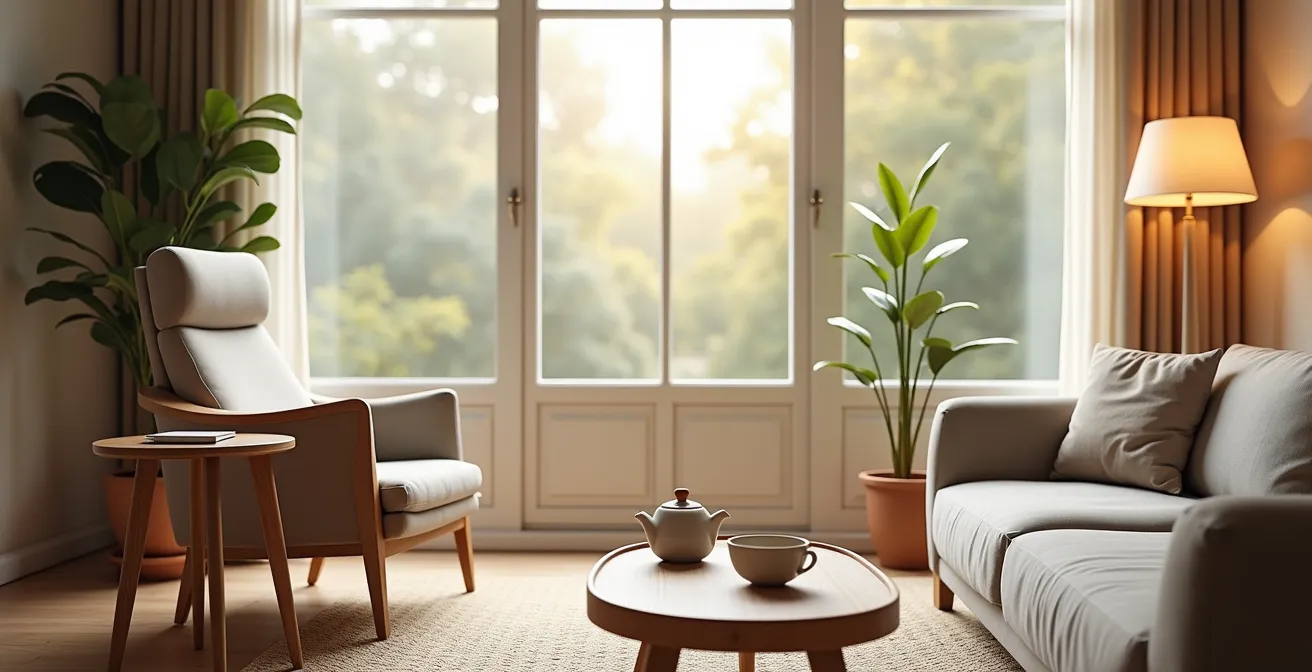
The space should be an enabler, not a container. This involves choosing furniture that assists movement without looking clinical, placing essential items within easy reach, and ensuring that controls for the environment (like lights and thermostats) are accessible and intuitive. A living room designed for agency is a powerful antidote to the passivity that can accelerate cognitive decline.
Action Plan: Designing for Agency and Empowerment
- Chair Selection: Choose stylish lift chairs or ergonomic high-seated armchairs that maintain dignity while making it easier to stand up.
- Table Accessibility: Add C-shaped side tables that slide over chair arms, bringing surfaces for drinks or books within effortless reach without leaning.
- Control Placement: Position remote controls, phones, and lighting controls in a designated, easily accessible spot next to the primary seating area.
- Hosting Station: Create a small, dedicated ‘hosting station’ with a carafe of water and glasses, where the senior can easily offer refreshments to guests.
- Lighting Access: Ensure that primary light switches are reachable from a seated position, or install smart lighting controlled by voice or a simple remote.
How to Upgrade Home Lighting to Reduce Sundowning Symptoms?
Sundowning, or late-day confusion, is a state of increased agitation, anxiety, and disorientation that occurs in the late afternoon and evening. Research indicates that as many as 1 in 5 adults with Alzheimer’s will experience ‘sundowning’, and environmental factors, particularly lighting, play a critical role. The human brain’s internal clock, or circadian rhythm, is regulated by light exposure. In a brain already struggling with cognitive impairment, poor or inconsistent lighting can disrupt this rhythm, triggering confusion.
A conventional lighting scheme is often the enemy. The transition from bright daylight to dim indoor evening light, often punctuated by deep shadows and glare from single-source lamps, can be deeply disorienting. The solution is to implement a transitional, circadian-supportive lighting strategy. This involves mimicking the natural progression of daylight throughout the day, using both the intensity and the color temperature of light to keep the brain’s internal clock properly synchronized.
This is a more sophisticated approach than simply “making the room brighter.” It’s about providing the *right kind* of light at the *right time*. This can be achieved with modern smart lighting systems, but the principles can also be applied with careful selection of standard bulbs and fixtures. The key is to create a smooth, gradual transition and to eliminate the environmental triggers of confusion.
- During the morning and early afternoon, use high-intensity, blue-toned light (around 5000K) to promote wakefulness and alertness.
- Beginning about two hours before sunset, gradually transition to a much warmer, amber-toned light (around 2700K) to signal to the brain that it’s time to wind down.
- Implement multiple sources of light (table lamps, floor lamps, uplighting) to create a uniform field of illumination, eliminating the deep shadows and dark corners that can be frightening or confusing.
- Use matte finishes on walls, floors, and furniture to reduce glare, which can be another source of visual discomfort and agitation.
- Install dimmers on all lights to allow for smooth, seamless transitions rather than abrupt changes.
This deliberate management of light is one of the most powerful non-pharmacological interventions for reducing the frequency and severity of sundowning, creating a more peaceful and predictable environment for the evening hours.
How to Identify Hidden Fall Hazards in Your Hallways in 10 Minutes?
Hallways are transitional spaces that we often overlook, yet they are prime locations for falls. The danger frequently lies not in obvious clutter, but in subtle visual-perceptual challenges. As the brain and eyes age, the ability to perceive contrast and depth diminishes. A hallway with a floor, baseboard, and wall of similar colors can become a visually ambiguous tunnel, making it difficult for the brain to judge distances and changes in plane. This disorientation significantly increases the risk of instability and falls.
A key principle in designing for aging is to maximize color and tonal contrast between horizontal and vertical surfaces. This provides the brain with clear visual cues to define the space. A dark floor against a light wall, with a distinctly colored baseboard in between, creates a clear “map” for the brain, improving stability and confidence during navigation. Busy, high-contrast patterns on floors or rugs should be avoided, as they can create visual “noise” and be misinterpreted as obstacles or changes in depth, causing hesitation.
One of the most effective ways to audit your own hallway is to take a black and white photograph of it. This simple trick removes the distraction of color and instantly reveals issues with tonal contrast. A space that looks fine in color might appear as a flat, confusing sea of grey in monochrome, highlighting exactly where you need to improve differentiation.
Case Study: Contrast Sensitivity Solutions
Decades of experience in senior living design by firms like Shive-Hattery have shown that providing good color contrast between the floor, wall base, and walls significantly improves resident stability. They observed that residents with dementia often walk by touching the walls when there’s poor color differentiation, a clear sign of spatial disorientation. Their solution involves specifying highly contrasting colors between horizontal and vertical planes throughout their facilities, creating clear navigational pathways that reduce cognitive load and enhance safety.
Beyond contrast, look for changing light conditions. A hallway that is safe in the morning might have blinding glare from a window in the afternoon or deep, disorienting shadows cast from doorways in the evening. Adding a single, distinctive piece of artwork can also serve as a crucial visual landmark, providing an anchor point for navigation.
Why the Bathroom Is the Most Dangerous Room in Your House?
While we focus heavily on the living room, it’s critical to acknowledge that, statistically, the bathroom is the most dangerous room in the house. According to safety research, a staggering 80% of home falls for seniors happen in the bathroom. The danger is a perfect storm of hard, slippery surfaces and tasks that require multitasking both physically (balancing) and cognitively (making decisions). For a person with dementia, this environment presents an extremely high cognitive load, leading to confusion, hesitation, and falls.
A standard bathroom is a minefield of poor design cues. A white toilet on a white floor next to a white wall becomes nearly invisible. Identical, unlabeled chrome taps for hot and cold water require complex decision-making. The need to stand, balance, reach, and operate controls all at once can be overwhelming. The goal of a dementia-friendly bathroom is radical simplification and the reduction of cognitive load at every turn. Every element that can be made simpler and more obvious reduces the mental effort required and, by extension, the risk.
This is achieved through the same principles we’ve discussed: maximizing contrast and minimizing choice. A colored toilet seat provides a clear target. Color-coded taps (red for hot, blue for cold) make temperature selection an intuitive, non-verbal task. A shower stool eliminates the need to balance while washing. Open shelves with only the absolute essentials visible reduce the visual overwhelm of searching through cluttered cabinets.
The following table illustrates how simple design changes can dramatically reduce the cognitive burden in the bathroom:
| Challenge | Standard Bathroom | Dementia-Friendly Solution | Cognitive Benefit |
|---|---|---|---|
| Water Temperature | Separate hot/cold taps | Color-coded taps (red/blue) | Reduces decision complexity |
| Balance | Standing tasks | Shower stool provided | Eliminates balance multitasking |
| Item Location | Multiple storage areas | Only essentials visible | Reduces visual overwhelm |
| Toilet Visibility | White on white | Contrasting colored seat | Improves target recognition |
Key Takeaways
- The goal of senior living design is not just physical safety but creating ‘environmental scaffolding’ to reduce cognitive load and support brain health.
- Sensory inputs are tools: acoustics can lessen brain strain, while personalized scents can trigger positive autobiographical memories.
- Empowering autonomy through accessible design (e.g., lift chairs, reachable controls) is critical to fighting the learned helplessness that accelerates cognitive decline.
Renovate or Relocate: What Is the Best Financial Choice for Aging in Place?
Ultimately, families face a major strategic decision: invest in renovating the current home or relocate to a more suitable environment, such as a single-story house or a dedicated senior living community. This choice should not be based on finances alone, but on the “scaffolding potential” of each option. How much cognitive and social support can the environment realistically provide in the long term? A costly renovation in a socially isolated, multi-story home may offer less long-term brain health value than relocating to a less expensive but more accessible and community-integrated setting.
Renovating the family home offers the powerful benefit of familiarity, but it is limited by the existing structure. It can be difficult and expensive to truly fix core issues like multiple levels, narrow hallways, or a lack of natural light. Relocating to a purpose-built or more suitable single-story home can solve many accessibility issues from the start, significantly reducing fall risks and simplifying navigation. Finally, modern senior living communities are designed from the ground up with these principles in mind, offering not only physical scaffolding but also built-in social and medical support systems that are nearly impossible to replicate at home.
Case Study: The LiveWell River Homes Co-Living Model
The LiveWell River Homes project, an award-winner in senior housing architecture, showcases the high potential of a “relocate” strategy. They designed cottage-style co-living spaces filled with natural light and outdoor access. By integrating passive monitoring systems, they successfully balance the need for security with resident autonomy. This model proves that a purpose-built environment, designed with environmental psychology in mind, can significantly improve quality of life and support aging in place with dignity, even for those with cognitive decline.
The decision is a complex matrix of cost, emotional attachment, and long-term value. The following table provides a framework for evaluating these choices based on their potential to provide the environmental scaffolding necessary for sustained brain health.
| Option | Initial Cost | Scaffolding Potential | Long-term Brain Health Value |
|---|---|---|---|
| Home Renovation | High ($50,000+) | Medium (if isolated location) | Limited by existing structure |
| Relocate to Single-Story | Variable (depends on equity) | High (accessibility built-in) | Better navigation, reduced falls |
| Senior Living Community | Monthly fees | Very High (built-in social, medical) | Maximum cognitive support |
The most supportive and loving environment for an aging mind is one that is intentionally designed. By applying these principles of environmental psychology, you can transform a living space from a passive container into an active partner in preserving cognitive function, memory, and dignity. The next logical step is to begin a thoughtful audit of the current living space, using these concepts as your guide to identify the most impactful changes you can make today.