

In summary:
- Medication non-adherence is often a habit-design problem, not a memory failure.
- Link medication to a solid daily ritual (like your morning coffee) to make it automatic.
- Use dynamic visual cues (e.g., a two-sided coaster) to avoid “cue blindness” where static reminders become invisible.
- Create a “confirmation ritual” (like flipping the bottle) to instantly eliminate the “Did I take it?” anxiety.
- Empower caregivers through shared systems, turning reminders into a collaborative partnership.
For many active seniors, the frustration isn’t about confusion or memory loss. It’s the nagging inconsistency of a medication schedule that doesn’t fit a life that is still vibrant and varied. You feel healthy, your day isn’t dictated by the clock, and so a crucial dose gets missed. The common advice—buy a pillbox, set an alarm—treats the symptom, not the cause. These tools can feel like a constant, intrusive reminder of a medical condition, adding to the mental clutter of daily life.
But what if the goal wasn’t to force yourself to remember, but to make remembering completely unnecessary? The solution lies not in more reminders, but in smarter routines. This is a problem of behavioral design. By understanding the psychology of habit formation, you can seamlessly graft medication intake onto the automatic rituals that already structure your day. The pill doesn’t become another task to remember; it becomes as effortless and ingrained as brushing your teeth or brewing your morning coffee.
This guide moves beyond generic tips to explore the psychological architecture of adherence. We will deconstruct why we forget, analyze how to create visual triggers that work without creating clutter, and build systems that eliminate the anxiety of double-dosing. The objective is to create a resilient routine that works at home, on the go, and in partnership with those who care for you, ensuring your health is protected without compromising your independence.
To achieve this, we will explore the core behavioral strategies that transform medication from a chore into a seamless part of your daily life. The following sections break down each psychological hurdle and provide a practical, habit-based solution.
Summary: Building an Unforgettable Medication Habit
- Why “Feeling Healthy” Is the Main Cause of Missed Doses?
- How to Place Medication Visually to Trigger Memory Without Clutter?
- Smartphone Apps or Simple Alarms: Which Is Less Intrusive?
- The “Did I Take It?” Panic and How to Solve It Instantly
- How to Pack Medication for a Weekend Trip Without Breaking Routine?
- The “I Feel Better” Mistake That Leads to Rebound Hypertension
- Why “Double Dosing” Happens and How to Stop It?
- How to Empower Caregivers to Manage Medication Without Errors?
Why “Feeling Healthy” Is the Main Cause of Missed Doses?
The most significant barrier to medication adherence isn’t forgetfulness; it’s a psychological trap called “present bias.” When you feel perfectly fine, the motivation to take a preventative medication plummets. Your brain, wired for immediate feedback, sees no instant reward for taking the pill and no immediate consequence for skipping it. This is especially true for chronic conditions like hypertension or high cholesterol, where the symptoms are invisible. The act of taking medication feels like a solution to a problem you don’t currently have.
Overcoming this requires shifting the reward from a distant future (preventing a heart attack in 10 years) to the immediate present. You need to create a new, positive association with the act itself. This isn’t about willpower; it’s about re-engineering the behavioral loop. Here are three strategies to counteract the “feeling healthy” trap:
- Create an immediate reward system: Pair your medication with a small, guaranteed pleasure. Taking your pill could be the trigger that “unlocks” your morning crossword puzzle, a favorite piece of music, or a cup of high-quality tea. This builds a positive feedback loop.
- Track your health metrics: The benefits of your medication are often invisible. Make them visible. Using a home blood pressure monitor or a simple symptom diary creates tangible evidence that your consistency is working, reinforcing the value of the habit.
- Reframe the narrative: The language we use matters. Shift your internal monologue from a chore (“I have to take this pill”) to a choice (“I am choosing to maintain my independence and energy”). Writing down a personal health mission statement can solidify this proactive mindset.
This mental shift transforms medication from a passive obligation into an active step toward a self-directed, healthy life. It becomes a tool you wield, not a rule you follow.
How to Place Medication Visually to Trigger Memory Without Clutter?
The standard advice to “put your pills where you can see them” often backfires. A bottle left on the kitchen counter quickly suffers from “cue blindness”—your brain learns to filter it out as part of the background scenery. It becomes visual clutter, not an effective reminder. The secret to a powerful visual cue is not its permanence, but its context and interactivity. The goal is to create a dedicated “habit station” that integrates medication into an existing, high-traffic routine.
Think about the first things you do in the morning. Is it making coffee? Preparing breakfast? This is where your habit station belongs. Instead of a standalone pillbox, create an aesthetically pleasing tray or coaster next to your coffee maker. This simple act re-contextualizes the medication: it’s no longer a medical item, but part of your morning ritual. For this to work long-term, the cue must be dynamic. A study on medication placement found that using two-sided indicators, like a coaster that is red on one side (“to take”) and green on the other (“taken”), dramatically increases adherence. You physically interact with the cue by flipping it over, an action that both confirms the dose and resets the trigger for the next day.
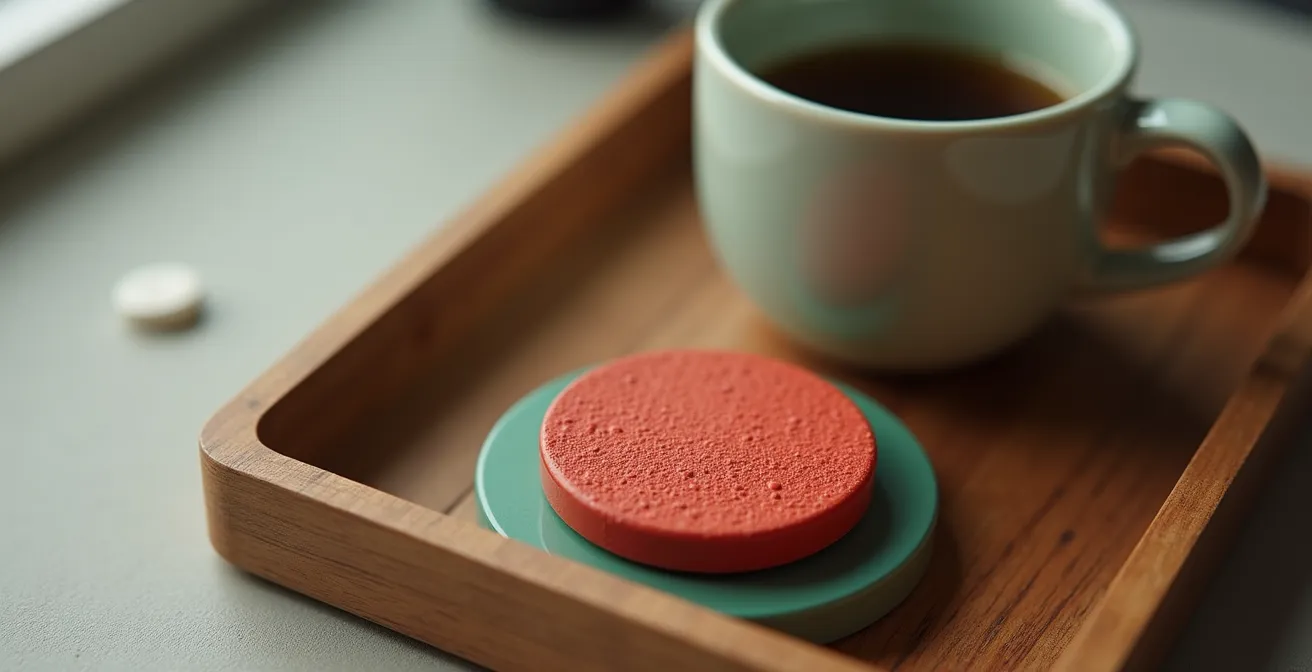
This approach leverages environmental design to offload the mental work. The coffee maker is the primary trigger, the station is the location, and the dynamic disc is the interactive confirmation. It’s a closed-loop system that requires minimal thought and creates zero clutter, turning a daily chore into a graceful, automatic sequence of actions.
Smartphone Apps or Simple Alarms: Which Is Less Intrusive?
In the quest for adherence, technology can be a double-edged sword. A blaring alarm certainly grabs your attention, but its high level of intrusiveness can create annoyance and “alarm fatigue,” leading you to dismiss it without taking action. Conversely, a silent app notification can be too passive and easily ignored. Choosing the right tool depends on your personality and the complexity of your regimen. The key is to minimize cognitive load—the mental effort required to manage the system.
As The Conversation Research Team notes in their analysis, “Always forgetting to take your medicines?”:
Reminder alarms only seem to be effective when they are interactive or personalised
– The Conversation Research Team, The Conversation – Always forgetting to take your medicines
This highlights the need for a system that engages you just enough without being disruptive. For some, a simple, non-negotiable alarm is perfect for a life-critical medication. For others, a gentler nudge integrated into their digital life is more sustainable. The following comparison helps to identify the best fit for different needs.
| Method Type | Intrusiveness Level | Best For | Key Features |
|---|---|---|---|
| Simple Phone Alarms | High | Critical medications | Immediate attention required, works offline |
| Calendar Notifications | Medium | Routine medications | Passive visual cue, syncs across devices |
| Smart Home Devices | Low | Digital fatigue users | Ambient light changes, gentle voice reminders |
| Medication Apps | Variable | Complex regimens | Tracking, refill reminders, adherence reports |
Ultimately, the best reminder is the one you don’t resent. A smart home device that gently changes the color of a light might be far more effective for someone sensitive to noise than a loud alarm. The goal is a gentle, reliable prompt that integrates into your life’s flow rather than interrupting it.
The “Did I Take It?” Panic and How to Solve It Instantly
Few things are more unsettling than the moment of doubt: staring at your pill bottle and having no memory of whether you’ve taken today’s dose. This mental blank is a common side effect of automatic habits. Because you perform the action without conscious thought, your brain doesn’t always create a distinct memory of it. This leads to the risk of either missing a dose or, more dangerously, taking a second one. The solution is to build a “confirmation ritual” into your habit—a simple, physical action that closes the loop and serves as undeniable proof.
This isn’t just about tracking; it’s about creating a system so clear and immediate that doubt has no room to enter. The power of such systems is well-documented; for instance, studies on barcode scanning in healthcare show that implementing verification processes reduced medication errors by up to 78%. While you may not have a barcode scanner, you can create an equally effective personal verification process. This transforms the act of taking a pill from a single step into a two-part sequence: take the pill, then confirm the action.
Your Action Plan: 5 Verification Systems to Eliminate Doubt
- Use a daily pill organizer: The simplest method. An empty compartment for the current day or time is an instant and unambiguous confirmation that the dose has been taken.
- Create a confirmation ritual: After swallowing your pill, immediately turn the bottle upside down. The bottle’s orientation becomes your visual proof. Alternatively, move a small object like a pebble from a “To Do” jar to a “Done” jar.
- Maintain a simple check-off chart: Keep a small calendar or printed chart next to your medications. Make a physical checkmark or cross out the day immediately after taking each dose.
- Employ a two-sided cue: Use a dedicated coaster or disc with a “To Take” side (e.g., red) and a “Taken” side (e.g., green). Flipping it provides a clear signal.
- Consider smart pill bottles or caps: For those comfortable with technology, devices that track when they are opened can send a confirmation to a smartphone app, providing a digital log.
By implementing one of these systems, you are outsourcing the task of remembering from your fallible brain to a reliable external system. The mental energy saved from worry and doubt is a significant benefit in itself.
How to Pack Medication for a Weekend Trip Without Breaking Routine?
Travel is a notorious habit-breaker. The carefully constructed cues of your home environment—the coffee maker, the bathroom cabinet, the morning light—are suddenly gone. This disruption is a primary reason for missed doses during trips. The key to maintaining adherence while away is not to rely on memory, but to create a portable and self-contained routine. This involves creating a dedicated “travel cue” and a system that accounts for potential disruptions.
Healthcare professionals advise a proactive approach. Before you even pack your clothes, prepare your medication system. Instead of throwing bottles into a bag, use a portable pill organizer that mirrors your at-home daily structure (e.g., AM/PM compartments). This maintains the familiar pattern. A crucial tip is to always pack at least one extra day’s medication as a buffer against unexpected travel delays. This simple step prevents the stress of rationing or running out. For any travel involving time zone changes of more than three hours, it’s wise to consult your pharmacist beforehand. They can help create a gradual adjustment plan to keep your doses on a consistent 24-hour cycle.

Your new travel cue could be your toiletry bag. Make it a rule: every time you open your toiletry bag in the morning or evening, you check your pill organizer. This links your medication to another solid travel habit. By preparing a self-sufficient system before you leave, you carry your routine with you, ensuring your health is managed seamlessly, no matter where you are.
The “I Feel Better” Mistake That Leads to Rebound Hypertension
One of the most dangerous behavioral traps in managing chronic conditions is stopping medication simply because you feel better. This is particularly prevalent with “silent” diseases like hypertension. When medication successfully lowers your blood pressure to a healthy range, it’s easy to mistakenly believe the problem is “cured” and the pills are no longer necessary. This is a fundamental misunderstanding of how these treatments work. The medication is not a cure; it is a management tool. It is the reason you feel well.
Stopping blood pressure medication abruptly can lead to rebound hypertension, where your blood pressure can surge to levels even higher than before you started treatment, significantly increasing your risk of a stroke or heart attack. The feeling of wellness is a sign the medication is effective, not a signal that it’s redundant. As Kelly A. Thompson-Brazill of Georgetown University’s School of Nursing bluntly states:
Medications do not work in patients who do not take them.
– Kelly A. Thompson-Brazill, Georgetown University School of Nursing
This simple truth underscores the importance of consistency. The protective benefits of these medications are entirely dependent on their continued use. Studies consistently show the direct link between adherence and outcomes; for example, when heart failure patients adhered to medication, studies found a 65% reduction in hospital readmissions. While this data is for heart failure, the principle is the same for hypertension: adherence is what produces the positive health outcome. Viewing your medication as a daily commitment to your long-term vitality, rather than a temporary fix, is essential for sustained health.
Why “Double Dosing” Happens and How to Stop It?
Accidentally taking a medication twice is often caused by the exact same mental slip that leads to forgetting it: a moment of distraction or an automatic routine performed on autopilot. The risk is significantly amplified by polypharmacy—the use of multiple medications. When managing several pills, each with its own schedule, the cognitive load increases dramatically. It becomes easy to lose track of which pill was taken when. According to the Lown Institute, this is a widespread issue, as nearly 40% of older adults in the U.S. are affected by polypharmacy.
The key to preventing double dosing is to implement a “closed-loop” system where the act of taking a pill is inextricably linked to a confirmation action. This system must be simple, immediate, and unambiguous. The goal is to create a process where it is physically impossible to be unsure if a dose was administered. This is not about trying harder to remember, but about designing a smarter, fail-safe process.
Effective strategies directly address the moment of uncertainty. Using a pill organizer with separate AM/PM compartments is a first line of defense, as it isolates doses. Another powerful technique is “habit stacking,” where you link your medication to an unbreakable daily habit. For instance, the rule becomes: “After I put my toothbrush back in its holder, I will immediately take my morning pill.” This creates a specific, unmissable trigger. The final piece is immediate documentation. Whether using a simple paper chart or a medication app, logging the dose the second you take it closes the loop and eliminates any future doubt.
Key takeaways
- Habit Over Memory: The most reliable way to ensure adherence is to anchor medication intake to a deeply ingrained daily habit, making it an automatic action rather than a conscious decision.
- Dynamic Cues Beat Static Clutter: A visual reminder you interact with (like flipping a disc) is far more effective than a pill bottle that sits on the counter, as it prevents “cue blindness.”
- Close the Loop with Confirmation: Instantly eliminate the anxiety of “Did I take it?” by implementing a simple, physical confirmation ritual, such as turning the pill bottle upside down after each dose.
How to Empower Caregivers to Manage Medication Without Errors?
When a caregiver is involved, medication management can sometimes devolve into a stressful cycle of reminders and questions, which can feel like nagging to the senior. This dynamic can create resistance and undermine a person’s sense of autonomy. A more effective and empowering approach is to shift from a model of supervision to one of partnership. This involves creating a “Shared Source of Truth”—a central, visible system that both the senior and caregiver can see and update together.
This shared system can be as simple as a whiteboard on the kitchen fridge or a shared digital calendar. The tool itself is less important than the collaborative process it enables. Instead of the caregiver asking, “Did you take your pills?”, the process becomes, “Let’s check off our medication list together.” This simple change in language from “you/your” to “we/our” reframes the task as a team effort. This approach not only reduces the caregiver’s burden but also empowers the senior by keeping them actively involved in their own health management.
A “Medication Master Document”—a single paper or digital file with all drug names, dosages, purposes, and schedules—is another key element of this partnership. It ensures both parties are working from the same information. This collaborative approach fosters communication and accountability without sacrificing dignity, as shown in the comparison below.
The Partnership Approach: A Shift in Communication
Healthcare teams found success using a ‘Shared Source of Truth’ approach – either digital (shared Google Calendar) or physical (kitchen whiteboard) that both patient and caregiver can access. This reduces caregiver burden and creates team dynamics. Key elements include: using ‘we/our’ language instead of ‘you/your’, creating a Medication Master Document with all drug details, and establishing regular medication review sessions where both parties participate equally.
| Traditional Approach | Partnership Approach | Impact on Adherence |
|---|---|---|
| ‘Did you take your pills?’ | ‘Let’s check off our medication list together’ | Reduces resistance, increases cooperation |
| Caregiver manages alone | Shared medication calendar | Empowers patient, reduces caregiver stress |
| Verbal reminders only | Visual systems both can access | Creates accountability without nagging |
| Crisis-driven discussions | Regular review sessions | Prevents errors, maintains routine |
By building a system of shared responsibility, medication management transforms from a potential point of conflict into an opportunity for connection and mutual support.
By thoughtfully designing your environment and routines, you can transform medication adherence from a daily struggle into an effortless habit. The key is to work with your own psychology, building a system that provides clear cues and rewarding confirmation, empowering both yourself and those who support you to manage your health with confidence and ease.