
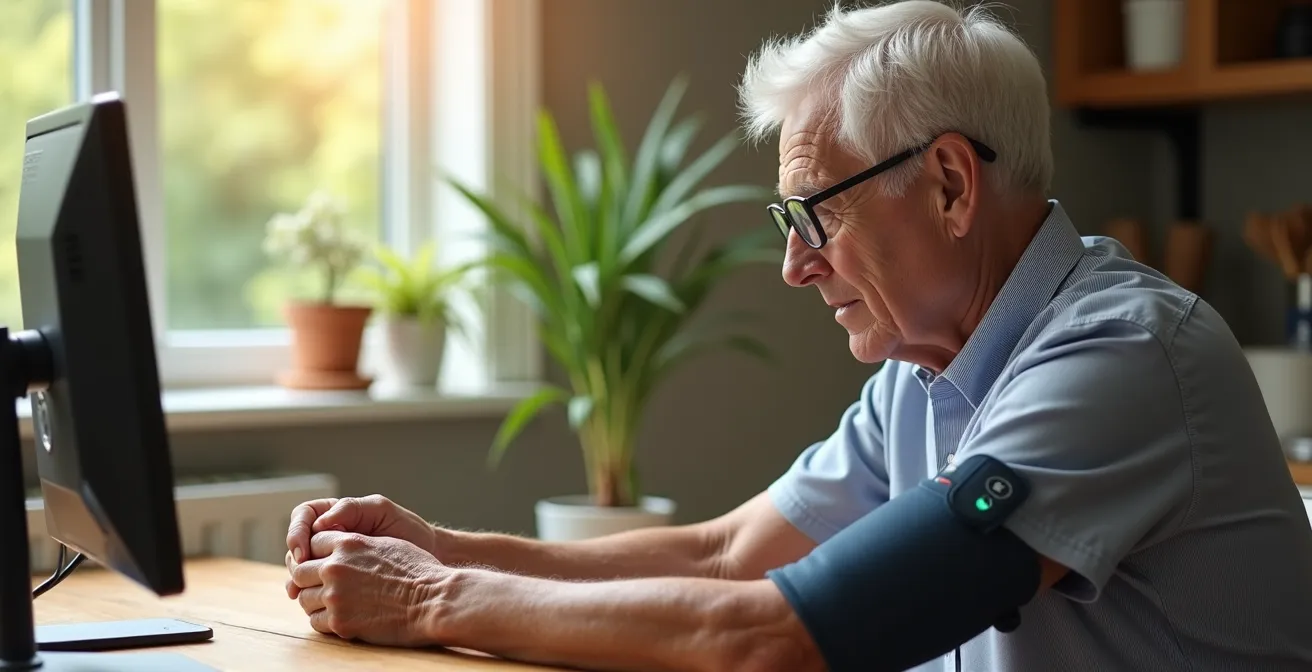
Achieving clinically accurate home blood pressure readings depends more on controlling hidden variables than just following basic steps.
- The choice between an upper arm and wrist monitor has significant accuracy implications for seniors.
- Physiological factors like anxiety, breathing patterns, and time of day can create false readings if not properly managed.
Recommendation: Adopt a structured protocol for measurement, logging, and medication management to create a data trend that is truly valuable for clinical decisions.
For seniors managing heart or lung conditions, monitoring blood pressure at home is not just a routine—it’s a critical tool for preventing hospitalization. You have likely been told the basics: rest beforehand, use the correct cuff size, and sit quietly. You may even keep a diligent log of your readings. Yet, the data you collect can sometimes feel confusing, with numbers that swing wildly from one measurement to the next, leaving you and your doctor questioning their reliability.
The common advice focuses on the mechanics of taking a reading, but it often overlooks the subtle, yet powerful, variables that can distort the results. These “hidden variables” include natural daily fluctuations, the anxiety of seeing a high number, and even how you breathe during simple exertion. The problem is not a lack of effort on your part, but a lack of strategy for ensuring the numbers you record reflect your true physiological baseline, not just momentary noise.
This guide moves beyond the standard instructions. Our focus is on achieving clinical validity. We will deconstruct the process to help you control these hidden variables. Instead of just taking a reading, you will learn how to produce a stable, trustworthy data trend that empowers you and your physician to make proactive, informed decisions about your health. We will explore everything from equipment selection and anxiety management to creating a vitals log that tells a clear story.
For those who prefer a visual summary, the following video demonstrates the fundamental techniques for measuring blood pressure at home, providing a great foundation for the detailed clinical strategies we will discuss.
This article provides a structured approach to mastering home vital sign monitoring. Each section is designed to address a common point of failure, providing the clinical reasoning and precise steps needed to ensure your data is accurate and actionable.
Summary: How to Measure Blood Pressure at Home for Clinical Accuracy?
- Why Your Blood Pressure Fluctuates Between Morning and Evening?
- How to Use a Pulse Oximeter Correctly on Cold Fingers?
- Upper Arm or Wrist Monitor: Which Gives Reliable Data for Seniors?
- The Anxiety Loop: Why Retesting BP Immediately Gives False Highs
- How to Keep a Vitals Log That Doctors Actually Want to Read?
- Why High Blood Pressure Is Called the “Silent Killer” for Seniors?
- The Breathing Error That Spikes Blood Pressure During Exercise
- How to Organize a 5-Drug Regimen Without Mixing Up Dosages?
Why Your Blood Pressure Fluctuates Between Morning and Evening?
One of the most common sources of confusion in home monitoring is the natural fluctuation of blood pressure throughout the day. A reading taken in the morning can be significantly different from one taken in the evening, but this variation is not necessarily a sign of a problem. In fact, it’s an expected physiological pattern known as a diurnal rhythm. Typically, blood pressure is lowest during sleep, begins to rise just before waking, continues to increase throughout the day, and then starts to fall again in the late afternoon and evening.
This pattern is driven by your body’s internal clock and hormonal cycles, like cortisol, which peaks in the morning to prepare you for the day’s activities. Research published in the journal *Hypertension* shows that for most healthy individuals, there is a normal 10-20% drop in blood pressure during sleep, a phenomenon called “nocturnal dipping.” The absence of this dip can be a clinical indicator of increased cardiovascular risk.
For clinical accuracy, the key is consistency. To establish a reliable baseline, you should measure your blood pressure at the same times each day, ideally once in the morning before medication and once in the evening. This creates a trend log that accounts for diurnal rhythm, allowing your doctor to distinguish between normal fluctuations and a genuine change in your underlying health status. A single, isolated high reading is just noise; a consistent upward trend in your morning readings is a clear signal that requires attention.
How to Use a Pulse Oximeter Correctly on Cold Fingers?
For individuals with co-existing heart and lung conditions, a pulse oximeter is as vital as a blood pressure monitor. However, getting an accurate oxygen saturation (SpO2) reading can be challenging, especially for seniors who often experience poor circulation or cold extremities. A low or fluctuating reading is frequently caused by a simple issue: insufficient blood flow to the fingertip.
The device works by shining light through your finger to measure the oxygen level in your blood. If your fingers are cold, the blood vessels constrict, reducing perfusion and making it difficult for the oximeter to get a strong signal. This can result in a falsely low SpO2 reading, causing unnecessary alarm. Before measuring, you must ensure your hand is warm. Gently rub your hands together or run them under warm water for a minute. The finger should be clean and free of any nail polish or artificial nails, which can block the light sensor.
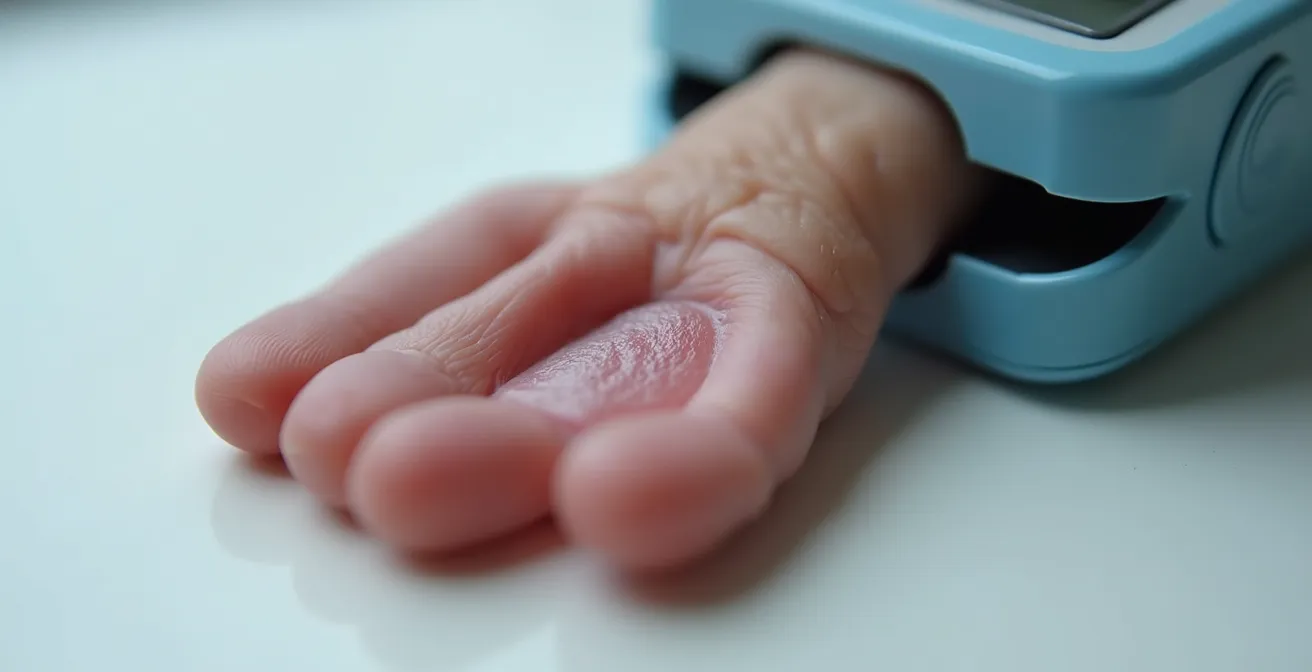
Proper placement is equally critical. The finger should be inserted fully into the device so that the fingertip is resting against the internal stop, but without being forced. It should feel snug, not tight. The most common error is shallow insertion, where the sensor isn’t aligned with the most perfused part of the finger pad. The image below illustrates the correct depth and positioning.
Once the device is on, remain still and rest your hand on a flat surface at chest level. It can take 30 to 60 seconds for the reading to stabilize. Avoid the temptation to accept the first number that appears on the screen. Wait until the waveform or pulse bar on the display is steady and the numeric reading has been consistent for at least five seconds. This patience ensures you are recording a true signal, not transient noise.
Upper Arm or Wrist Monitor: Which Gives Reliable Data for Seniors?
The choice of a blood pressure monitor is not a matter of convenience; it is a clinical decision with direct implications for accuracy. While wrist monitors are often easier to use, especially for those with arthritis or limited mobility, the gold standard for clinical reliability remains the upper arm cuff monitor. The brachial artery in the upper arm is larger and less affected by body position, yielding more consistent and accurate measurements.
Wrist arteries are smaller and more superficial. Readings from wrist monitors are highly sensitive to the position of the arm; if your wrist is not held at the exact level of your heart, the reading can be falsely high or low due to gravity’s effect on blood flow. Furthermore, conditions common in seniors, such as arterial stiffness or peripheral artery disease, can make wrist readings less reliable. As Dr. Beverly Green, a senior investigator at Kaiser Permanente Washington Health Research Institute, notes:
Wrist monitors are appropriate alternatives when upper arm monitors don’t fit well or cause pain, but they’re less reliable for people with peripheral artery disease or diabetes-related circulation issues.
– Dr. Beverly Green, Kaiser Permanente Washington Health Research Institute
For seniors, particularly those with atrial fibrillation (AFib) or circulatory issues, an upper arm monitor validated for these conditions is the most responsible choice. The following table, based on guidance from leading health organizations, summarizes the key differences.
This comparison, informed by data from institutions like the American Heart Association, highlights the trade-offs. The data in this table is derived from a consensus of clinical guidelines, such as those discussed in research on home blood pressure monitoring.
| Feature | Upper Arm Monitor | Wrist Monitor |
|---|---|---|
| Accuracy in Seniors | Gold standard – most reliable | 5-10 mmHg variation possible |
| Ease of Use for Arthritis | More difficult to position | Easier to apply and position |
| Position Sensitivity | Less sensitive to arm position | Must be at exact heart level |
| Recommended for AFib | Yes – validated models available | No – unreliable readings |
| Arterial Stiffness Impact | Minimal impact on accuracy | Can cause falsely high readings |
The Anxiety Loop: Why Retesting BP Immediately Gives False Highs
It’s a familiar scenario: you take your blood pressure, the reading is higher than expected, and a wave of anxiety hits. Your immediate instinct is to retest, hoping for a better number. However, this action often triggers an “anxiety loop,” where the stress of the first high reading causes a physiological response that makes the second reading even higher. This is a home-based version of “white coat hypertension.” The anxiety itself releases stress hormones like adrenaline, which constrict blood vessels and increase heart rate, artificially inflating your blood pressure.
Retesting immediately is clinically counterproductive because it introduces stress-induced noise into your data. The American Heart Association recommends waiting at least one minute between measurements because even back-to-back readings can show variations of 5-10 mmHg. When anxiety is involved, this gap can be even larger. The key is to break the psychological and physiological cycle before re-measuring.
If you get an unexpectedly high reading, do not retest right away. Instead, implement a “circuit breaker” protocol to allow your body and mind to return to a true resting state. This involves physically removing yourself from the measurement environment and using simple relaxation techniques to calm your nervous system. Only after a minimum of five minutes should you attempt to take another reading. This deliberate pause helps ensure that your next measurement reflects your genuine baseline, not a fleeting spike of anxiety.
Your 5-Step Anxiety Reset Protocol
- Stand up and walk to another room to physically break the measurement space association.
- Drink a small glass of room temperature water to activate the vagus nerve, which helps regulate heart rate.
- Practice box breathing for 2 minutes: inhale for 4 seconds, hold for 4, exhale for 4, and hold for 4.
- Perform gentle shoulder rolls or arm stretches to release physical tension built up from the stress response.
- Return to the measurement area only after completing all steps, ensuring at least 5 minutes have passed since the high reading.
How to Keep a Vitals Log That Doctors Actually Want to Read?
A blood pressure log is only as valuable as the insights it provides. A simple list of numbers is data, but it isn’t information. To be clinically useful, your log must tell a story, providing context that helps your doctor identify patterns, assess treatment effectiveness, and make informed decisions. An “actionable log” goes beyond just the systolic and diastolic numbers; it includes contextual variables that explain the “why” behind the readings.
To create a log your doctor will find invaluable, you must record more than just the numbers. For each entry, include:
- Date and Time: To track diurnal patterns.
- Systolic/Diastolic BP and Pulse: The core data.
- Which Arm Was Used: To maintain consistency.
- Contextual Notes: This is the most critical part. Note if the reading was taken before or after medication, your activity level in the 30 minutes prior (e.g., “resting,” “after walking”), and any symptoms you were feeling (e.g., “dizzy,” “headache,” “felt fine”).
This additional context transforms your log from a raw data sheet into a powerful diagnostic tool.

Instead of presenting your doctor with pages of individual readings, take the extra step of calculating and highlighting weekly averages for your morning and evening measurements. This simple act of data synthesis makes patterns immediately visible. The Million Hearts® initiative provides a clear framework for this process, turning logging into an effective clinical tool.
Case Study: Effective Logging via the Million Hearts® Protocol
The Million Hearts® initiative recommends a structured approach for self-measured blood pressure monitoring (SMBP). Patients are advised to record blood pressure twice in the morning and twice in the evening for one week leading up to a clinical appointment. The most successful patient logs are those that not only include the readings but also contextual information such as the timing of medication, recent activity levels, and any concurrent symptoms. Critically, patients who provide weekly averages in addition to their daily readings help physicians identify underlying trends far more efficiently than those who present a simple list of numbers.
Why High Blood Pressure Is Called the “Silent Killer” for Seniors?
High blood pressure, or hypertension, earns its ominous nickname “the silent killer” because it typically has no obvious symptoms in its early and even advanced stages. Unlike many other conditions that trigger pain, discomfort, or visible changes, hypertension can quietly damage the body for years before it is detected. For seniors, this silence is particularly dangerous, as the cumulative effects of aging already place increased strain on the cardiovascular system.
The danger lies in the unseen damage. Persistently high pressure forces the heart to work harder, causing the heart muscle to thicken and weaken over time. It also damages the delicate inner lining of arteries, leading to atherosclerosis (hardening of the arteries). This damage isn’t isolated; it affects the entire body. It can lead to a host of catastrophic events, often without any prior warning signs:
- Heart Attack: Damaged arteries in the heart become blocked.
- Stroke: Arteries leading to or within the brain rupture or become blocked.
- Kidney Failure: Arteries in the kidneys become narrowed and damaged, impairing their ability to filter waste.
- Vision Loss: Blood vessels in the eye are damaged.
- Cognitive Decline: Reduced blood flow to the brain can contribute to vascular dementia.
The scale of the problem is immense. According to 2024 research in Circulation Research, hypertension affects nearly 1 in 2 adults globally. Because symptoms are absent, many people are unaware they have the condition until a major health event occurs. This is why regular, accurate home monitoring is not just a good practice for seniors; it is a fundamental pillar of preventative health, turning a silent threat into a manageable condition.
The Breathing Error That Spikes Blood Pressure During Exercise
While this guide focuses on measuring blood pressure at rest, understanding how exertion affects your body is critical for interpreting your overall cardiovascular health. A common and significant error that artificially spikes blood pressure is improper breathing during physical effort. This is often the act of holding your breath during a moment of strain, a physiological response known as the Valsalva maneuver.
When you hold your breath and bear down—whether lifting a heavy object, pushing open a heavy door, or even straining on the toilet—you dramatically increase the pressure inside your chest cavity. This action momentarily compresses the major blood vessels, causing a rapid and sharp increase in blood pressure when you finally exhale and blood flow is restored. For a person with existing hypertension, this sudden spike can be dangerous, potentially triggering a cardiovascular event.
The key to preventing this is to consciously practice the “exhale on effort” technique. This means you should always be exhaling during the most strenuous part of any movement. For example, when standing up from a chair, you should inhale while seated and then exhale steadily as you push yourself up. This simple habit prevents the dangerous pressure build-up of the Valsalva maneuver. It’s crucial to wait at least 30 minutes after any moderate exertion before taking a blood pressure measurement to allow your body to return to its true resting baseline.
Key takeaways
- Clinical accuracy in home monitoring is achieved by controlling variables like anxiety, equipment choice, and time of day, not just following basic steps.
- An upper arm blood pressure monitor is the gold standard for seniors due to its reliability, especially for those with AFib or circulatory issues.
- An “actionable log” that includes contextual notes (medication timing, symptoms, activity) and weekly averages is far more valuable to a doctor than a simple list of numbers.
How to Organize a 5-Drug Regimen Without Mixing Up Dosages?
For many seniors, managing hypertension is part of a larger health strategy that involves multiple medications for various conditions. A complex regimen of five or more drugs (polypharmacy) significantly increases the risk of errors, such as missing a dose, taking the wrong medication, or dangerous drug interactions. Achieving clinical accuracy in your health monitoring must extend to meticulous medication management. An incorrect or missed dose can directly impact your blood pressure readings, rendering your log inaccurate.
The first step toward organization is a comprehensive review. A clinical pharmacist strongly recommends an annual “Brown Bag Review.”
A clinical pharmacist recommends the ‘Brown Bag Review’ – bringing all medications, supplements, and over-the-counter drugs in a single bag to your pharmacist annually. This comprehensive review helps identify dangerous interactions, redundancies, and opportunities to simplify complex regimens, particularly important for seniors managing multiple conditions.
– Pharmacist Recommendation, familydoctor.org
Once your regimen is confirmed to be safe and necessary, the next step is implementing a physical organization system. The right system depends on the complexity of your schedule. A simple weekly pillbox may be sufficient for once-daily medications, but a multi-dose organizer or an automated dispenser with alarms is essential for more complex schedules involving different medications at different times of the day.
The following table outlines systems appropriate for varying levels of medication complexity, helping you select the tool that best fits your needs. This information reflects a consensus of best practices from leading health institutions on medication adherence, available from sources like Mass General Brigham.
| Complexity Level | Recommended System | Best For |
|---|---|---|
| Basic (1-2 meds daily) | Weekly 7-day pillbox | Simple once-daily medications |
| Moderate (3-4 meds, varying times) | Multi-dose organizer (AM/PM/EVE/BED) | Different medications at different times |
| Complex (5+ meds) | Automated dispenser with alarms | Memory concerns or complex schedules |
| Digital Support | Apps like Medisafe or EveryDose | Tech-savvy seniors wanting reminders |
Begin applying these precise measurement and management techniques today. By controlling these variables, you transform your home monitoring from a simple task into a powerful strategy for safeguarding your health, creating a record that you and your doctor can rely on to make the best decisions together.
Frequently Asked Questions on How to Measure Blood Pressure at Home for Clinical Accuracy?
Why does holding my breath during exercise increase blood pressure?
The Valsalva maneuver (breath-holding during exertion) causes a sharp increase in intrathoracic pressure, followed by a dramatic blood pressure spike when you finally exhale. This is why it is critical to exhale during the effort phase of any activity.
Should I avoid measuring blood pressure right after exercise?
Yes, wait at least 30 minutes after any moderate or strenuous exercise before measuring. Physical activity temporarily elevates blood pressure, and measuring too soon will not reflect your true resting baseline.
Is straining during bowel movements dangerous for hypertensive seniors?
Yes, straining creates the same Valsalva effect as improper exercise breathing. For individuals with existing severe hypertension, this sudden pressure spike can be dangerous and could potentially trigger a cardiovascular event. It’s important to manage constipation with diet, hydration, and medical advice to avoid this risk.