

In summary:
- Using a walking aid correctly is a biomechanical skill that can significantly reduce joint load and pain.
- A single cane, held in the hand opposite the painful hip, is the most effective way to reduce compressive forces.
- Applying vertical force through the aid, while maintaining an upright posture and engaging core muscles, prevents secondary back pain.
- Not all supports are equal; bathroom fixtures like towel racks are not designed to handle the dynamic forces of a fall.
- Proper handle selection is crucial for users with arthritic hands to ensure effective load transfer and comfort.
The persistent, grinding pain of severe hip osteoarthritis (OA) transforms simple movements into daunting challenges. For many seniors aiming to delay surgery, a walking aid seems like a straightforward solution. However, simply acquiring a cane or walker is only the first step. The world is awash with well-meaning but often incomplete advice, leading many to use these aids incorrectly. This not only fails to provide adequate relief but can introduce new problems, such as shoulder strain or debilitating back pain on the opposite side of the body. The global burden of this condition is immense, with 46.6 million new OA cases in 2021 alone, highlighting the urgent need for effective, non-surgical management strategies.
But what if the key wasn’t just *using* an aid, but understanding it as a precision biomechanical tool? The true power to preserve your hip joint lies not in leaning on a piece of metal, but in mastering the physics of load distribution. It requires shifting your perspective from passive support to active engagement, transforming the way your body interacts with the ground. By understanding the forces at play within your kinetic chain—the interconnected system of muscles and joints from your feet to your spine—you can turn a simple cane into a powerful instrument for joint protection.
This guide will deconstruct the biomechanical principles of using walking aids. We will move beyond the “what” and delve into the “why,” explaining how to correctly offload your painful hip, maintain spinal health, and make your support system work for you, not against you.
Summary: A Biomechanical Guide to Using Walking Aids for Hip Pain
- Why Reducing Load by 10% Can Save Your Knee Cartilage?
- How to Use Walking Sticks to Stand Up Straighter?
- Single Point Offloading or Bilateral Support: What Is Best for Hip Pain?
- The “Leaning” Mistake That Causes Back Pain on the Opposite Side
- How to Engage Abs While Walking With Support?
- Why a Towel Rack Cannot Support Your Body Weight During a Fall?
- Why Sitting for More Than 4 Hours Worsens Arthritis Symptoms?
- How to Select the Right Cane Handle for Arthritic Hands?
Why Reducing Load by 10% Can Save Your Knee Cartilage?
To understand the profound impact of a walking aid, we must first appreciate the nature of articular cartilage. This smooth, resilient tissue covers the ends of bones in a joint, providing a low-friction surface for movement. In osteoarthritis, this cartilage progressively breaks down. The forces passing through the hip and knee joints during walking are substantial, often multiples of your body weight. Every step sends a shockwave of force, or a “load vector,” through the joint, compressing the already vulnerable cartilage.
It may seem insignificant, but even a small reduction in this peak force can have a dramatic, cumulative effect on joint preservation. The goal is not to eliminate force entirely—which is impossible—but to reduce it below the threshold that causes further damage and inflammation. This is where a walking aid demonstrates its clinical value. It acts as an external conduit, redirecting a portion of your body weight away from your leg and through the aid into the ground.
Research provides compelling evidence for this effect. According to clinical evidence reviews, the proper use of walking aids can lead to a 10-40% reduction in knee joint forces. While this figure pertains to the knee, the principle of offloading is identical for the hip. A 10% reduction may sound modest, but when multiplied by thousands of steps taken each day, it represents a massive decrease in the total cumulative stress on your cartilage. This reduction can slow the progression of arthritis, decrease pain, and ultimately improve your quality of life, buying valuable time before surgical intervention becomes necessary.
How to Use Walking Sticks to Stand Up Straighter?
Chronic hip pain often triggers a subconscious postural adaptation: a tendency to slouch or lean away from the painful side. This creates an imbalance in the kinetic chain, shortening muscles on one side and overstretching them on the other, which can lead to further musculoskeletal issues. Using walking sticks, particularly bilateral (one in each hand), provides a powerful tool to counteract this and retrain your body to maintain an upright posture.
The mechanism is based on creating a wider and more stable base of support. With only your feet on the ground, your base is relatively narrow. Adding two walking sticks significantly expands this base, providing greater stability and reducing the body’s fear of falling. This increased sense of security allows you to consciously focus on your posture without the overriding need to protect the painful hip. The sticks provide tactile feedback, encouraging you to keep your torso erect, shoulders back and down, and head aligned over your spine.
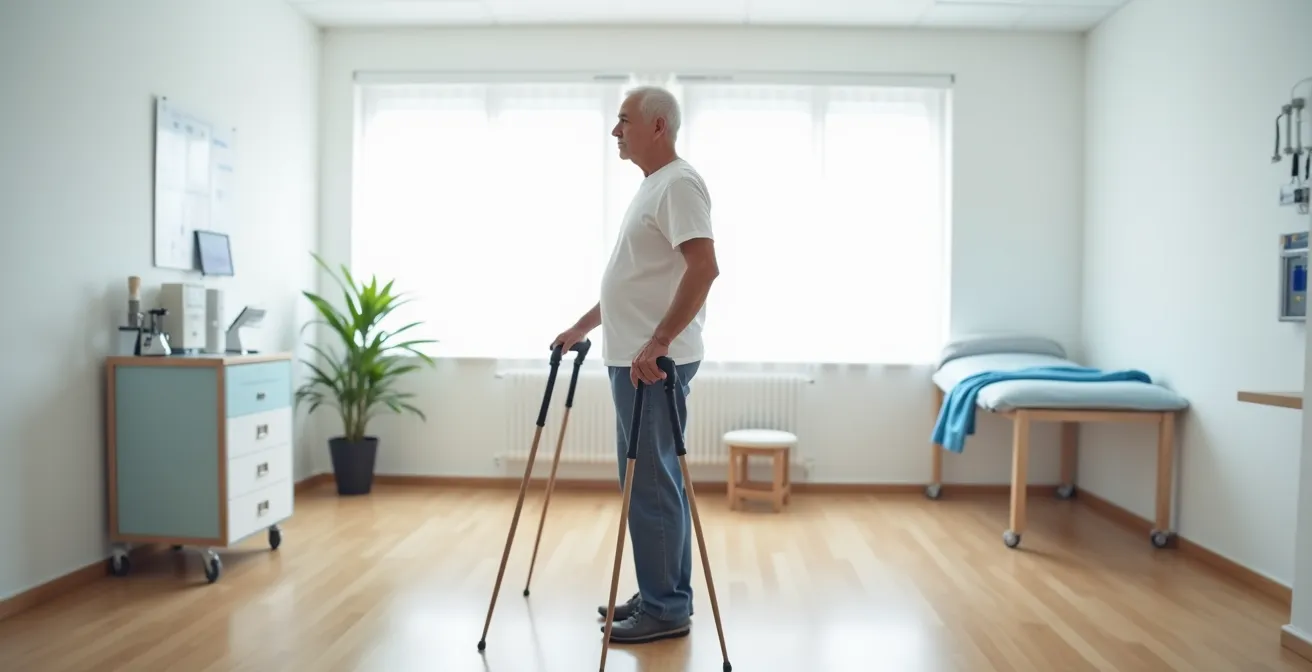
As the illustration demonstrates, the correct technique involves using the sticks to propel yourself forward while maintaining a straight spine. The goal is to use your arms and shoulders to assist in propulsion and support, allowing your core and back muscles to hold your torso in its natural, upright alignment. This not only looks more confident but is biomechanically more efficient, reducing strain on your lower back and improving breathing mechanics. Regularly practicing this upright walking pattern helps reprogram your neuromuscular system, making good posture your default setting once again.
Single Point Offloading or Bilateral Support: What Is Best for Hip Pain?
The choice between a single cane (unilateral support) and two canes or a walker (bilateral support) depends on the specific biomechanical goal and the user’s condition. For most individuals with unilateral (one-sided) hip osteoarthritis, single point offloading is the gold standard for reducing joint-specific pain and compressive forces.
The science behind this is fascinating and somewhat counter-intuitive. During walking, as you bear weight on your painful hip, the abductor muscles on that same side must contract powerfully to keep your pelvis level. This muscular contraction is the single largest contributor to the compressive force on the hip joint. A cane held in the opposite hand (contralateral support) creates a turning force, or torque, around the painful hip that assists the abductor muscles. Because the cane is helping, the muscles don’t have to work as hard, and the resulting compressive force on the hip joint is significantly reduced.
Bilateral support, using two canes or a walker, is indicated when the primary issue is severe balance impairment, significant weakness in both legs, or bilateral hip/knee pain. While bilateral support provides maximum stability by creating the widest possible base, it may not offload a single painful hip as efficiently as a correctly used contralateral cane. Walkers, in particular, can encourage a forward-leaning posture if not adjusted and used correctly, potentially trading hip pain for back strain. Therefore, for isolated, severe hip OA, mastering the contralateral cane technique is often the most targeted and effective approach.
The “Leaning” Mistake That Causes Back Pain on the Opposite Side
One of the most common and detrimental errors when using a single cane is leaning the torso over the cane. This is a natural but incorrect compensatory pattern. Users often feel that by shifting their weight onto the cane, they are taking pressure off their hip. In reality, they are creating a new, and often more problematic, set of biomechanical issues, particularly leading to back pain on the side *opposite* the cane.
When you lean sideways, you are causing a lateral flexion of your spine. To prevent you from completely toppling over, the muscles on the convex side of this curve must work overtime. This primarily strains the quadratus lumborum (QL) muscle on the non-cane side, a deep back muscle that connects the pelvis to the spine and rib cage. This sustained, isometric contraction leads to muscle fatigue, trigger points, and a deep, aching pain in the lower back. The correct technique is not to lean your body onto the cane, but to apply a firm, vertical force downward through your arm and into the cane, keeping your shoulders level and your torso upright.
This principle is fundamental to safe and effective cane use. As orthopedic surgeon Dr. Atul Kamath emphasizes when explaining the basics of mobility aids:
If your Right knee or hip is weak or painful, hold the cane in your Left hand. This positioning helps you to balance more effectively while distributing your weight.
– Dr. Atul Kamath, Mastering Mobility Aids: Tips for Using Canes and Walkers
This contralateral placement is the first step. The second is to avoid the lean and apply force correctly. Mastering this prevents the trading of one type of pain for another.
Your Action Plan: Auditing Your Cane Leaning Technique
- Contact Points Check: Confirm you are holding the cane in the hand opposite your painful hip. Ensure the cane tip is placed slightly to the side and forward, in sync with your painful leg’s movement.
- Posture Collection: Stand in front of a full-length mirror while holding your cane. Observe your natural stance. Are your shoulders level? Is your spine straight, or is it curving to one side? Note any visible lean.
- Coherence Analysis: Compare your observed posture to the ideal. The goal is a straight line from your head to your feet, with level shoulders. Your arm should apply vertical force, not your torso leaning over the cane. Is your current technique coherent with protecting your spine?
- Kinesthetic Feedback: Walk a short distance and focus on the *feeling*. Can you feel the pressure going straight down through your arm? Or do you feel your side muscles (obliques and QL) straining as you lean? The goal is to feel stable and upright, not crooked.
- Integration Plan: Dedicate five-minute practice sessions daily. Focus on just one element, such as “pushing straight down” or “keeping shoulders level.” This builds the correct motor pattern until it becomes automatic.
How to Engage Abs While Walking With Support?
A common concern with long-term use of walking aids is the potential for deconditioning, particularly of the core muscles that stabilize the spine and pelvis. However, this is not an inevitable outcome. By adopting an active approach, you can use the act of walking with a cane as an opportunity to strengthen your core, further protecting your back and improving your overall gait mechanics.
Engaging your abs while walking involves a conscious activation of the deep core musculature, primarily the transverse abdominis. This muscle acts like a natural corset, wrapping around your midsection. To activate it, imagine gently drawing your navel in towards your spine without holding your breath. This simple maneuver should create a feeling of tension and stability around your lower back and pelvis. It’s not about “sucking in” your stomach forcefully, but about maintaining a low-level, constant engagement.
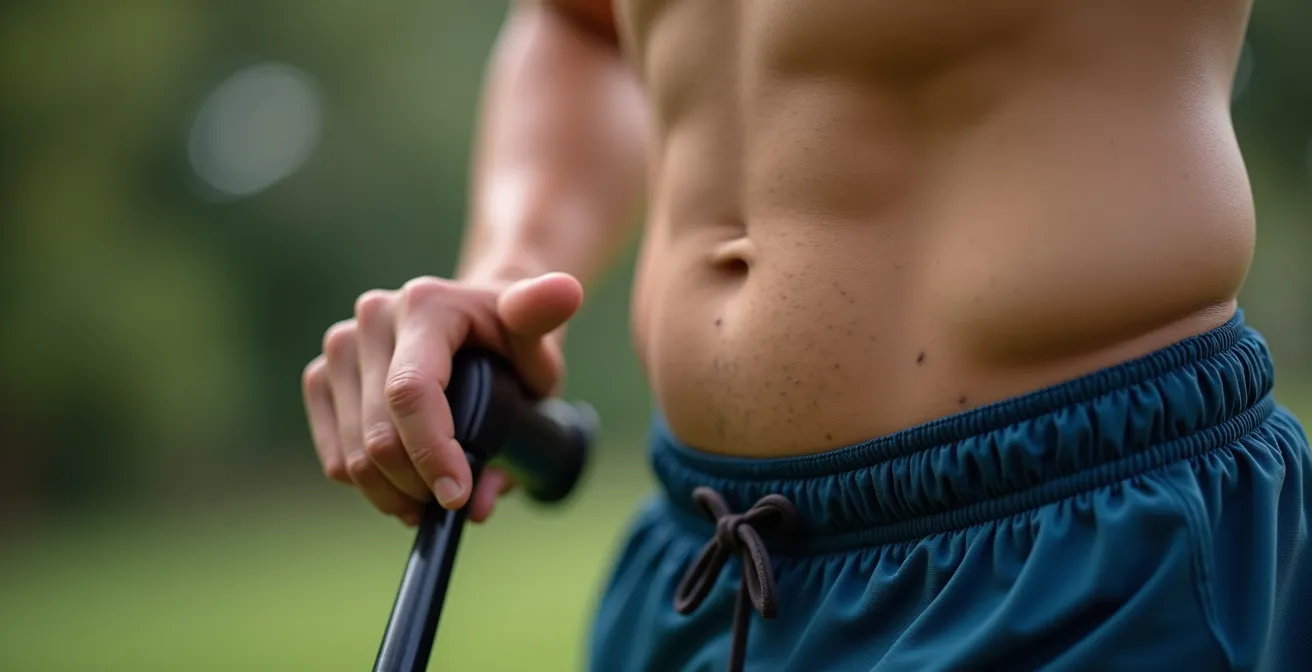
When you walk with this core engagement, you create a stable “cylinder” from which your limbs can move more efficiently. It prevents the pelvis from tilting excessively and reduces rotational stress on the lumbar spine. This active stabilization, combined with the support from your walking aid, creates an optimal environment for safe movement. This is a core tenet of physical therapy; indeed, studies show that combining proper technique with active strengthening is highly effective. For example, evidence suggests that strength training can enhance mobility by over 40% for post-surgery patients when combined with proper walking aid technique, underscoring the power of an active approach.
Why a Towel Rack Cannot Support Your Body Weight During a Fall?
While walking aids provide support during ambulation, maintaining a safe home environment is equally critical for fall prevention. A common and dangerous misconception is that fixed bathroom features like towel racks or toilet paper holders can serve as makeshift grab bars in an emergency. From a biomechanics and physics perspective, this is a recipe for disaster.
The critical difference lies in the concepts of static load versus dynamic force. A towel rack is designed to withstand a static load—the simple, constant, downward pull of a wet towel’s weight. Its mounting hardware, typically small screws into drywall or a stud, is sufficient for this purpose. However, a fall is a dynamic event. It generates immense forces that are far greater than a person’s body weight. In fact, biomechanical studies demonstrate that falls create forces equivalent to 3 to 5 times a person’s body weight.
Furthermore, the direction of force is different. A person falling or slipping will typically grab and pull outwards and downwards, subjecting the fixture to a combination of shear and tensile (pulling) forces. Towel rack anchors have virtually no resistance to this tensile force and will rip out of the wall with surprising ease. In contrast, certified grab bars are installed with large, angled bolts into reinforced blocking within the wall structure. They are specifically engineered to withstand these high dynamic loads from any direction, providing a secure anchor point when it is needed most. Relying on a towel rack for support creates a false sense of security that will fail at the critical moment.
Why Sitting for More Than 4 Hours Worsens Arthritis Symptoms?
Managing hip osteoarthritis extends beyond how you move; it also involves how you don’t move. Prolonged periods of sitting can be surprisingly detrimental, often leading to increased stiffness, pain, and a feeling of being “locked up” upon standing. This phenomenon is rooted in the unique physiology of our articular cartilage.
Unlike most tissues in the body, cartilage has no direct blood supply. It receives its nutrients and expels waste products through the synovial fluid that fills the joint capsule. This process is dependent on movement. As you move a joint through its range of motion, the cartilage is cyclically compressed and released, like a sponge. This “pumping” action circulates the synovial fluid, ensuring the cartilage cells are nourished and healthy. When you remain seated for extended periods, this vital circulation stagnates.
Without the regular loading and unloading from movement, the synovial fluid becomes less effective at nourishing the cartilage. Waste products can accumulate, contributing to a pro-inflammatory environment within the joint, which exacerbates OA symptoms. The result is a cycle of pain and immobility that can have a severe impact on daily life. The scale of this disability is staggering; recent Global Burden of Disease data reveals that osteoarthritis was responsible for 21.30 million Years Lived with Disability (YLDs) globally in 2021. Breaking up long bouts of sitting with short walks or simple standing exercises is a crucial strategy to keep synovial fluid circulating and mitigate these debilitating symptoms.
Key Takeaways
- The primary goal of a walking aid is to reduce the compressive force on the hip joint, which is mainly caused by the contraction of abductor muscles.
- Correct technique (contralateral use, upright posture, vertical force) is more important than the aid itself and prevents secondary injuries to the back and shoulders.
- Joint health depends on a balance of movement and rest; both prolonged sitting and improper movement patterns can accelerate cartilage degradation.
How to Select the Right Cane Handle for Arthritic Hands?
The effectiveness of a walking aid depends on the user’s ability to comfortably and firmly transmit force through it. For individuals also suffering from arthritis in their hands, the choice of a cane handle is not a minor detail—it is a critical factor for success. An improperly shaped or sized handle can cause pain, reduce grip strength, and ultimately lead to the user abandoning the aid altogether. The handle serves as the primary interface between the user and the support system, and it must be optimized for both comfort and function.
Different types of hand arthritis require different handle shapes to distribute pressure away from painful joints. For example, a wider “derby” or “palm rest” handle can be beneficial for those with thumb base (CMC) arthritis, as it allows weight to be borne through the palm rather than the thumb. For those with rheumatoid arthritis affecting the wrist, an “offset” handle, which centers the user’s weight directly over the shaft of the cane, helps maintain a neutral wrist position and reduces strain.
The material of the handle also plays a role in comfort. Hard plastics can be unforgiving, while handles made of gel-filled or visco-elastic foam can help dampen the vibrations that travel up the cane shaft from the ground with each step. Ultimately, selection is a personal process. For those with significant hand deformities or pain, a consultation with an occupational therapist is highly recommended, as they can create specially designed handles to accommodate specific needs and ensure adequate force can be placed through the aid without causing further hand pain.
To properly apply these principles, the next logical step is to consult a physical or occupational therapist for a personalized assessment of your gait, posture, and equipment needs.
Frequently Asked Questions about Using Aids for Hip Pain
What’s the difference between static load and dynamic force in bathroom fixtures?
Static load is the weight a fixture can hold when stationary (like hanging a towel), while dynamic force occurs during movement or falls, multiplying forces by 3-5 times body weight, exceeding towel rack capacity.
Why do towel racks fail during falls when they feel sturdy to touch?
Towel racks use small screws designed for downward shear force, not the outward tensile force of a fall. Their solid feel creates a dangerous false sense of security.
What makes grab bars different from towel racks structurally?
Grab bars use large, properly angled bolts designed to resist both shear and tensile forces, with mounting systems specifically engineered for human body weight support during falls.