
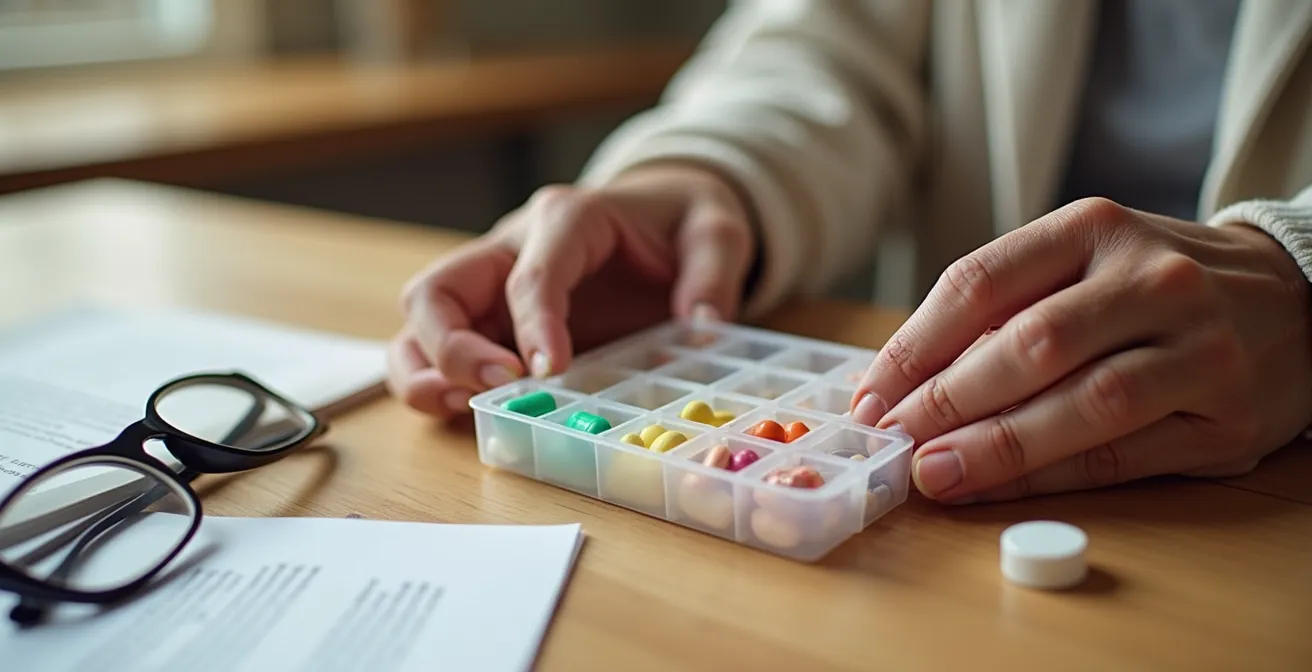
The fear of medication error with a complex regimen is valid, but it can be eliminated by replacing simple reminders with a rigorous, multi-layered safety protocol.
- A single, master medication list (a “Single Source of Truth”) is non-negotiable and must be reconciled at every doctor’s visit.
- Physical organization tools (blister packs vs. pill boxes) must be chosen based on regimen stability, not just convenience.
- Linking medication intake to ingrained daily habits creates a powerful, automatic adherence system that traditional alarms cannot match.
Recommendation: Shift your mindset from passively taking pills to actively managing a personal medication protocol. Your primary objective is to identify and eliminate every potential point of failure.
Managing a complex medication regimen, especially one involving five or more prescriptions, is a high-stakes task. The constant worry of taking the wrong dose, at the wrong time, or mixing incompatible drugs is a significant source of anxiety for many seniors. This fear is not unfounded; the consequences of an error can range from diminished therapeutic effect to a life-threatening medical emergency. The complexity increases exponentially with each new prescription and each new specialist involved in your care.
Common advice often revolves around basic tools: get a pillbox, set an alarm, or make a simple list. While these are components of a solution, they are rarely sufficient on their own. They are disparate tactics, not a cohesive strategy. They fail to address the root causes of error, such as prescription conflicts between specialists, the hidden dangers of over-the-counter supplements, or the psychological pitfalls that lead to non-adherence.
The true key to safety is not a better tool, but a superior system. This guide reframes medication management as the creation of a personal, professional-grade medication protocol. It is a system designed with built-in redundancies and checks, aimed at achieving zero errors. We will move beyond simple lists and alarms to construct a robust framework that accounts for every potential point of failure, from the pharmacy counter to the moment you take your medication.
This article will guide you through the critical components of this protocol. We will deconstruct the risks, from supplement interactions to specialist-driven conflicts, and provide actionable procedures for creating a Medication Administration Record (MAR), selecting the right dispensing system, and integrating your regimen into your daily life for foolproof adherence. This is the path to regaining control and confidence in your health.
This comprehensive guide details the essential strategies for building your personal medication protocol. The following sections break down each critical component to help you master your regimen with confidence and precision.
Contents: A System for Zero-Error Medication Management
- Why Taking Herbal Supplements Can Make Your Heart Medication Toxic?
- How to Maintain an Up-to-Date Medication List for Emergency Responders?
- Pre-Sorted Blister Packs or DIY Pill Boxes: Which Reduces Error Rates?
- The “I Feel Better” Mistake That Leads to Rebound Hypertension
- When to Take Diuretics to Avoid Waking Up at Night?
- Why Seeing 3 Different Specialists Can Lead to Conflicting Prescriptions?
- How to Create a Medication Administration Record (MAR) for Home Use?
- How to Link Medication Intake to Daily Habits for 100% Adherence?
Why Taking Herbal Supplements Can Make Your Heart Medication Toxic?
A common and dangerous point of failure in any medication protocol is the assumption that “natural” means “safe.” Many herbal supplements and even certain foods can have potent pharmacological effects that interfere with prescribed medications, particularly those for cardiovascular conditions. This is not a minor risk; these interactions can either render your medication dangerously ineffective or amplify its effects to toxic levels. For example, St. John’s Wort is notorious for accelerating the metabolism of drugs like statins and anticoagulants, effectively lowering the dose you receive and compromising your treatment.
Conversely, other substances can inhibit the enzymes that break down medications. Grapefruit, in any form, is a classic example. It can block the CYP3A4 enzyme in the intestine, leading to a sharp, unpredictable increase in the concentration of certain statins and calcium channel blockers in your bloodstream. This elevates the risk of serious side effects, including muscle damage or severe low blood pressure. Your medication protocol must therefore extend beyond prescriptions to include every substance you ingest, including over-the-counter supplements and vitamins.
The following table, based on information from established medical resources, illustrates some of the most critical interactions to be aware of. It is imperative to review this and disclose all supplement use to your primary physician and pharmacist for a formal risk assessment.
| Herbal Supplement | Heart Medication Type | Interaction Risk |
|---|---|---|
| St. John’s Wort | Statins, Anticoagulants | Reduces medication effectiveness |
| Ginkgo Biloba | Warfarin (Blood Thinner) | Increases bleeding risk |
| Grapefruit Products | Statins, Calcium Blockers | Increases drug concentration |
| Garlic Supplements | Anticoagulants | Enhances anticoagulation effect |
Treat every supplement with the same seriousness as a prescription drug. Full disclosure to your healthcare team is not optional; it is a critical safety requirement. Your pharmacist is a key resource for screening these potential herb-drug interactions.
How to Maintain an Up-to-Date Medication List for Emergency Responders?
In a medical emergency, you may be unable to communicate. In this scenario, a comprehensive, accurate, and easily accessible medication list becomes your most important advocate. This document is the “Single Source of Truth” for your entire medical team, from the EMTs who arrive at your home to the emergency department physicians. A simple, handwritten list of drug names is insufficient. A professional-grade list provides the immediate, high-fidelity data needed for rapid, safe decision-making and prevents catastrophic errors like administering a drug to which you are allergic.
This list must be a living document, updated instantly with any change—a new prescription, a discontinued medication, or a change in dosage. It must include not only prescription drugs but also all over-the-counter medications, vitamins, and herbal supplements. The goal is to create a complete pharmacological picture for first responders. Having this information readily available, such as in a wallet card and on a smartphone’s medical ID feature, is a critical form of system redundancy.

The image above illustrates the principle of accessible redundancy: your vital information should exist in both physical and digital formats, ready for any emergency. A list on the refrigerator is standard practice, but a portable copy is essential. The following checklist outlines the non-negotiable components of an effective emergency medication list.
Action Plan: Building Your Emergency Medication List
- Document All Substances: List every prescription, over-the-counter medication, and supplement with its name, dosage, and frequency.
- Detail Prescriber Information: For each prescription, add the prescribing doctor’s name and contact information to facilitate communication between providers.
- Record Allergic Reactions: Clearly list all known drug allergies and any previous adverse reactions to medications. This is critical to prevent iatrogenic harm.
- Implement System Redundancy: Store physical copies in your wallet and on your refrigerator door. Maintain a digital copy in your smartphone’s Medical ID or a secure notes app.
- Establish an Update Protocol: Make it a strict rule to update all copies of the list immediately after any prescription change, hospital discharge, or specialist appointment.
Assign a trusted family member as a secondary keeper of this list. Ensure they have the most current version and understand their role as your information advocate in an emergency. This adds another layer of safety to your protocol.
Pre-Sorted Blister Packs or DIY Pill Boxes: Which Reduces Error Rates?
The physical organization of your medications is a critical control point in your protocol. The choice between having a pharmacy pre-sort your doses into blister packs (multi-dose packaging) and managing them yourself with a DIY pill box is a strategic one, with significant implications for error rates. A pharmacy-filled blister pack offers a high degree of accuracy, as the sorting and verification are performed by a professional. This dramatically reduces the risk of filling errors, such as putting the wrong pill in the wrong slot or using an incorrect dose.
However, this system lacks flexibility. If a physician changes a dose or adds a new medication mid-cycle, the entire blister pack may become obsolete, leading to confusion and potential waste. DIY pill boxes, on the other hand, offer maximum flexibility. You can adjust your regimen week-to-week or even day-to-day. The trade-off is a significantly higher risk of manual error during the filling process. This task requires absolute focus, good lighting, and a systematic cross-verification process against your master medication list.
The following analysis, informed by guidance for older adults, compares these two systems across key factors to help you determine which is more appropriate for your specific situation. The stability of your regimen is the most critical deciding factor.
| Factor | Pharmacy Blister Packs | DIY Pill Boxes |
|---|---|---|
| Error Risk | Lower (pre-verified) | Higher (manual filling) |
| Flexibility | Limited | High |
| Cost | Higher/Insurance dependent | Lower one-time cost |
| Best For | Stable regimens | Changing prescriptions |
If you opt for a DIY pill box, implement a strict “filling protocol.” For instance, fill the box for the week at the same time, in a quiet and well-lit area. Lay out all medication bottles. Fill one medication at a time across all seven days before moving to the next. This minimizes the chance of confusion between different pills.
The “I Feel Better” Mistake That Leads to Rebound Hypertension
One of the most insidious points of failure in a medication protocol is psychological. The “I feel better” mistake is the unilateral decision to stop a maintenance medication, like one for high blood pressure, precisely because it is working. The patient feels well, assumes the problem is solved, and stops taking the drug. This is a critical misunderstanding of how chronic disease medications function. They are not cures; they are management tools. Ceasing them does not maintain the status quo—it invites the underlying condition to return, often with a vengeance.
For blood pressure medications, this can lead to rebound hypertension, a dangerous and rapid increase in blood pressure to levels that may be even higher than before treatment began. This dramatically increases the short-term risk of stroke or heart attack. Similar rebound effects can occur with other classes of drugs, including certain antidepressants, steroids, and beta-blockers. The feeling of wellness is a sign of treatment success, not a signal for treatment cessation.
No medication, especially one for a chronic condition, should ever be stopped without the direct guidance and supervision of the prescribing physician. If you are feeling better and believe a medication may no longer be necessary, or if you are experiencing side effects, it is a signal to start a conversation with your doctor, not to take unilateral action. A physician may agree to a trial reduction, but this will be done with a clear tapering schedule and a plan for monitoring for adverse effects. Before any such conversation, you should be prepared to ask critical questions to ensure you understand the risks.
Never make a change to your medication regimen based on how you feel on a given day. Your treatment plan is a strategic, long-term intervention. Any deviation from that plan must be a collaborative decision with your healthcare provider, based on data and a clear medical rationale, not on subjective feelings.
When to Take Diuretics to Avoid Waking Up at Night?
The timing of specific medications is a crucial layer of your protocol, directly impacting both therapeutic efficacy and quality of life. Diuretics (“water pills”), commonly prescribed for high blood pressure or heart failure, are a prime example. Their function is to help your body remove excess salt and water, which involves increased urination. If taken too late in the day, their peak effect will occur during the night, leading to nocturia (frequent nighttime urination), fragmented sleep, and an increased risk of falls in the dark.
The standard, and generally correct, advice is to take diuretics in the morning. This allows the peak diuretic effect to happen during your most active hours. However, a “one-size-fits-all” morning dose may not be optimal for everyone. The onset and peak effect can vary based on the specific drug (e.g., furosemide vs. hydrochlorothiazide), your personal metabolism, and other factors. A more sophisticated approach involves a period of self-monitoring to determine your personal “peak effect window.”
To optimize your schedule, you can keep a simple log for a few days: note the time you take your diuretic and the times you experience the most significant increase in urination. This data will help you and your doctor fine-tune the timing. For example, if you find your morning dose peaks too early and interferes with an outing, you might shift it by an hour. If you are on a twice-daily dose, the second dose must be timed carefully—generally no later than 6 to 8 hours before your typical bedtime—to preserve sleep. This level of personalization moves your regimen from a set of instructions to a responsive, optimized protocol.
Your Personal Diuretic Timing Strategy
- Take your morning diuretic with breakfast to anchor it to a consistent daily routine.
- For three days, keep a simple log of when you take the pill versus when you notice the peak urination window.
- If on a twice-daily regimen, ensure the second dose is taken at least 6-8 hours before your planned bedtime.
- Begin to taper your fluid intake (especially caffeine and alcohol) 3-4 hours before sleep to avoid compounding the diuretic’s effect.
- Discuss your logged “peak effect window” with your doctor to see if minor timing adjustments could improve your daily schedule or sleep quality.
Remember, the goal is not just to take the medication, but to integrate it into your life in a way that maximizes its benefit while minimizing its disruptive side effects. Small, data-driven adjustments to your timing protocol can yield significant improvements in your quality of life.
Why Seeing 3 Different Specialists Can Lead to Conflicting Prescriptions?
As healthcare becomes more specialized, it’s common for a patient with multiple conditions to see a cardiologist, a nephrologist, and an endocrinologist. While each specialist is an expert in their field, they often operate in silos. This creates a significant potential point of failure known as polypharmacy and fragmented care. The cardiologist might prescribe a drug for your heart that negatively impacts your kidneys, or the endocrinologist might change a diabetes medication without realizing how it will affect a blood pressure drug prescribed by the nephrologist. Research shows that 26.3% of older adults are dealing with polypharmacy (defined as taking five or more medications), creating a complex web of potential interactions.
Each specialist has a deep but narrow view of your health. Without a central coordinator, no single person has the complete picture. This can lead to conflicting prescriptions, redundant therapies (two different drugs doing the same job), and a cascade of interactions that can be difficult to untangle. It is an absolute imperative for the patient or their advocate to bridge this communication gap. You cannot assume the specialists are talking to each other. You must be the active conduit of information.

The solution is to designate a “medication quarterback,” typically your primary care physician (PCP). This physician should be the central repository for all medical information. Furthermore, you must take an active role at every appointment. This means hand-carrying your up-to-date master medication list (the “Single Source of Truth”) to every specialist visit and explicitly asking, “How does this new prescription interact with everything else I am taking?”
Your role is to ensure your PCP has the final say on your complete medication list, a process called medication reconciliation. This centralization is the most effective defense against the dangers of fragmented care. Using a single pharmacy for all prescriptions is another critical safety measure, as their system can automatically flag potential interactions between drugs prescribed by different doctors.
Key Takeaways
- A medication protocol is a system, not a to-do list. It requires active management, not passive compliance.
- Your master medication list is the single most important document for your safety. It must be comprehensive, current, and accessible.
- Every substance, including herbal supplements and OTC drugs, must be considered part of your regimen and vetted for interactions.
How to Create a Medication Administration Record (MAR) for Home Use?
For professionals in a clinical setting, every dose of medication administered is meticulously documented on a Medication Administration Record (MAR). This document is the legal and medical record of what was given, when, by whom, and if any doses were missed. Adopting a simplified version of this professional tool for home use is a powerful way to elevate your medication protocol, especially if a caregiver is involved. It transforms the process from a memory-based task to a documented procedure, drastically reducing the risk of double-dosing or missed doses.
A home MAR doesn’t need to be complex. It can be a simple chart or a dedicated notebook—what some call a “Caregiver’s Notebook.” For each day, it should list every medication and provide a space to initial or check off when a dose is taken. This creates an unambiguous, real-time record. If there’s ever a question like, “Did I take my morning blood pressure pill?” the MAR provides a definitive answer. This is particularly crucial for individuals with memory challenges or complex schedules with multiple medications taken at different times of the day.
The act of creating and maintaining the MAR also reinforces the seriousness of the medication protocol. It provides a structured way to track adherence and can be an invaluable tool during doctor visits. You can show your physician a perfect record of adherence or highlight patterns of missed doses, which can inform discussions about side effects or the need for a simpler regimen. As noted in a guide from the Caregiver Action Network, a simple loose-leaf binder can be an ideal way to compile medical information and maintain a clear medication history, which is essential for informing all doctors involved in your care.
Your home MAR should have a section for notes. Use it to record any side effects, note when a prescription was refilled, or document any communication with a doctor’s office. This transforms the MAR from a simple checklist into a valuable longitudinal health diary.
How to Link Medication Intake to Daily Habits for 100% Adherence?
While alarms and reminders have their place, they are often fragile cues. They can be silenced, ignored, or go off at inconvenient times, breaking the chain of adherence. A far more robust method for ensuring 100% compliance is to weave your medication protocol into the fabric of your most ingrained daily habits. This strategy, often called “habit stacking,” links the new behavior (taking a pill) to an existing, automatic one (like brushing your teeth or making coffee). With an estimated 87% of seniors taking at least one prescription drug, establishing a reliable system is paramount.
The principle is simple: “After I [EXISTING HABIT], I will [TAKE MY MEDICATION].” The existing habit acts as a powerful, natural trigger. For example, instead of a generic 8 AM alarm, the rule becomes, “After I turn off my alarm clock and sit up in bed, I will take the thyroid pill I keep on my nightstand.” The physical placement of the medication is a key part of this strategy. You are engineering your environment to make adherence the path of least resistance.
This method is more resilient than an alarm because it’s tied to an action you are already guaranteed to perform. You will almost certainly make coffee in the morning or brush your teeth before bed. By physically placing your pill box on the coffee maker or next to your toothbrush, you create an unmissable visual and behavioral cue. You are no longer relying on willpower or memory; you are leveraging the power of established routine. This requires a one-time strategic effort to identify your strongest habits and pair them with your medication schedule, but the long-term payoff in effortless adherence is immense.
Action Plan: Habit Stacking for Medication Adherence
- Morning Anchor: Pair your first medication of the day with an unavoidable morning action. Place the pill bottle directly on top of your alarm clock or coffee maker.
- Mealtime Link: For medications taken with food, place the pill box directly on the dining table before you set the table for your meal.
- Bedtime Ritual: Link your evening medication to a pre-sleep activity. Place the dose on top of the book on your nightstand or next to the TV remote if you watch TV before bed.
- Environmental Cues: Use physical reminders. For a medication that needs to be taken with a glass of milk, wrap a rubber band around the milk carton as a tactile cue.
- Secondary Safety Net: While habit is primary, maintain a single, mid-day phone alarm as a backup check. The alarm’s purpose is to ask, “Has the protocol been followed so far today?” not to be the primary trigger for every dose.
Now that you have a complete framework for a zero-error medication protocol, the final step is implementation and continuous improvement. The system is not static; it must be reviewed and adapted as your health needs evolve. The goal is to move from a state of anxiety to one of confident control over your health. To put these strategies into practice, the logical next step is to perform a full audit of your current regimen and identify your specific points of failure.