
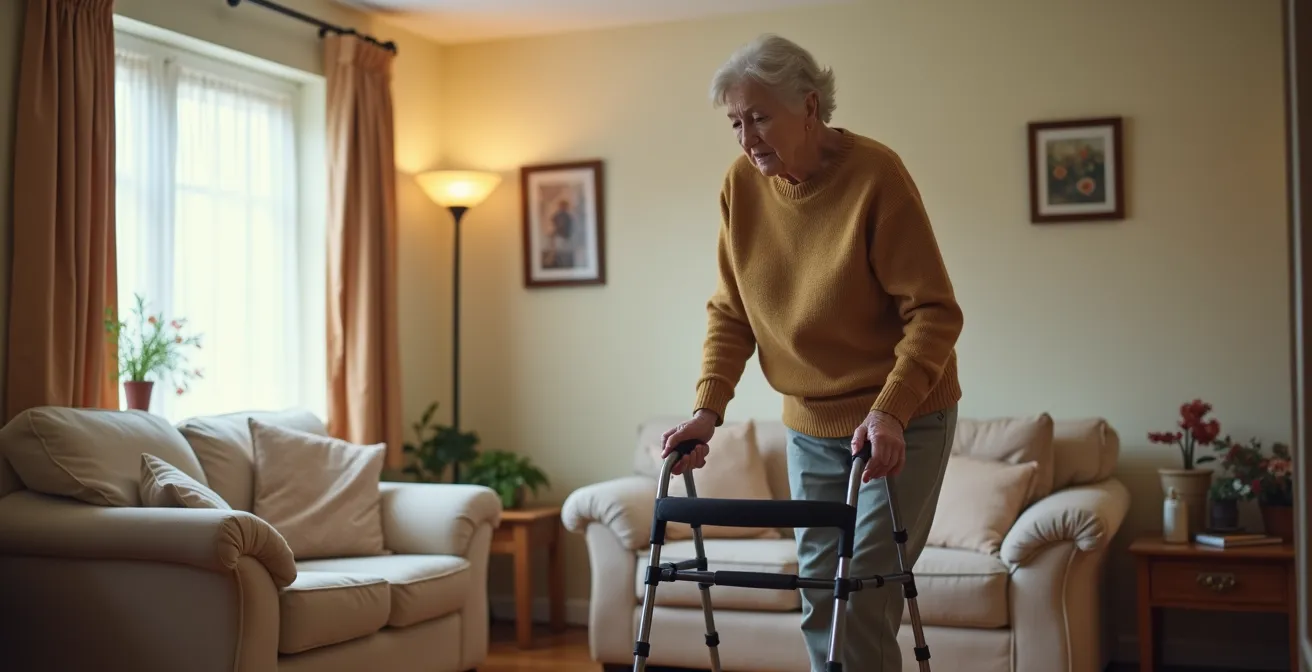
The key to ditching your walker isn’t just leg strength; it’s about retraining your brain’s trust in your body and breaking a psychological habit.
- Prolonged, unnecessary walker use can weaken your natural balance reflexes and create a fear of falling.
- A gradual, confidence-based approach using your home environment (“furniture walking”) is safer and more effective than rushing.
Recommendation: Focus on passing specific, real-world balance milestones rather than just counting the weeks since your surgery.
The moment you stand up from a chair without thinking about it, or walk across the kitchen to grab a glass of water, you’re taking a step toward true independence. After hip replacement surgery, the walker is an essential tool for safety and initial mobility. But there comes a point where it can transform from a helpful aid into a psychological anchor, holding you back from the freedom you’ve worked so hard to regain. Many guides focus solely on a list of exercises, but that’s only half the story. The journey from walker-dependence to walking freely is as much a mental challenge as it is a physical one.
This isn’t about simply getting stronger; it’s about re-establishing a conversation between your brain and your new hip. It’s about rebuilding trust in your body’s ability to balance and move naturally. The common advice to “just listen to your body” is difficult when your body and brain are still learning to communicate again. This guide is different. We will focus on the progressive steps and mental shifts required to make that transition, not based on a rigid timeline, but on building verifiable confidence.
We’ll explore why your brain needs to re-learn to trust your leg, how to use your own home as a training ground, and how to understand the difference between the strength you build in physical therapy and the functional skills you need for daily life. We’ll also tackle the common pitfalls, like keeping the walker “just in case” and the risks of moving on too soon, providing you with a clear roadmap to walk forward with stability and self-assurance.
This article provides a structured path to help you navigate this final, crucial stage of your recovery. Below is a summary of the key milestones we will cover to guide you on your way back to confident, unaided movement.
Summary: Your Path to Walking Independently After Hip Surgery
- Why Your Brain Needs to Re-Learn How to Trust Your Leg?
- How to Practice “Furniture Walking” to Build Confidence?
- Physical Therapy for Strength or Occupational Therapy for Daily Tasks: What Do You Need Now?
- The “Just in Case” Habit: Why Keeping the Walker Too Long Hurts Balance
- When to Do Your PT Exercises to Ensure Consistency?
- Why Forearm Crutches Put Less Strain on Wrists Than Canes?
- The “Too Soon” Mistake That Causes Re-Injury
- How to Build Muscle Strength After 65 Without Straining Joints?
Why Your Brain Needs to Re-Learn How to Trust Your Leg?
After your hip surgery, the physical healing of bone and muscle is only part of the recovery equation. The most significant, yet often overlooked, challenge is retraining your brain. For weeks or months, your brain has received pain signals and learned to distrust your hip’s stability. It developed a protective pattern: rely on the walker, don’t put full weight on that leg. Now, even though the hip is mechanically sound, that neural pathway of caution remains. This is a process of proprioceptive re-calibration, where your brain must relearn where your leg is in space and trust that it can bear weight without collapsing.
This disconnect is not just a feeling; it’s a measurable phenomenon. In fact, research published in BMC Musculoskeletal Disorders reveals that balance abnormalities persist up to 5 years after THA surgery. This isn’t due to a “bad” hip, but because the complex system of nerves and muscles that controls balance hasn’t been fully re-integrated. Your brain is stuck in a protective mode, creating the very instability you fear. Every time you hesitate or shift your weight away from the surgical leg, you are reinforcing this pattern of distrust.
The goal, therefore, is not to just strengthen your muscles, but to provide your brain with successful, pain-free experiences of bearing weight. You need to create new neural pathways that scream “This is safe! This is stable!” This is why simply doing leg lifts isn’t enough. The exercises must be tied to function—standing, shifting weight, and eventually, taking a step. You are teaching your mind that the walker is no longer the primary source of your stability; your own body is.
How to Practice “Furniture Walking” to Build Confidence?
Graduating from your walker doesn’t mean stepping into open space unsupported. The next logical and safe step is to use your own environment as a support system. This is what we call “furniture walking” or “cruising the counters.” It’s a powerful technique that bridges the gap between total support and total freedom, allowing you to build confidence while minimizing risk. The idea is to move through your home by lightly touching stable surfaces like kitchen counters, the back of a sturdy sofa, or a heavy dining table.
Start by creating a “safe haven” in a corner of a room, with a sturdy armchair or wall behind you. From here, practice standing without holding on, but knowing support is just inches away. Then, plan a short, safe route—for instance, from the kitchen counter to the table. Place your hands lightly on the counter as you walk alongside it. The goal is not to lean or put weight on the furniture, but to use it for balance feedback. Your fingertips act as an extension of your sensory system, telling your brain you are stable.
This practice directly addresses the fear of falling. By keeping support within reach, you lower the mental stakes. Your brain is less panicked, allowing it to focus on coordinating your steps and maintaining a natural gait. As your confidence grows, you can start to “feather” your touch, lifting your hands off the surface for a second or two at a time. The visual below shows an ideal setup for this kind of practice at home, creating a controlled environment for you to build stability and trust in your own body.

As you can see, the key is to have a clear, uncluttered path with stable “hand-offs” along the way. This method allows for progressive challenge. You might start by always keeping one hand in contact, then move to touching only when you feel a wobble, and eventually, to walking the path with your hands just hovering above the surfaces. This is how you prove to your own nervous system that you are in control.
Physical Therapy for Strength or Occupational Therapy for Daily Tasks: What Do You Need Now?
As you progress, you might wonder what kind of professional support you need. This is where understanding the distinct roles of Physical Therapy (PT) and Occupational Therapy (OT) becomes vital. While they often work together, they have different primary goals. Choosing the right one—or a combination of both—can significantly accelerate your return to full independence. Physical Therapy focuses on the body’s mechanics: rebuilding raw muscle strength, improving your range of motion, and normalizing your gait pattern. It’s about building the physical capacity to move.
Occupational Therapy, on the other hand, is about function. An OT’s goal is to help you perform your “occupations”—the meaningful activities of daily life—safely and independently. This could be anything from getting dressed and cooking a meal to getting in and out of a car. They are masters of adaptation, strategy, and real-world problem-solving. A popular clinical analogy effectively captures the difference:
PT builds the engine, OT teaches you how to drive the car
– Clinical therapy analogy, Hip replacement rehabilitation guidelines
In the walker-weaning phase, you likely need a blend of both. You need the PT exercises to ensure your glutes, quads, and core are strong enough to support you. But you also need the OT’s functional approach to apply that strength. An OT might notice you’re struggling to put on your socks and suggest not just a strengthening exercise, but also a specific technique or an adaptive tool (like a sock aid) to make it happen *today*. This success then builds the confidence you need to try the next task. The following table breaks down their focus areas:
| Aspect | Physical Therapy (PT) | Occupational Therapy (OT) |
|---|---|---|
| Primary Goal | Build raw strength and range of motion | Apply strength to daily living tasks |
| Example Focus | Lifting leg higher, muscle resistance training | Putting on socks, getting dressed independently |
| Equipment Used | Resistance bands, weights, exercise machines | Adaptive tools: grabbers, sock aids, rolling carts |
| Typical Duration | 2-3 times per week for 2-3 months post-surgery | As needed for specific daily task challenges |
At this stage, ask yourself: Is my primary barrier a lack of strength, or a fear of performing a specific task? If it’s strength, focus on your PT. If you feel strong but are hesitant to try daily activities, an OT consultation could provide the breakthrough you need.
The “Just in Case” Habit: Why Keeping the Walker Too Long Hurts Balance
One of the biggest obstacles to full recovery is the “just in case” habit. It’s the tendency to keep the walker nearby, even when you can walk without it, for a sense of security. While this feels like a safe strategy, it’s profoundly counterproductive. By constantly relying on the walker as a psychological anchor, you are preventing your body’s own balance systems from fully engaging and getting stronger. You are, in effect, teaching your brain that it doesn’t need to work as hard because external support is always available.
This prolonged dependence actively degrades your natural balance reflexes. A healthy gait relies on constant, tiny adjustments from your feet, ankles, and core muscles to maintain stability. When you use a walker, you create an artificially wide and rigid base of support. Your body “forgets” how to make those subtle weight shifts. Instead of improving your balance, you create a state of learned helplessness. This can, paradoxically, increase your risk of falling when you are eventually caught without your walker. The numbers support this concern; even after successful surgery, fall risk remains high. For instance, a prospective cohort study found that more than 40% of older adults fell in the 12 months after elective hip replacement surgery.
Breaking this habit requires a conscious decision to embrace small, calculated risks in a safe environment. It means leaving the walker in another room while you practice “furniture walking” in the kitchen. It means trusting that the strength you’ve built is sufficient for the task at hand. The fear is real, but the way to conquer it is not by avoiding it, but by gradually proving to yourself that it’s unfounded. Each successful trip from the sofa to the table without the walker is a powerful message to your brain that you are capable and stable on your own.
When to Do Your PT Exercises to Ensure Consistency?
Consistency is the engine of progress in your recovery. But “being consistent” doesn’t mean you need to block out a full hour every day for a grueling workout. In fact, for many people, that approach leads to fatigue and burnout. A far more effective and sustainable strategy is “exercise snacking”—breaking up your physical therapy routine into several short, 5-10 minute sessions spread throughout the day. This approach keeps your muscles activated, combats stiffness, and makes the routine feel much less daunting.
The key is to link these “snacks” to your existing daily schedule. Think of it as habit-stacking. For example, you could do your range-of-motion exercises right after you wake up, when your body is naturally a bit stiff. You could perform standing exercises midday, when your energy levels are likely at their peak. This method not only ensures you get the exercises done but also integrates them into the rhythm of your life, making them automatic rather than a chore.
A particularly powerful technique is task-priming. This involves doing one or two specific activation exercises right before you perform a challenging daily task. For example, before getting up from a low chair, do two or three slow, controlled glute squeezes while standing. This “wakes up” the exact muscles you need for the movement, making the task feel easier and more stable. It directly connects the strength you’re building with the function you want to achieve. Here is a sample schedule:
- Morning Session (10 min): Gentle range-of-motion exercises after waking to reduce stiffness.
- Midday Session (10 min): Standing exercises like leg lifts and mini-squats during your peak energy window.
- Pre-Activity Session (5 min): 2-3 glute squeezes or bridges before challenging tasks like rising from chairs or climbing stairs.
- Evening Session (10 min): Flexibility and gentle stretching exercises to wind down.
- Frequency: Aim for 3-4 of these short sessions daily rather than one long, exhausting one.
This approach makes consistency achievable. A 10-minute commitment is easy to say “yes” to, and those small efforts accumulate into significant gains in strength, stability, and confidence over time.
Why Forearm Crutches Put Less Strain on Wrists Than Canes?
As you gain confidence and stability, the next step after the walker is often a single assistive device. While many people automatically reach for a standard cane, it’s crucial to consider an alternative: the forearm crutch (also known as a Lofstrand crutch). For many individuals recovering from hip surgery, especially those who may need support for a longer period or have pre-existing wrist issues, forearm crutches offer a significant biomechanical advantage. The primary difference lies in how they distribute your body weight.
A standard cane forces all of your supporting weight directly onto your hand and wrist. This can lead to significant strain, pain, and even conditions like carpal tunnel syndrome over time. Forearm crutches, by contrast, have a cuff that encircles your forearm. This design allows the weight to be distributed along the entire length of your forearm, dramatically reducing the pressure on the delicate joints of your wrist. In fact, biomechanical analysis demonstrates that forearm crutches can support 40-50% of a user’s body weight while spreading the load much more effectively than a cane.
This distribution not only protects your wrists but also promotes a more upright and natural posture. Because the support is integrated with your arm, it encourages you to walk with your shoulders back and your core engaged, which is essential for a proper gait. A cane can sometimes lead to leaning or hunching over. While a cane may seem simpler, if you find yourself putting significant weight on your walking aid, or if you experience any wrist or hand pain, a forearm crutch is a superior and safer choice for this intermediate phase of your recovery. It provides robust support without creating a new joint problem in the process.
The “Too Soon” Mistake That Causes Re-Injury
While the goal is to wean off your walker, doing so prematurely is one of the most common and dangerous mistakes in hip replacement recovery. Eagerness is understandable, but progressing before your body is truly ready can lead to increased pain, inflammation, the development of a limp, and even a fall that could jeopardize your new hip. The decision to move on should not be based on a calendar date (“it’s been 4 weeks, so I should be done with it”), but on passing a series of functional tests that prove your strength and stability.
Your body sends clear signals when you are overdoing it. As one clinical source warns, you must be attentive to these cues. Paying attention to these signs is a critical part of a safe recovery.
Increased soreness or swelling in the groin or thigh is a sign your body is trying to tell you to slow down and that you may be overdoing it.
– Clinical warning, Alexander Orthopaedics
Before you even consider putting the walker aside, you need an objective way to measure your readiness. Think of it as a pilot’s pre-flight check. You wouldn’t take off without confirming all systems are go. This checklist provides a set of clear, actionable milestones. You should be able to complete all of them comfortably and consistently before progressing to a cane or walking unaided. Work on these with your physical therapist to ensure you’re performing them correctly.
Your Pre-Flight Checklist for Walker Graduation
- Can you stand on your surgical leg for at least 10 seconds while lightly holding a counter for balance?
- Can you walk the length of a room with the walker, using it only for balance and not putting significant weight on it?
- Can you rise from a standard-height chair (like a dining chair) without using your hands to push off the armrests?
- Have you mastered shifting your full weight from one leg to the other smoothly and without hesitation while standing?
- Can you maintain your balance without wobbling while standing and turning your head from side to side or reaching for a light object?
Only when you can confidently say “yes” to all these points, and have received approval from your physical therapist, are you truly ready for the next step. Patience at this stage is not a sign of weakness; it’s a sign of wisdom.
Key Takeaways
- Weaning off your walker is a mental and physical process; you must rebuild your brain’s trust in your leg.
- Use your environment for “furniture walking” as a safe, intermediate step to build confidence before walking unaided.
- Consistency is more important than intensity. Short, frequent “exercise snacks” throughout the day are highly effective.
How to Build Muscle Strength After 65 Without Straining Joints?
The final piece of the puzzle is building sustainable, long-term strength. After 65, the goal of strength training changes. It’s less about lifting heavy weights and more about creating muscular endurance and stability in a way that protects your joints. For hip recovery, this means focusing on the quality of muscle contraction, not just the quantity of repetitions. This approach is not only safer but also highly effective for improving balance and function.
A cornerstone of joint-safe strength training is focusing on proprioception—your body’s awareness of its position in space. Targeted exercises can significantly improve this sense, which is vital for balance. A meta-analysis of proprioceptive training shows a moderate to high significant effect on balance and functionality after knee/hip replacement. This is achieved through slow, controlled movements that challenge your stability in a safe manner.
One of the best protocols for this is focusing on “Time Under Tension” (TUT). Instead of quickly performing 15 leg lifts, you do 8 slow, deliberate ones. By increasing the time the muscle is working during each repetition, you stimulate strength gains without needing heavy loads that could strain your new hip or other joints. This method emphasizes control over momentum and is perfect for rebuilding a solid foundation. Here’s how to apply it:
- Isometric Hold: At the peak of an exercise (like a bridge), contract the muscle and hold the position for 5-10 seconds without moving. This builds stability.
- Eccentric Focus: Concentrate on the “lowering” phase of an exercise. For example, take a full 5 seconds to lower your leg during a straight leg raise. This phase is crucial for building strength and control.
- Slow, Controlled Tempo: For each repetition, aim for a tempo of 3 seconds up, a brief pause, and 5 seconds down.
- Adequate Rest: Rest for 30-60 seconds between sets to allow muscles to recover and prevent fatigue, which can lead to poor form.
- Focus on Quality: Aim for 3 sets of 8-10 high-quality reps. If your form falters, stop. It’s better to do 5 perfect reps than 10 sloppy ones.
By adopting these principles, you can continue to build the strength needed for an active, independent life, all while keeping your joints safe and healthy for the long haul.
You have the tools, the knowledge, and the strategy. Now is the time to put them into practice. Start building your personalized plan today to confidently take that next step toward full independence and the active life that awaits you.