
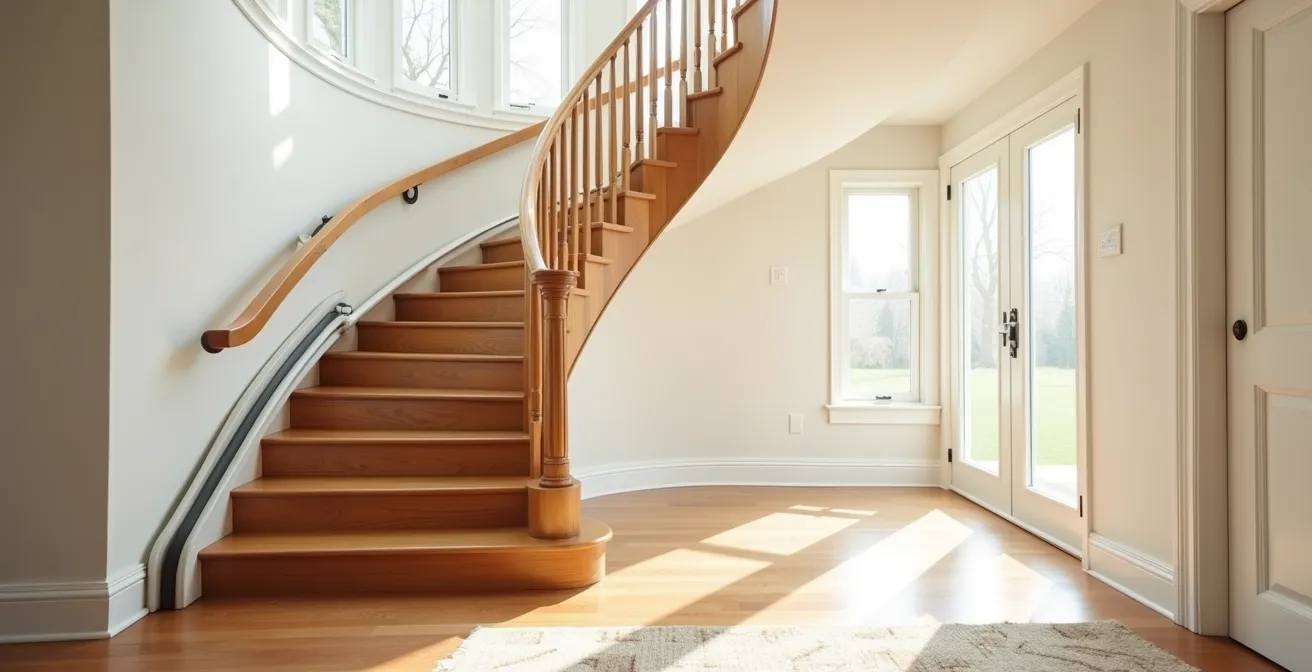
Choosing a curved stairlift is a major home investment where the biggest risks—rail incompatibility and hidden long-term costs—are often overlooked.
- The rail for a curved staircase must be custom-made and new, making used models a significant gamble on fit and safety.
- The total cost of ownership, including maintenance and battery replacement, is a more accurate financial metric than the initial purchase price.
Recommendation: Prioritize a professional, on-site measurement and a certified installation over potential savings from non-certified used units.
The decision to remain in a multi-story home is often deeply emotional. It’s a space filled with memories, rooted in a familiar community. Yet, when stairs become a daily obstacle, many seniors feel pushed toward the drastic choice of either relocating or confining their life to the ground floor. This decision feels like a compromise, a retreat from the home you love. While these options seem practical, they overlook a more empowering and technically sound solution: adapting the home to fit your needs.
The common advice often circles around downsizing or major renovations. However, for a curved or complex staircase, the conversation shifts to a specific piece of mechanical engineering: the curved stairlift. This isn’t just about adding a chair to a rail; it’s about commissioning a bespoke piece of equipment. The key to making the right choice isn’t just comparing prices or features, but understanding the fundamental technical constraints and long-term financial implications that differentiate a successful installation from a costly mistake.
This guide moves beyond the sales pitch. We will deconstruct the critical factors from a technical standpoint, focusing on the non-negotiable aspects of a curved stairlift installation. We’ll analyze the risks of used models, the hidden costs of ownership, and how this decision impacts your home’s future value, allowing you to make an informed, strategic choice that ensures both your mobility and your peace of mind.
To help you navigate this important decision, this article breaks down the essential technical, financial, and practical considerations. We will cover everything from the health implications of inactivity to the specifics of measuring your stairs and the long-term impact on your home’s value.
Summary: A Technical Guide to Installing a Curved Stairlift
- Why “Living on the Ground Floor” Can Accelerate Muscle Atrophy?
- How to Measure Your Stairs to Know If a Standard Lift Will Fit?
- Used Stairlifts or New Custom Models: Are the Savings Worth the Risk?
- The Maintenance Error That Leaves You Stranded on the Stairs During a Power Outage
- When to Remove a Stairlift to Maximize Home Resale Potential?
- Bungalow Living or Installing a Stairlift: Which Offers Better Long-Term Mobility?
- Wooden Ramps or Vertical Platform Lifts: Which Fits Your Porch?
- How to Secure Steep Staircases With Lighting and Grip Enhancements?
Why “Living on the Ground Floor” Can Accelerate Muscle Atrophy?
The seemingly practical solution of avoiding stairs by living exclusively on the ground floor carries a significant, often invisible, health risk: accelerated muscle atrophy, specifically a condition known as sarcopenia. This age-related loss of muscle mass and strength is a natural part of aging, but it is dramatically hastened by inactivity. Research from Harvard Health confirms the scale of the issue, indicating that while 5% to 13% of people ages 60-70 are affected by sarcopenia, that figure can climb to 50% for those 80 or older.
Stairs represent a form of resistance training integrated into daily life. Each ascent and descent engages major muscle groups in the legs, hips, and core. Removing this activity from your routine eliminates a crucial opportunity to maintain muscle tone, balance, and cardiovascular health. While a stairlift provides essential safety and access, the goal should be to use it as a tool to safely navigate the home, not to eliminate all physical effort. Continuing to use the stairs when feeling able, even for just one or two trips a day, can be a powerful way to combat sarcopenia.
The choice is not simply between climbing stairs or not; it’s about finding a sustainable balance. A stairlift provides the safety net that allows you to remain in your multi-story home and continue to engage in incidental exercise, preserving strength for longer. Opting to live downstairs effectively removes this built-in exercise, potentially leading to a faster decline in mobility and independence. Therefore, a stairlift is not a sign of giving up; it is a strategic tool to enable continued activity and prolong functional health within the home you cherish.
How to Measure Your Stairs to Know If a Standard Lift Will Fit?
Before a consultation, taking some preliminary measurements can provide a realistic understanding of your staircase’s compatibility with a stairlift. While a professional survey is essential for a custom curved rail, these initial numbers will help you understand the core spatial requirements. The most critical measurement for any stairlift is the unobstructed width of the staircase. For curved staircases, the requirements are stricter; industry specifications generally mandate a minimum width of 800mm (about 31.5 inches) to accommodate the chair’s movement around bends.
This measurement should be taken from the wall to the innermost edge of the handrail or banister, not just the width of the steps themselves. It’s crucial to identify the narrowest point along the entire path of the staircase, as this will be the limiting factor. You must also consider headroom. A minimum of 6.5 feet of vertical clearance is required along the entire path to ensure the user’s head will not be at risk. Finally, assess the landing areas at the top and bottom. There needs to be sufficient clear space for the chair to park without obstructing doorways or creating a trip hazard, and for you to get on and off safely. A typical requirement is at least 24-30 inches of clear space beyond the last step.
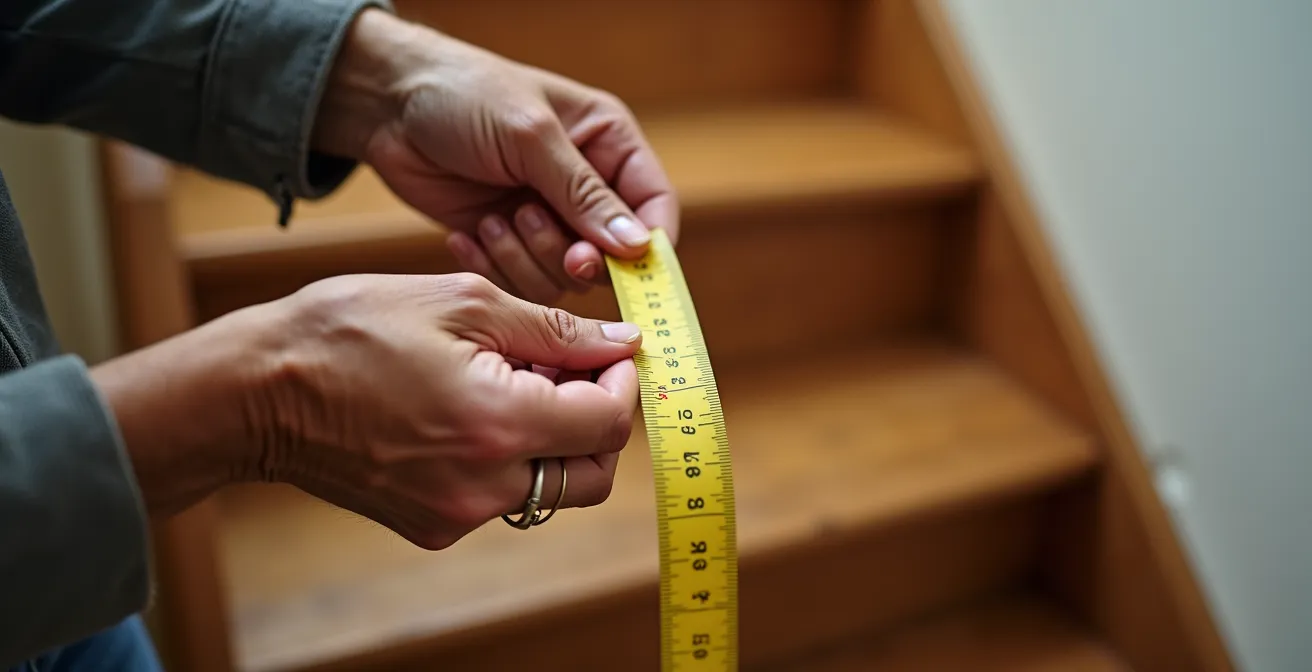
As the image illustrates, the focus is on the tightest points. Documenting any obstructions like radiators, windowsills, or doors that open onto the staircase is also vital. This preliminary data will not replace a technician’s precision survey, which uses photogrammetry or laser measurement systems for custom rail fabrication, but it will arm you with the knowledge to have a more productive conversation with potential suppliers.
Your Pre-Consultation Measurement Checklist: Curved Stairs
- Measure total staircase length from the edge of the top landing to the floor at the bottom.
- Check the clear width at the top, bottom, and especially at the narrowest point of any curve.
- Verify headroom clearance is at least 6.5 feet (2 meters) all along the staircase angle.
- Document the clear, unobstructed space on the landings at both the top and bottom for safe entry and exit.
- Note the location of any obstructions like doors, radiators, or window sills that might interfere with the rail or chair.
Used Stairlifts or New Custom Models: Are the Savings Worth the Risk?
The primary appeal of a used stairlift is, without question, the potential for significant initial cost savings. However, for a curved staircase, this is a high-risk gamble where the savings can be quickly erased by compatibility and safety issues. The fundamental, non-negotiable truth of curved stairlifts is that the rail must be custom-fabricated for the unique geometry of your staircase. A pre-owned rail from another home will not fit. This is the single most critical technical point to understand.
This reality is a standard across the industry. As experts at Lifeway Mobility state in their guide:
For curved stairs, the rail must ALWAYS be custom-made and new, but the chair/motor unit can sometimes be a certified refurbished model.
– Industry Standard Practice, Lifeway Mobility Curved Stairlifts Guide
This introduces the concept of a “hybrid” solution: a new, custom-made rail paired with a certified refurbished chair and motor unit. This can offer a safe compromise, providing some savings without compromising on the most critical component. A non-certified used model purchased privately, however, comes with an unknown history, no warranty, and a high likelihood of not meeting current safety standards. The following table breaks down the technical and financial trade-offs.
| Factor | New Custom Model | Certified Refurbished | Used (Non-Certified) |
|---|---|---|---|
| Rail | Always new & custom-made | New custom rail required | May not fit properly |
| Motor/Chair Unit | Brand new with full warranty | Factory reconditioned | Unknown condition |
| Warranty | 2-5 years comprehensive | 1-2 years limited | None or very limited |
| Installation | Professional certified | Professional certified | May lack certification |
| Service Contract | Available | Usually available | Rarely available |
| Safety Compliance | Meets all current standards | Updated to standards | May not meet standards |
| Cost Savings | None (baseline) | 20-30% savings | 40-50% initial savings |
Ultimately, the risk of a non-certified used model lies in the lack of technical compliance and support. An ill-fitting rail can create excessive wear on the motor and rollers, leading to premature failure, while the absence of a service contract leaves you responsible for costly and difficult-to-source repairs. The modest savings from a certified refurbished unit can be a viable option, but a private-sale used unit often introduces more long-term costs and safety risks than it solves.
The Maintenance Error That Leaves You Stranded on the Stairs During a Power Outage
A common fear associated with stairlifts is being stranded during a power outage. However, all modern stairlifts are battery-operated. The main electrical supply is used only to charge the batteries, which are typically housed within the chair unit. This means a lift will continue to function for several trips (usually around 10) even when the power is out. The real point of failure isn’t the power outage itself, but a lack of proper battery maintenance.
The single biggest maintenance error is neglecting the batteries until they fail completely. Stairlift batteries are not like standard consumer batteries; they are deep-cycle sealed lead-acid (SLA) or gel units designed for consistent power delivery. According to mobility equipment specialists, these batteries have a typical lifespan of 3-5 years, but this is highly dependent on proper care. The most critical aspect of this care is ensuring the lift remains plugged in and switched on at all times, allowing the smart charger to maintain the battery’s health through a “float charge.”
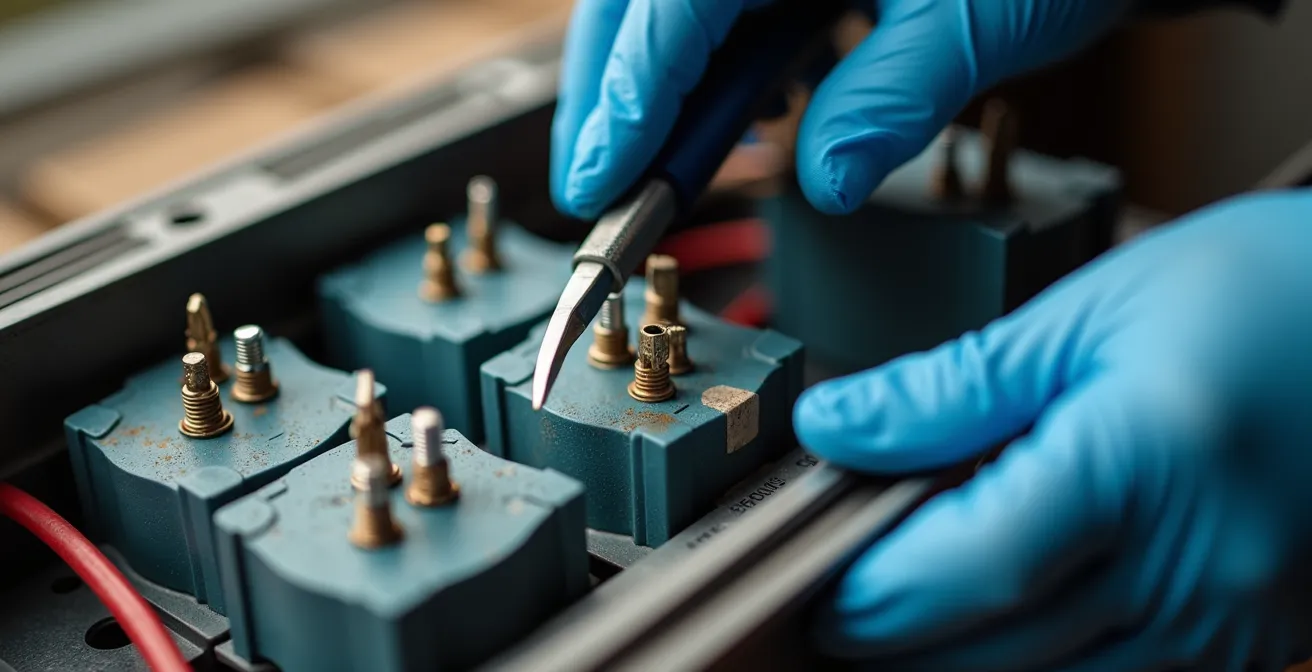
Warning signs of a failing battery include a slower travel speed, the lift stopping intermittently, or beeping codes from the diagnostic system. These should never be ignored. An annual service from a certified technician is vital, as it should include a battery load test. This test simulates the energy draw of a full trip and measures the battery’s ability to hold a charge under pressure—something a simple visual inspection cannot do. Neglecting this professional check-up and failing to replace aging batteries proactively is what leads to the scenario of being stranded, not the power outage itself.
When to Remove a Stairlift to Maximize Home Resale Potential?
A common question from homeowners is whether a stairlift will help or hinder the resale of their property. The answer is highly dependent on the target buyer demographic for your specific neighborhood. The old assumption that a stairlift is always a detriment to a home’s value is outdated. In the right market, it can be a significant selling feature.
A key market analysis from Bruno, a leading manufacturer, shows that in 55+ communities and areas with aging demographics, a well-maintained, modern stairlift can be a powerful asset. For potential buyers looking for an “age-in-place” ready home, a pre-installed stairlift removes a significant barrier and expense, making a multi-story home with a main bedroom upstairs immediately accessible and more appealing.
Conversely, if your home is in a neighborhood that primarily attracts young families, a stairlift may be perceived as an unnecessary obstruction. In this scenario, removal is often the best strategy. The key is timing: the lift should be removed just before professional real estate photos are taken and showings begin. The cost of removal typically includes labor ($300-500) and minor repairs to the stair treads and wall where the rail was mounted ($200-400). It’s also worth contacting the manufacturer or dealer; some offer buy-back programs that can recoup 10-20% of the original cost, offsetting the removal expenses. If a buy-back isn’t available, donation to a charity for a potential tax deduction is another option. The decision to keep or remove should be a strategic calculation based on local market data, not an emotional reaction.
Bungalow Living or Installing a Stairlift: Which Offers Better Long-Term Mobility?
When faced with staircase challenges, the two most common long-term solutions considered are installing a stairlift or selling the family home to move to a single-story bungalow. While moving may seem like a definitive solution, a technical and financial breakdown reveals that a stairlift is often the more sound decision, both in terms of cost and quality of life. The total cost of ownership (TCO) is the most accurate metric for this comparison.
The initial outlay for a curved stairlift, while significant, is often dwarfed by the transactional costs of moving. Realtor fees, closing costs on a new property, and moving expenses can easily add up to tens of thousands of dollars. Furthermore, the decision to sell a long-time family home is irreversible. It often means leaving a cherished community, neighbors, and a familiar support network—a social cost that cannot be quantified in a spreadsheet. A stairlift installation, by contrast, is a fully reversible decision.
The following table provides a conservative 10-year TCO comparison, demonstrating the stark financial difference between the two options.
| Cost Factor | Installing Stairlift | Moving to Bungalow |
|---|---|---|
| Initial Cost | $10,000-15,000 (curved model) | Realtor fees (6% of home value) |
| Annual Maintenance | $300-500/year | Potentially higher property taxes |
| Battery Replacement | $200-300 every 3-5 years | N/A |
| Moving Expenses | None | $5,000-15,000 |
| Closing Costs | None | 2-5% of new home price |
| 10-Year Total | $13,000-22,000 | $30,000-100,000+ |
| Reversibility | Fully reversible | Not reversible |
| Social Network Impact | None – stay in community | Loss of neighbors/friends |
From a long-term mobility perspective, installing a stairlift is a targeted intervention that solves a specific problem without disrupting the rest of your life. It preserves financial resources and, more importantly, the social and emotional stability that are critical to well-being. As one mobility planning guide aptly puts it, “a stairlift installation is a reversible decision; selling a long-time family home is not.”
Wooden Ramps or Vertical Platform Lifts: Which Fits Your Porch?
While a stairlift solves interior accessibility, getting to the front door can present its own challenge. For homes with a raised porch or multiple entry steps, the primary solutions are a ramp or a Vertical Platform Lift (VPL). The choice between them is largely dictated by two factors: available space and the user’s mobility device. A wooden ramp seems like a simple, low-tech solution, but its footprint is deceptively large. According to ADA guidelines, a ramp requires one foot of length for every inch of vertical rise. For a 30-inch-high porch, this means a 30-foot-long ramp, which is often impractical for most front yards.
A VPL, often called a “porch lift,” is a miniature elevator that travels vertically. Its footprint is much smaller, typically requiring only a 5×5 foot area. This makes it a far more practical solution for homes with limited space. VPLs are also better suited for heavy, powered wheelchairs, which can be difficult to maneuver up the incline of a ramp. However, VPLs are a more significant investment, require a concrete pad, electrical wiring, and almost always need a building permit.
The decision involves a trade-off between footprint, cost, and maintenance. Ramps can become slippery in wet or icy weather and require annual sealing, while VPLs have mechanical components that need weatherproofing and regular inspection. The table below compares the key technical aspects.
| Factor | Wooden Ramp | Vertical Platform Lift (VPL) |
|---|---|---|
| Footprint | 12 feet length per 1 foot rise (ADA) | 5×5 feet platform area |
| Permits Required | Usually for ramps over 30 inches | Almost always required |
| Weather Impact | Slippery when wet/icy, rot risk | Mechanical components need weatherproofing |
| Maintenance | Annual sealing, algae removal | Annual mechanical inspection |
| Mobility Device | Best for manual wheelchairs/scooters | Accommodates power chairs |
| Installation Cost | $1,500-5,000 | $5,000-15,000 |
| Daily Usability | Always accessible, no power needed | Requires power, backup battery |
Ultimately, a VPL offers a more compact and often safer solution for significant porch heights, while a ramp may be suitable for very low rises of just one or two steps. For exterior access, a VPL provides a solution with a static footprint, unlike a ramp which can consume an entire entryway as highlighted by comparative analysis showing ramps requiring 12 feet of length for every foot of rise.
Key takeaways
- For curved staircases, a custom-fabricated new rail is a non-negotiable technical and safety requirement.
- The Total Cost of Ownership (TCO), including maintenance and battery replacement, is a more realistic financial metric than the initial purchase price.
- A stairlift is a reversible home modification that preserves community ties and avoids the immense financial and emotional costs of moving.
How to Secure Steep Staircases With Lighting and Grip Enhancements?
Even after installing a stairlift, the staircase itself should be made as safe as possible for all users. A holistic approach to stair safety involves enhancing both grip and visibility, which can dramatically reduce the risk of slips and falls for ambulatory users or guests. Traditional solutions like basic adhesive grip strips are functional, but modern options offer superior safety and aesthetics.
For grip, consider high-grip transparent varnishes that can be applied over wooden stairs, preserving their natural beauty while adding a textured, anti-slip surface. For more robust needs, textured aluminum stair treads with integrated nosing provide excellent traction and durability. For visibility, especially on steep or poorly lit stairs, lighting is paramount. Motion-activated LED strips installed under the handrail or along the base of the wall can create an illuminated pathway that turns on automatically as you approach, eliminating the need to fumble for a switch in the dark. Photoluminescent (glow-in-the-dark) edge strips are another excellent, electricity-free option for nighttime visibility.
A crucial and often overlooked aspect is the use of visual contrast. Experts in home safety highlight the importance of color differentiation. According to guidance on visual perception in stair safety, “using high-contrast colors between the tread and the riser” dramatically improves the brain’s ability to judge step depth and distance, reducing the cognitive load and anxiety associated with descending stairs. This can be achieved with contrasting paint, or by using anti-slip carpet runners that have a high-contrast border. For users with arthritis, installing a second handrail on the opposite wall, with a comfortable 1.5-inch diameter, provides bilateral support and stability.
To ensure a safe and successful installation that fits your home and budget, the most important next step is to schedule a professional, no-obligation assessment of your unique staircase.