

In summary:
- Social isolation is not just an emotional issue; it poses a direct biological risk to heart and brain health, comparable to well-known physical risk factors.
- Building emotional resilience in later life requires consciously designing a “cognitive portfolio” of varied, purposeful social and mental engagements.
- Simple, actionable strategies exist to overcome the psychological barriers to forming new connections and finding a renewed sense of purpose.
- Moving from passive consumption (like watching TV) to active creation (like writing or volunteering) is key to maintaining mental clarity and emotional well-being.
There’s a quiet narrative that often accompanies aging—a sense of gradual fading, a slow retreat from the vibrant tapestry of life. For many active seniors, retirement opens up a void that was once filled with professional purpose and daily interaction. The common advice is to “stay busy” or “join a club.” While well-intentioned, this counsel often misses a profound truth: connection is not a pastime; it is a biological imperative. The feeling of loneliness is a signal from our bodies, as critical as hunger or thirst.
The stakes are far higher than a simple case of the blues. The link between our emotional state and physical health is undeniable, and compelling research now quantifies this risk. For instance, a landmark scientific statement from the American Heart Association revealed that an increased risk of 29% for heart attack and 32% for stroke is directly linked to social isolation. This positions loneliness not as a secondary concern, but as a primary health risk on par with smoking or obesity. It’s clear we must reframe the conversation from simply filling time to actively and strategically engineering our emotional and social well-being.
But what if the true key to resilience lies not in just being around people, but in understanding the psychological mechanisms that make those connections meaningful? This isn’t about forcing yourself into crowded rooms. It’s about building a personalized portfolio of engagement that nourishes your brain, provides a sense of purpose, and actively counteracts the neurological drifts of aging. This guide will explore the deep science behind why connection is so vital and provide concrete strategies to build that resilience, one meaningful interaction at a time.
To navigate this journey, we will explore the science behind social isolation, compare different avenues for finding purpose, and offer practical techniques for everything from joining a new group to rewiring your daily habits for better mental health. The following sections provide a roadmap to building your own blueprint for resilience.
Summary: A Psychologist’s Guide to Thriving Through Connection
- Why Isolation Accelerates Memory Loss More Than Genetics?
- How to Join a Local Hobby Group Without Feeling like an Outsider?
- Volunteering or Social Clubs: Which Provides a Greater Sense of Purpose?
- The Television Habit That Increases Depressive Symptoms by 30%
- When to Start Writing Your Memoirs: The 3 Benefits for Mental Clarity
- The Routine Trap: Why Doing the Same Puzzle Daily Stops Working
- Peer Support Groups or Private Therapy: Which Is Better for Aging Anxiety?
- How to Practice Mindfulness to Lower Cortisol Levels After 65?
Why Isolation Accelerates Memory Loss More Than Genetics?
The first step in understanding the power of connection is to recognize that loneliness is not just a feeling; it’s a physiological state that actively damages the brain. When we feel isolated, our bodies produce higher levels of the stress hormone cortisol. Chronically elevated cortisol is particularly toxic to the hippocampus, the brain region responsible for forming and retrieving memories. This creates a vicious cycle: loneliness causes stress, which impairs memory, which can lead to further withdrawal and social anxiety.
Beyond the chemical impact, social interaction is a complex cognitive workout. A simple conversation requires you to listen, interpret non-verbal cues, access vocabulary, recall shared experiences, and formulate responses in real-time. This is a far more dynamic and demanding mental exercise than passive activities. When we are isolated, these “social muscles” atrophy. The brain, following the “use it or lose it” principle, begins to prune the neural pathways that support these complex functions. This neurological drift can lead to a decline in cognitive function that is often more rapid and pronounced than that caused by genetic predispositions alone.
Therefore, social engagement isn’t a soft skill; it is essential brain maintenance. It provides the rich, unpredictable stimulation needed to build and maintain cognitive reserve—the brain’s ability to withstand age-related changes. Viewing connection through this biological lens transforms it from a “nice-to-have” into a non-negotiable component of a brain health strategy.
How to Join a Local Hobby Group Without Feeling like an Outsider?
Knowing that you should connect is one thing; overcoming the internal barriers to do so is another. Walking into a room of strangers can be daunting at any age. The key is to shift your mindset from “making friends” to “becoming an interested observer.” This lowers the pressure and allows for a more natural integration. Instead of forcing conversations, you can adopt a deliberate, step-by-step strategy to ease into a new social environment.
A proven method is to treat your first few encounters as a form of light reconnaissance. This approach transforms anxiety into curiosity and provides a clear plan of action. Consider this three-phase strategy:
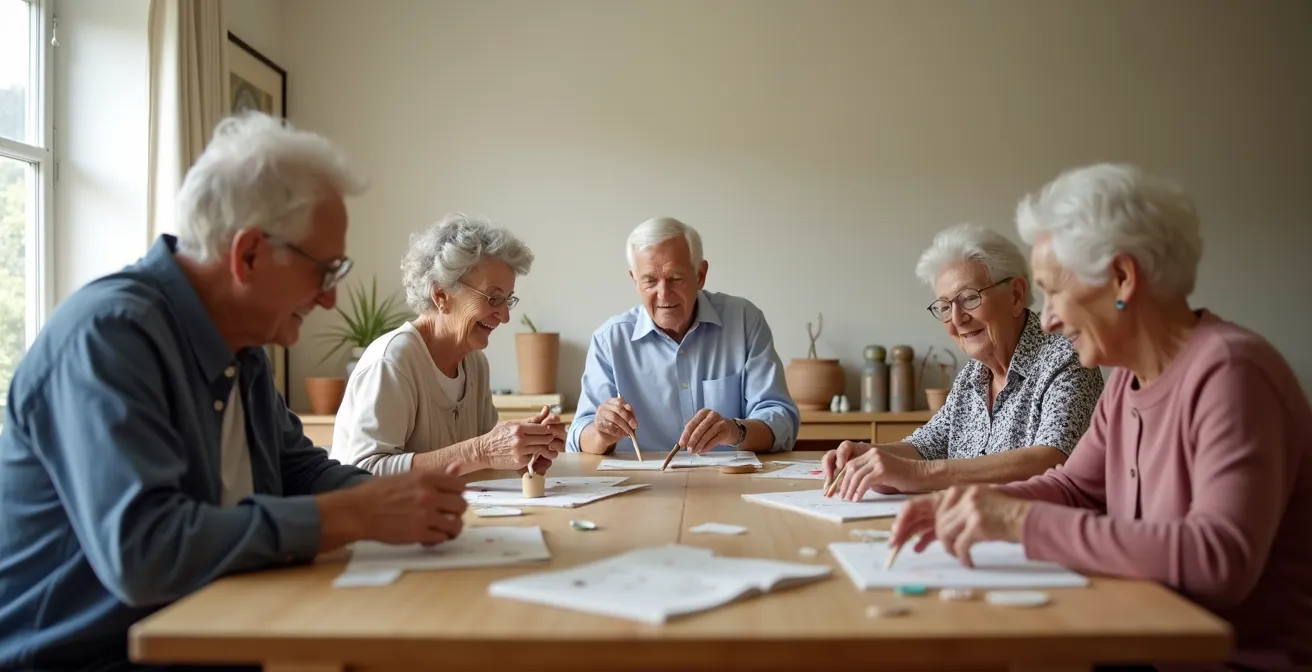
As this image suggests, the goal is to find a place of shared activity where the focus is on the task at hand, not on social performance. The following steps can help you navigate this process:
- Step 1: The Digital Scout. Before attending, observe the group’s online presence. Look at their social media or website to understand their dynamics, key members, and recent activities. This gives you context and makes the environment feel less alien.
- Step 2: The Anthropologist. At your first meeting, give yourself the role of an observer. Your goal is simply to watch and listen. Who are the natural leaders? What are the inside jokes? Focusing on observation rather than participation removes the pressure to perform.
- Step 3: The Helpful Assistant. The easiest way to start an interaction is by offering help. Small gestures like asking, “Can I help set up the chairs?” or “Is there anything I can do to help clean up?” create natural, low-stakes points of contact.
- Step 4: The Inquisitive Apprentice. Instead of introducing yourself as “new,” frame your questions around the group’s expertise. A question like, “This is fascinating. What’s the one mistake every beginner makes?” is an invitation for others to share their knowledge and positions you as an engaged learner.
Volunteering or Social Clubs: Which Provides a Greater Sense of Purpose?
Once you’re ready to engage, a common question arises: where should you invest your time? Both volunteering and social clubs offer connection, but they fulfill different psychological needs. As the Heritage Senior Communities Research Team notes, “Volunteering your time and talent not only gives you a sense of purpose but also connects you with others who share your values.” This highlights a key distinction: volunteering is often about contribution and legacy, while social clubs are about belonging and shared leisure. The “better” option depends entirely on your personal “purpose profile.”
Understanding whether you are primarily a “Contributor” or a “Connector” can guide your choice. Contributors derive their greatest sense of purpose from seeing the tangible impact of their skills and experience. They thrive on building, fixing, or mentoring. Connectors, on the other hand, derive purpose from the feeling of belonging and shared identity within a group. They are energized by the social bonds and regular interaction itself. There is no right or wrong profile, only what best nourishes your spirit.
This comparative table can help clarify which path aligns more closely with your intrinsic motivations. It’s a tool for self-reflection, not a definitive judgment.
| Aspect | Volunteering (‘Legacy Building’) | Social Clubs (‘Purposeful Leisure’) |
|---|---|---|
| Primary Purpose | Contributing skills and experience to causes | Building belonging and shared identity |
| Best For | ‘Contributors’ who derive purpose from tangible impact | ‘Connectors’ who derive purpose from social belonging |
| Benefits | Creates lasting impact, provides sense of giving back | Reduces isolation, provides regular social interaction |
| Hybrid Option | Club-Based Volunteering: Social clubs that incorporate regular volunteer activities (e.g., a walking group that participates in charity walks) | |
Ultimately, the most powerful approach may be a hybrid one. Many social clubs now incorporate volunteer activities, offering the best of both worlds: the consistent social belonging of a club combined with the meaningful impact of giving back. The goal is to build a purposeful engagement portfolio that meets both your need to belong and your need to contribute.
The Television Habit That Increases Depressive Symptoms by 30%
While the title of this section highlights a startling statistic on depression, the underlying issue is one of passive versus active brain engagement. In our quest for connection and purpose, it’s equally important to identify the habits that silently undermine our mental well-being. Excessive television viewing is one of the most common and insidious culprits. It’s not the content of television that’s necessarily the problem; it’s the passivity of the consumption. It requires minimal cognitive effort and displaces time that could be spent on mentally stimulating and socially rewarding activities.
Scientific research provides a clear picture of the cognitive cost. While specific figures on depression can vary, the neurological impact of prolonged TV viewing is well-documented. For example, a major study published in *Nature* looked at the habits of adults over 35 and found a direct dose-response relationship, revealing that more than 3.5 hours of daily TV viewing is associated with a decline in verbal memory over the following six years. The brain is not being challenged; it is simply receiving information. This lack of active processing contributes to the “neurological drift” we discussed earlier.
This habit creates a feedback loop. Feelings of lethargy or low mood can make turning on the TV an easy, low-effort choice. However, the lack of engagement and social reward it provides can exacerbate those very feelings, leading to a cycle of passivity and mild depressive symptoms. Breaking this cycle requires a conscious act of emotional engineering: intentionally replacing a portion of that passive viewing time with an activity that requires active participation, whether it’s a puzzle, a phone call, or a short walk.
When to Start Writing Your Memoirs: The 3 Benefits for Mental Clarity
If passive consumption is the problem, active creation is the antidote. One of the most powerful forms of active engagement is the process of writing your memoirs. This is often seen as a task for the very end of life, a final summary. However, from a psychological perspective, the ideal time to start is now, regardless of your age. The act of writing is not just about recording the past; it’s about actively restructuring it to make sense of your life, which provides profound benefits for mental clarity and future purpose.
This process grants you what psychologists call narrative agency—the power to be the author of your own story, rather than a passive character. It’s an act of taking control of your life’s meaning. The benefits are tangible and directly combat the feelings of irrelevance or confusion that can accompany aging.

This introspective journey offers at least three key psychological rewards:
- Cognitive Re-consolidation: The human brain doesn’t store memories like files in a cabinet. Every time we recall a memory, we subtly rewrite it. By actively structuring past events into a coherent narrative, you are not just remembering; you are processing unresolved emotions and integrating life lessons. This frees up significant cognitive bandwidth that was previously occupied by unprocessed emotional baggage.
- Legacy Crafting: This process shifts your focus from passive reminiscing to actively shaping the story you will leave behind. It is an empowering act that combats feelings of irrelevance by creating a tangible legacy of wisdom and experience. You become the curator of your own life museum.
- Scripting the Future: As you write, you will inevitably identify recurring themes, coping mechanisms, and moments of resilience in your own past. This self-discovery provides a powerful roadmap for the future, helping you intentionally plan your next chapters in a way that is deeply aligned with your core narrative and values.
The Routine Trap: Why Doing the Same Puzzle Daily Stops Working
Keeping the mind active is a cornerstone of healthy aging, and daily puzzles are a popular and valuable tool. However, there’s a hidden pitfall in this practice: the routine trap. While consistency is good, repetition without variation leads to diminishing returns. Doing the same crossword or sudoku puzzle every day is like going to the gym and only ever exercising your right bicep. The muscle becomes strong, but the rest of the body is neglected. Your brain adapts, becomes highly efficient at that one task, and the cognitive benefit plateaus.
The science of neuroplasticity confirms this; research on cognitive reserve shows that the neural benefit of a task diminishes significantly after mastery. The brain grows most when it is challenged with novelty and complexity. To truly keep your mind sharp, you need to build a varied “cognitive portfolio” that works out different mental muscles. This means intentionally introducing variety, difficulty, and new types of challenges into your routine, rather than just repeating what is comfortable and familiar.
The goal is not to abandon your favorite puzzle—it can still be a comforting and enjoyable ritual. The goal is to supplement it with new challenges that push your brain out of its comfort zone. This simple audit and action plan can help you diversify your mental workout and escape the routine trap.
Your Action Plan: Diversifying Your Cognitive Workout
- Assess your current routine: For one week, list all the “brain games” or puzzles you do daily. Note what cognitive skills they use (e.g., vocabulary, logic, spatial reasoning).
- Identify the gaps: Look at your list. Are you only doing word-based puzzles? Or only number-based ones? Identify the types of thinking you are neglecting.
- Introduce novelty: Dedicate a 15-minute “Novelty Slot” each day to a completely new type of challenge. If you do crosswords, try a logic puzzle or a spatial reasoning game on a tablet.
- Add a layer of difficulty: Once a week, add a constraint to a familiar puzzle. Try solving it with a time limit or using your non-dominant hand to write the answers. This re-engages the brain.
- Schedule a review: Every month, repeat this audit. Is your new routine becoming too easy? It’s time to find a new challenge to add to your portfolio.
Peer Support Groups or Private Therapy: Which Is Better for Aging Anxiety?
Anxieties about health, purpose, and mortality are a natural part of the aging process. The crucial question is how to address them. Two powerful resources are peer support groups and private therapy, but they serve fundamentally different, though complementary, roles. As experts in senior care at Sadie Mays note, “Peer groups offer the unparalleled power of shared lived experience… Private therapy offers the unique power of an unbiased, professionally trained ‘mirror’.” Understanding this distinction is key to choosing the right tool for the right time.
A peer support group’s primary strength is validation. The simple act of hearing someone else voice your own secret fears is incredibly powerful. It shatters the illusion that you are alone in your struggle, reducing stigma and fostering a sense of universal human experience. It answers the question, “Am I the only one who feels this way?” with a resounding “No.”
Private therapy, in contrast, is about strategy. A therapist provides a confidential, one-on-one space to identify the specific thought patterns and behaviors that fuel your anxiety. They provide personalized tools and coping mechanisms tailored to your unique history and personality. They answer the question, “Now that I know I’m not alone, what do I do about it?”
As this comparison from a report on social connections in senior care illustrates, the most effective approach is often phased, using both in sequence or in parallel.
| Factor | Peer Support Groups | Private Therapy |
|---|---|---|
| Primary Strength | Validation – ‘I’m not alone in this’ | Personalized strategies and tools |
| Unique Benefit | Shared lived experience and mutual encouragement | Unbiased professional mirror to identify patterns |
| Best Approach | Phased: Start with peer groups to de-stigmatize, then add therapy for specific strategies | |
| When Most Effective | Early stages for normalizing experience | When ready for targeted intervention |
Key takeaways
- Connection as a biological need: Recognize that social engagement is a fundamental requirement for brain and heart health, not a luxury or a simple pastime.
- Active engagement over passive consumption: Prioritize activities that require active participation and creation—like writing, volunteering, or learning—over passive habits like excessive TV viewing.
- The power of the “cognitive portfolio”: True mental fitness in aging comes from variety. Consciously build a diverse portfolio of mental and social activities that challenge your brain in new ways.
How to Practice Mindfulness to Lower Cortisol Levels After 65?
Throughout this guide, we’ve seen how stress, particularly the hormone cortisol, is a key villain in the story of isolation and cognitive decline. Building external connections is vital, but so is developing the internal skill to manage our physiological stress response directly. This is where mindfulness comes in—not as a vague spiritual concept, but as a practical, science-backed tool for emotional regulation. For seniors, the practice doesn’t have to involve sitting on a cushion for an hour. It can be integrated into daily life through simple, targeted techniques.
The goal of these practices is to interrupt the cortisol cycle. When a stressful thought arises, the body releases cortisol. If the thought loops, the cortisol keeps flowing. Mindfulness teaches you to notice the thought without getting swept away by it, allowing the physiological response to subside. It’s a workout for your brain’s emotional regulation centers. As one health resource on heart health explains, these small but consistent practices can have a profound effect on your well-being.
Here are five senior-specific mindfulness techniques you can start using today:
- Sensory Grounding Walks: Turn a simple walk into a mindfulness exercise. On Monday, focus only on the sounds you hear. On Tuesday, focus only on the feeling of the sun or wind on your skin. By focusing on one sense, you anchor yourself in the present moment.
- 3-Breath Reset: This can be done anywhere, anytime—in a line at the store, during a TV commercial. Simply take three slow, deep breaths. Inhale for four counts, hold for four, exhale for six. This simple act is enough to interrupt the stress cycle.
- Compassionate Self-Reflection: Instead of ruminating on past regrets, practice acknowledging past events and the emotions they bring up without judgment. Recognize that you did the best you could with the person you were then. This fosters self-compassion, a powerful antidote to stress.
- Movement-Based Mindfulness: For those who find it hard to sit still, combine mindfulness with gentle movement. Activities like Tai Chi or simple stretching are forms of moving meditation, connecting mind and body.
- Micro-Dosing Mindfulness: Instead of aiming for one long session, scatter multiple 30-second mindfulness breaks throughout your day. A moment of noticing your breath or the feeling of your feet on the floor is a small but potent dose of calm.
The journey to profound emotional resilience begins not with a grand gesture, but with a single, conscious choice. Choose one strategy from this guide today—send that first email, look up that local group, or simply take three deep breaths. Your future self will thank you for it.